



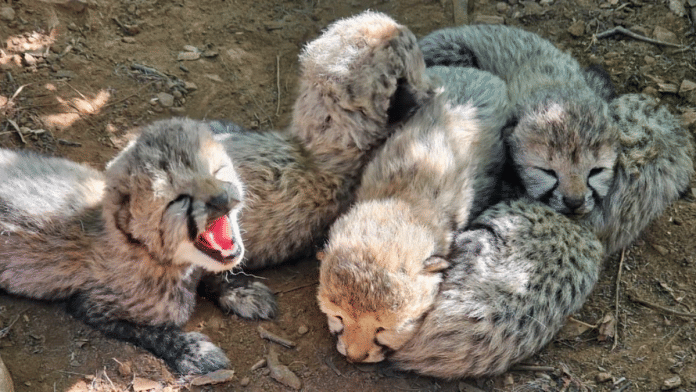
New Delhi: Five cheetah cubs were born to the Indian-born female cheetah KJP21 at the Kuno National Park on Monday. With the arrival of these five cubs, the cheetah population in India has reached 60, of which only 41 were born in the country.
“KJP21, a 32-month-old Indian-born female cheetah, has given birth to five healthy cubs in Kuno National Park today. KJP21 is the third Indian-born female cheetah to give birth, after Mukhi and KGP12—an important milestone in the emergence of the next generation of India’s cheetah population,” wrote Bhupender Yadav, minister of environment, forest, and climate change, in a post on X.
The new births come hardly a month after another Indian-born female cheetah, KJP12 or Mukhi, had given birth to four cubs in September.
“Importantly, these cubs also mark the beginning of the Botswanan lineage in India, as their father is a Botswanan male cheetah—adding a new genetic lineage to India’s growing cheetah population,” Yadav added.
Project Cheetah
India’s Project Cheetah began in September 2022, with the first batch of eight cheetahs (five females and three males) being flown in from Namibia. In February 2023, another batch of 12 cheetahs were brought to India from South Africa under a memorandum of understanding (MoU) signed between MoEFCC and the government of South Africa. However, since 2022, almost 23 cheetahs have died.
Reviewing the project on 13 September to celebrate four years of Project Cheetah, Yadav noted that the protected habitat for cheetahs had been expanded to 3,428 square kilometres and the authorities are eyeing the Banni Grasslands in Gujarat and the Nauradehi Wildlife Sanctuary in Madhya Pradesh as future release sites.
“Another generation born on Indian soil, adding yet another beautiful chapter to the remarkable story of cheetah reintroduction in India. Heartfelt congratulations to the veterinarians, field staff, managers and everyone associated with Project Cheetah, whose dedication, commitment and tireless efforts have made these moments possible,” wrote Yadav.
The milestone comes amid several such events in the world of Indian wildlife, including the release of two male Great Indian Bustards in Sam Desert National Park, Jaisalmer, on 4 October, and the reintroduction of a tiger, T138, to Buxa, West Bengal.
However, the Cheetah project has also received its fair share of criticism from wildlife experts and activists.
“Our cheetah project was the first intercontinental relocation of such animals. What the government wanted was free-ranging cheetahs, so if these births are in the wild, we welcome them, but if some part of this is happening in captive areas, then it is just breeding. We blame China for tiger farming, but what about this,” said Ajay Dubey, wildlife activist from Madhya Pradesh.
Dubey added that when cheetahs were first introduced, the Wildlife Act was amended to include them in schedule 1 along with tigers and other such species. However, even though the procedure for such animals clearly says that a public report must follow after their death, no such report of a post-mortem has been made available to the public in the recent past, according to Dubey.
“They welcome the Cheetah births, but tell us also about the deaths,” said Dubey.