



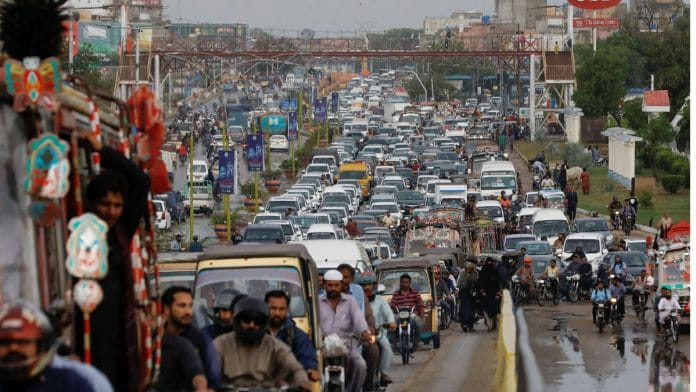
New Delhi: Pakistan is home to nearly half of the people living on less than $3 a day across the Middle East, North Africa, Afghanistan and Pakistan (MENAAP) region, the World Bank’s Economic Update on the region said Tuesday.
Pakistan accounts for 48 percent of the overall poverty in the region, the report says. This drove the regional increase, which is why MENAAP is the only world region where poverty remains above pre-pandemic levels and is still rising.
Three dollars is 830 Pakistani rupees and Rs 290. Pakistan’s poverty rate rose 6.4 percentage points at the $3.00 line and 3.2 points at the $4.20 line between 2018-19 and 2024-25 and exceeded 20 percent. Poverty rate is the ratio of the population whose income falls below the poverty line.
Afghanistan, Syria and Yemen accounted for another 47 percent of the region’s population living below the same poverty threshold, according to the report.
Earlier in February, poverty in Pakistan surged to an 11-year high of 29 percent, while income inequality has reached its highest level in 27 years, according to the country’s official statistics.
The World Bank said the region accounted for 14 percent of the world’s extreme poor, second only to Sub-Saharan Africa.
“The increase was driven primarily by a rise in poverty in Pakistan,” the report said, noting that the country’s poverty rate increased by 6.4 percentage points at the $3-a-day line and by 3.2 percentage points at the $4.20 line between 2018-19 and 2024-25.
The bank attributed the deterioration to the Covid-19 pandemic, the devastating 2022 floods, a macroeconomic crisis characterised by high inflation and currency depreciation, and a prolonged period of economic adjustment that weakened real household incomes and employment opportunities.
The latest estimates show that poverty at the $3-a-day threshold has approached or exceeded 20 percent in Djibouti, Pakistan, Syria and Yemen.
The World Bank then projected Pakistan’s economy to grow 3.8 percent in the current fiscal year, while inflation is expected to reach 8.2 percent. However, once population growth is taken into account, real GDP per capita is projected to rise by only 2.2 percent, compared with 2.1 percent last year.
Also Read: Indians live 2.8 years longer than Pakistanis, says WHO. Here’s why
Shifts through the years
The 2024 World Bank update had projected 2.8 percent growth in FY25, 3.2 per cent in FY26, and inflation easing to 9 percent in FY26 for Pakistan and a current account deficit forecast at 0.7 percent of GDP in FY26. For 2025, the MENAAP report put Pakistan’s FY2025-26 growth at 2.6 percent and FY2026-27 at 3.4 percent. The bank has forecast a current account deficit of 0.8 percent of GDP and a fiscal deficit of 3.5 percent this fiscal year. Both are higher than the previous year, but remain within what the report described as manageable levels.
In 2025 the main threat was floods and weak agriculture. In 2026 it is the Gulf conflict, with fuel price jumps, a weaker current account, possible remittance losses, and El Niño exposure.
The World Bank said governments across the region were facing competing demands to protect households from rising prices while also responding to humanitarian needs arising from regional conflicts.
Fuel prices have risen sharply since the start of the West Asia conflict. Petrol prices increased by 40 per cent or more in Lebanon, Pakistan, Syria and the United Arab Emirates, while diesel prices rose by more than 40 per cent in Pakistan and the West Bank and Gaza.
According to the report, Pakistan sits in the “developing oil importers” group, which is projected to grow 4.3 percent in 2026, while the Gulf economies contract sharply.
Moreover, poorer households spend 35–50 percent of their budgets on food, so higher food and fuel prices hit them hardest. Pakistan is also among the countries where gasoline prices rose 40 percent or more, and diesel is up over 40 percent since the conflict began.
The increases were substantially higher in some other countries, with diesel prices rising by more than 80 percent in Lebanon and nearly 70 percent in the UAE.
Pakistan remains particularly vulnerable as an oil-importing economy. Along with Djibouti, Egypt, Jordan, Morocco and Tunisia, it faces the risk of higher inflation and commodity prices, reduced fiscal space, weaker remittance flows from Gulf economies and higher borrowing costs as geopolitical risks persist.
Pakistan’s inflation reached about 11 percent by midyear, according to the report. The fiscal-year forecast of 7.1 percent is however lower than the previous year, and the report projects it rising further to 8.2 percent in FY2027.
In fiscal and external position, Pakistan slips from a surplus to a growing deficit and is listed among the economies facing “significant debt or financing pressures”, alongside Algeria, Djibouti, Iraq, and Morocco.
The report notes that to counter it the government has introduced targeted fuel and farm assistance as it advocates for targeted cash transfers over broad subsidies as cheaper and better for fiscal space.
Then there are remittances. Pakistan is a major labour-sending economy to the Gulf. A prolonged slowdown in Gulf tourism, construction, and hospitality could weaken the income flowing home and remittance decline is named as a risk channel for oil importers generally.
The World Bank reclassified Pakistan, along with Afghanistan, from its South Asia region into a newly created grouping known as MENAAP — Middle East, North Africa, Afghanistan and Pakistan in 2005.
Pakistan’s economic and external debt profile increasingly resembled that of MENA economies. Its debt-to-GDP ratio, estimated at around 33.4 percent, is broadly comparable with regional patterns in the region.
Pakistan also shares several demographic and labour-market characteristics with MENA countries, including a high youth dependency ratio, low employment-to-population rates and relatively weak labour-force participation. Female participation in the workforce remains particularly low, mirroring a broader challenge across much of the region.
Pakistan’s economic fortunes are increasingly connected to the Gulf and wider west Asia through remittances, capital flows and energy dependence. These ties have become an important component of Pakistan’s macroeconomic stability, outweighing the country’s relatively limited economic integration with other South Asian economies.
(Edited by Nardeep Singh Dahiya)
Also Read: Pakistan just set a reserve record. Much of it is borrowed money