




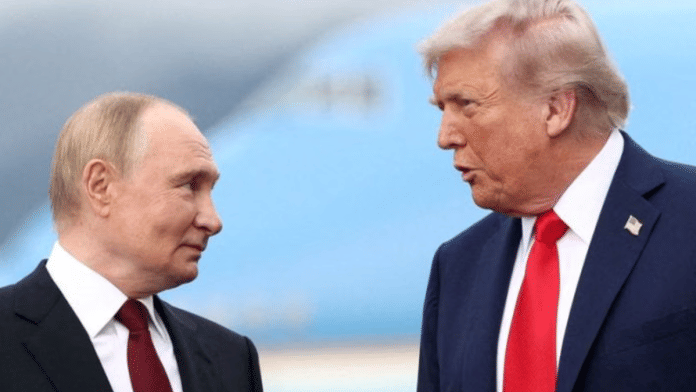

New Delhi: US President Donald J Trump’s diesel deal with Russia and his declaration of a ceasefire last Sunday, which collapsed within hours, highlight the growing limitations of American policy in Eastern Europe.
Trump’s announcement that the US would purchase 300,000 tonnes of diesel from Russia immediately, 500,000 tonnes in November and potentially one million tonnes the following month was met with anger in the US, while Europe largely shrugged, continued imposing sanctions on Moscow and pressed ahead with its support for Ukraine.
The deal has been met with a degree of incredulity in India, especially as Trump spent the better part of 2025 railing against New Delhi’s purchases of Russian oil. The deal will do little to bring down diesel prices across the US as Trump heads into the midterm elections on 3 November, which could potentially end Republican control of Congress. The diesel deal and its aftermath are ThePrint’s Newsmaker of the Week.
Following his announcement of the deal with Russian President Vladimir Putin, Trump took aim at Ukrainian President Volodymyr Zelenskyy, calling for his resignation on 10 October. Zelenskyy and Trump have had a difficult relationship, stemming partly from the American president’s first-term obsession with Hunter Biden’s laptop and investigations into the younger Biden’s links to Burisma, a Ukrainian company.
Their differences spilled into a public shouting match in the Oval Office in February 2025. Although US-Ukraine relations hit a rough patch for parts of 2025, Kyiv spent much of 2025 trying to repair ties, including by offering Washington a stake in Ukraine’s critical mineral reserves.
The latest rupture, however, has left the two leaders at loggerheads, with Zelenskyy publicly criticising Trump’s deal with Putin. This was followed by reports that Kyiv’s access to Starshield—the military arm of the Starlink satellite network—had been severely restricted last Wednesday.
Elon Musk, the owner of Starlink, passed the buck to Trump, pointing out that the military system is run by the US Department of Defense. The restrictions on Ukraine have since been lifted, according to reports.
Trump’s actions have drawn growing ire from both Republicans and Democrats, with a bipartisan group of senators calling for a reversal of the diesel deal with Putin. Trump promised to end the nearly half-decade-long Russia-Ukraine war within 24 hours of being elected president in 2024. Almost two years later, his approach to the conflict seems to have become a sideshow to his war with Iran and his falling poll numbers.
How did we get here?
Zelenskyy’s immediate reaction to the deal on Monday was to suggest that Trump was being driven by domestic concerns, given the insignificant share of Russian diesel exports in global supply. In a statement on X, the Ukrainian president pointed out that Russia’s diesel exports account for a little over 2 per cent of global supply and argued that the deal would do little to bring prices down.
For Trump, a fall in domestic fuel prices, particularly diesel, is key to his party’s electoral prospects in Congress. Diesel prices in the US rose from $6.2 a gallon last week to roughly $6.3 a gallon on Friday, according to AAA fuel prices. A year earlier, diesel was selling at roughly $3.2 a gallon at the pump.
Rising fuel prices have contributed to inflation across the US, which stood at 3.7 per cent in the year to September, according to the latest government data. The increase was higher than forecast, pointing to the impact of disruptions in global energy markets, largely caused by the war in West Asia, on the American economy.
Rising prices and concerns about affordability have become central campaign issues for several Democratic candidates running for Congress. On 3 November, a third of all Senate seats and every seat in the House of Representatives will be up for grabs. Trump’s approval rating has fallen to 37 per cent, with roughly 60 per cent of Americans disapproving of his performance so far, according to The New York Times.
In response, Trump has seemingly struck a deal with Putin, while promising that diesel prices will fall. The US administration has spent the past few months requesting Ukraine to stop striking Russian oil refineries. Kyiv has indicated that it is willing to accept, provided Moscow stops attacking Ukraine’s energy infrastructure. Trump went so far as to announce an “energy ceasefire” last Sunday, but the truce was broken within hours, with attacks on gas facilities across Ukraine, according to Zelenskyy.
Ukraine observed the ceasefire for 72 hours before resuming strikes on Russian oil refineries on Thursday, according to reports.The US has been Ukraine’s largest arms supplier for much of the past four years. Despite the leverage Washington holds, Kyiv has seemingly shrugged off Trump’s demands.
Europe shrugs, India watches
Last year, hours after Trump hosted Putin in Alaska, six European leaders made a beeline for Washington to secure continued American support for Kyiv. The photograph of the six leaders seated across from Trump went viral around the world.
This year, European Union (EU) leaders described the Trump-Putin diesel deal in unfriendly terms before proceeding to impose more than 1,600 sanctions listings targeting Russia on Monday.
EU High Representative for Foreign Affairs and Security Policy Kaja Kallas described the package as proof that “Europe is again showing a united front”. She added that the sanctions targeted Russia’s “production chain for ballistic missiles”, with the aim of making their production “significantly harder, slower and more expensive”.
“EU Foreign Ministers just adopted nearly 1,600 new sanctions listings targeting Russia’s military-industrial complex. This is the single largest expansion of our sanctions list since Russia started its war,” Kallas said on Monday.
Multiple diplomatic sources told ThePrint that the focus remains on managing Trump while expanding European support for Ukraine. The latest deal did not surprise European leaders as much as might have been expected. The EU has largely continued imposing its own sanctions on Russia, while acknowledging that Trump’s latest move cuts at the heart of the transatlantic partnership.
For India, Trump’s latest announcement comes weeks after the US Congress passed a law allowing the American president to impose tariffs of up to 100 per cent on countries that continue to purchase Russian and Iranian oil. Russia has become India’s largest source of oil since the war broke out.
The US law heightened fears in New Delhi of further tariffs as India continued purchasing Russian oil. The Ministry of External Affairs explicitly referred to the “potential implications” if Trump punished India for its energy policy.
US Ambassador Sergio Gor, speaking at the Bloomberg New Economy Forum in New Delhi on Thursday, said Trump would decide on the tariffs within the “next 10 days”. The prospect of the Trump administration targeting countries that purchase Russian crude while allowing the US to do the same to keep domestic energy prices low would be difficult for Washington to defend.
The Russia-Ukraine war and Trump’s policies have essentially laid bare the quagmire facing the US as it grapples with the conflict. Perhaps former House Speaker Nancy Pelosi was right when she pointed out that, with Trump, “all roads lead to Putin”.
Views are personal.
(Edited by Prashant Dixit)