



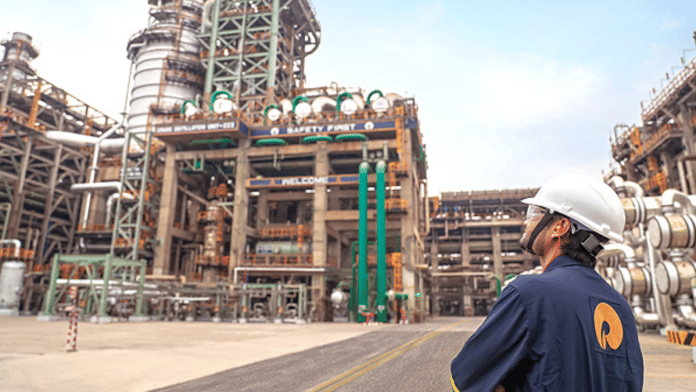
United States Secretary of State Marco Rubio’s visit to Reliance’s Jamnagar refinery on 21 October was telling. Rubio called India a “refining superpower” and spoke of processing more Venezuelan crude there. Jamnagar’s two plants can refine about 1.4 million barrels a day, including heavy oil. This visit enunciated what the map of oil production and exports usually leaves out: refining capacity.
Despite continuing uncertainty, Gulf crude exports have recovered in September to more than three-quarters of their pre war level, yet Middle Eastern exports of refined petroleum products remained below half. Diesel has also remained painfully scarce.
Energy security has never been an easy concept to define. Researchers Aleh Cherp and Jessica Jewell correctly asked what makes energy systems vital and what conditions assess how vulnerable they remain. The answer is never even and shifts with the crisis cycle. Crude reserves and diversification alleviate pressure from disruptions in crude supplies, but offer little insight into the disruption of production and supply chains of refined products. Refineries convert different crudes into usable fuels; traders and ships then deliver them.
But there is more to ponder: Which plants can process what kind of crude, what types of fuels can they make, and can those fuels safely reach buyers without getting bombed by an incoming drone?
Crude recovers, diesel doesn’t
The International Energy Agency estimated that Gulf crude exports had nearly recovered, reaching 13.9 million barrels a day in September, slightly below their pre war level of 15 million barrels a day, but they remain vulnerable to renewed attacks. The still higher price reflects that vulnerability: Brent oil was $115.22 a barrel on 20 October.
However, refined-product exports from the Middle East have remained hovering at 1.9 million barrels a day, against 4.7 million before the war. Why? And here comes the factor of refineries under attack.
Before the US-Iran war, the Energy Institute counted 103.8 million barrels a day of installed refining capacity worldwide in 2025, and actual processing averaged 83.1 million. Out of this, China had 18.8 million, the US 18.2 million, the EU 12.0 million, the Middle East 11.9 million, India 4.9 million and South Korea 3.6 million. India held 4.7 per cent shares of global installed capacity in the 2025 series. A newer Indian government inventory gives an even higher figure of more than five million a day.
Also Read: Not just warmth, Rubio’s Mumbai visit must give India clarity on US energy policy
Why diesel?
Petrol prices are visible to consumers, but diesel costs spread across goods and services before most consumers encounter them. Trucks, tractors, construction equipment, mining machinery and backup generators depend on it. A related product, gas oil, is used for heating homes.
But costlier diesel also increases the price of harvesting and transporting food, and completing buildings. As historian Adam Tooze discussed recently on Foreign Policy’s Ones and Tooze podcast, diesel’s economic reach is easily missed because end users’ attention stays fixed on the gas station or the petrol pump.
For 2026, the IEA put global diesel and gasoil output in the third quarter 1.7 million barrels a day below that of last year. Let’s look at what it means when converted into prices. In September, wholesale diesel exceeded $200 a barrel in Singapore and reached roughly $220 in Europe and the United States.
Disruptions across theatres
Let’s understand the refinery ecosystem. A refinery cannot simply choose to only make diesel because crude contains different hydrocarbons. Distillation separates them; cracking and hydro-cracking are subsequent conversion processes, while desulphurisation removes sulphur to meet fuel specifications. These processes alter yields and fuel quality. Diesel sits among the middle distillates, along with jet fuel and heating oil.
Heavy, sulphur-rich grades need more conversion and cleaning equipment, and naturally those units cost more money and time. Further, as refiners favoured jet fuel this summer, they reduced gas oil yields. What this means is that a replacement crude may still keep a plant running without giving it the same diesel yield.
Before we go further, let’s clarify a general confusion—on units. Neither crude nor diesel has an exclusive unit. Barrels measure volume and tonnes measure mass. The IEA uses an average of 7.37 barrels per tonne of crude and 7.46 barrels per tonne of diesel. US refiners, for example, get about 11 to 13 gallons of diesel-range fuel from a 42-gallon crude barrel. A tonne of such fuel takes roughly 24 to 29 crude barrels, which produce other fuels as well.
Then there is a second-order effect across Asia. India, China and South Korea import Gulf crude for domestic fuel and exports. Reduced flows through the Strait of Hormuz lowered their refinery runs and gas oil output in the second quarter. In China, crude runs, the amount processed by refineries, were 2.2 million barrels a day lower than in the first quarter. In India too, crude processing fell to 5.23 million barrels a day in April.
Whereas Ukraine has identified another vulnerable point. Russia has around 6.5 million barrels a day of installed refining capacity, but processed an estimated 3.6 million in September according to Bloomberg figures cited by iSANS. Runs recovered in the first week of October, but the Ukrainian deep strikes have continued. Ukrainian drones have struck upgrading units that clean diesel and jet fuel, sometimes requiring months of repairs. The strikes squeeze fuel and export earnings despite the fact that Russia produces enough crude.
Russia’s and the Gulf’s lost refined exports now meet in the same diesel market with amplified effect. In September, their combined net diesel and gas oil exports were merely 820,000 barrels a day, down 1.3 million from 2025.
Russian and Gulf disruption has made countries such as India and South Korea, and their access to suitable crude oil for their refineries and their ability to export finished fuel, a lot more consequential.
Also Read: Look beyond ease of doing business. Economic freedom is India’s real path to Viksit Bharat
Where is the refining capacity?
Europe has substantial capacity. Eurostat records EU production of 215.7 million tonnes of oil equivalent of gas and diesel oil in 2024, and yet net imports of only 15.7 million were recorded. Before the Russia-Ukraine conflict, northwestern European plants relied on Russia’s medium-sour Urals crude, which is suited to their configurations and diesel needs. Norway’s Johan Sverdrup, other North Sea grades and Middle Eastern crudes helped replace it, but remember that grades are not economically or qualitatively identical. Europe replaced Russian diesel with finished fuel from the Gulf, the US and Asia. New plants in Kuwait and Oman also supplied Europe. The European Commission said in early October that supplies remained physically stable, albeit expensive. In this regard, Europe’s vulnerability continued to remain manifold.
Washington’s recent responses show how uncomfortable this situation has become. President Donald Trump has announced that Russia would supply 300,000 tonnes of diesel immediately, another 500,000 in November and one million thereafter. Using the IEA conversion, the initial 300,000-tonne shipment would equal about 2.24 million barrels of diesel in total. The US Treasury has authorised specified transactions of Russian-origin diesel until 7 April 2027. Trump has also separately waived key sanctions and tariffs under the new Graham Act, and Rubio clarified that the administration would use up to 60 days to assess their economic impact, although the order itself does not mention a 60-day expiry. With renewed escalation in the Iran war being speculated, Washington has every reason to relieve the diesel squeeze to the extent possible. Another Gulf disruption would compound it further.
India’s position deserves much more than a run-through of Rubio at Jamnagar. The Indian government details lists 267.1 million tonnes a year of installed crude-processing capacity, or roughly 5.4 million barrels a day. It is important not to confuse capacity ceiling with actual daily diesel output.
The table below shows India’s installed crude-processing capacity, while actual diesel production varies with refinery runs, crude grades and yields.
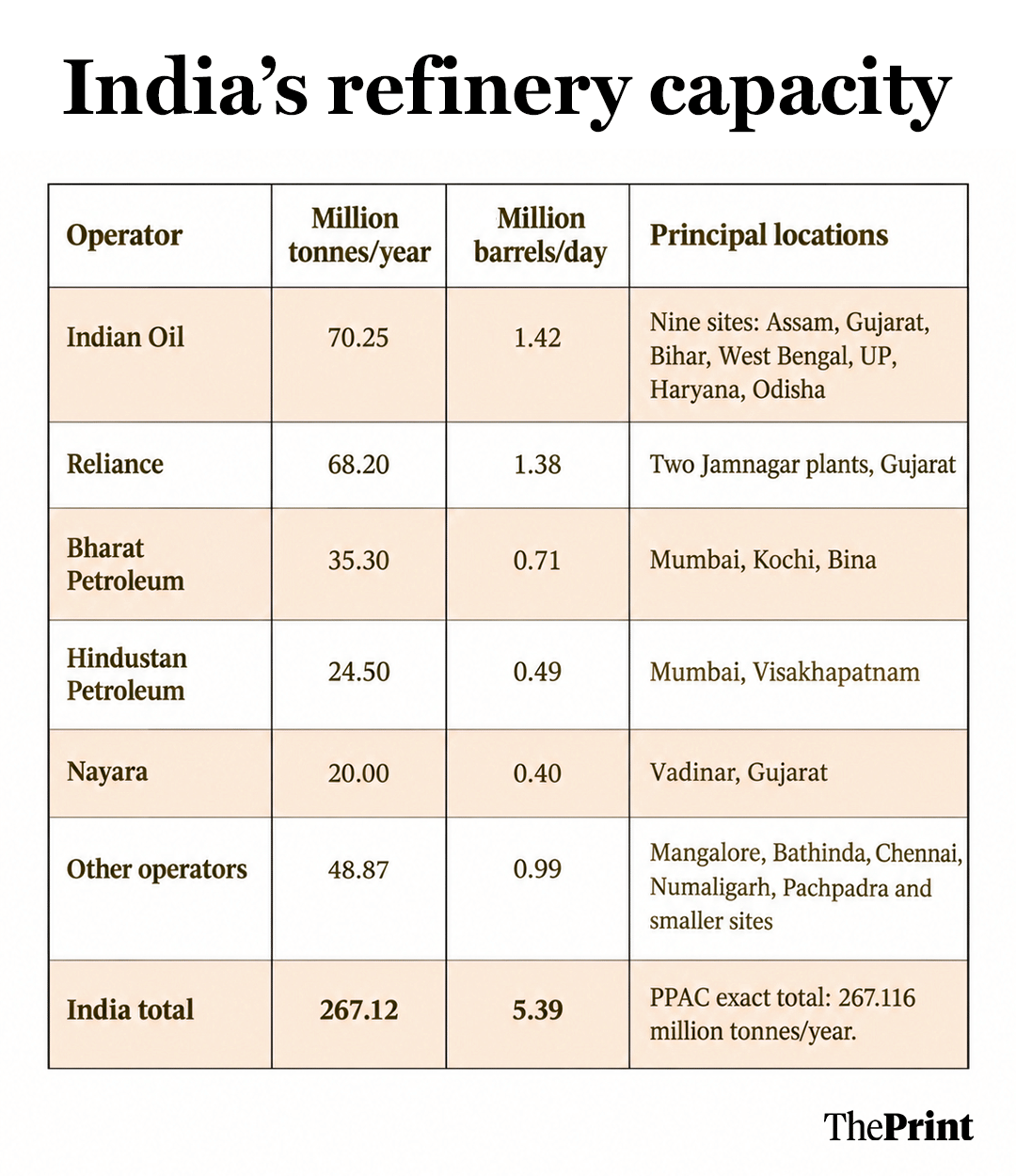
Indian plants do different work. Reliance says Jamnagar has processed over 216 crude grades, including heavy Venezuelan oil and describes Russian Urals as a substitute for some Middle Eastern grades. Indian Oil processed 275 grades from 48 countries in 2025–26 and Odisha’s Paradip Port was designed for high-sulphur crude. Nayara Energy says Vadinar in Gujarat can handle light sweet through ultra-heavy sour oil, though sanctions have pushed it towards Russian crude oil as its feedstock—the material fed into the refinery. What is important to note is that there is no permanent assignment of “Russian crude” to one refinery and “Gulf crude” to another. Operators blend and switch within technical, commercial and sanctions constraints. Flexibility helps, but India still depends on costly imported crude.
South Korea offers a parallel. Its five large refineries have the capacity of around 3.5 million barrels a day. They import virtually all crude by tanker, supplying domestic fuel and exporting high-quality products. Middle Eastern crude made up about 62 per cent of imports in the first eight months of 2026, despite diversification. S-Oil’s Onsan refinery has invested in upgrading and desulphurisation for export-standard diesel. Korea has a strong position within product markets, while its seaborne crude imports make Hormuz critical to its output and, in turn, to its refined-product exports.
China is the other indispensable refiner, with roughly 19 million barrels a day of capacity. State-owned complexes and smaller independents process different crudes; Shandong independents buy discounted Iranian and Russian grades. Capacity alone does not guarantee exports. Import quotas and product-export licences determine what plants may bring in and ship out.
Then, just like for the crude, there are diesel reserves too. The IEA said on 7 October that member states of the IEA held more than 200 million barrels of public emergency diesel stocks and were accelerating pledged releases. US commercial distillate stocks have stood at 104.3 million barrels in October. European countries also hold products under emergency obligations, though “how many days of diesel left” is often calculated against imports rather than total use. China publishes no comparable current diesel-reserve figure.
Crude production, refinery configuration, inventories and trade—all these describe different vulnerabilities. Refining capacity explains why India and South Korea have become so significant to this conversation as strikes on Russian processing units and on Aramco in Saudi Arabia reverberate abroad.
Rubio’s recent visit to Jamnagar and invoking India’s refining superpower status—all blend into the larger energy security question amid unprecedented disruptions.
The world is not running out of crude oil. It’s the refineries, stupid!
Swasti Rao is a Consulting Editor (International and Strategic Affairs) at ThePrint. She tweets @swasrao. Views are personal.
(Edited by Insha Jalil Waziri)