




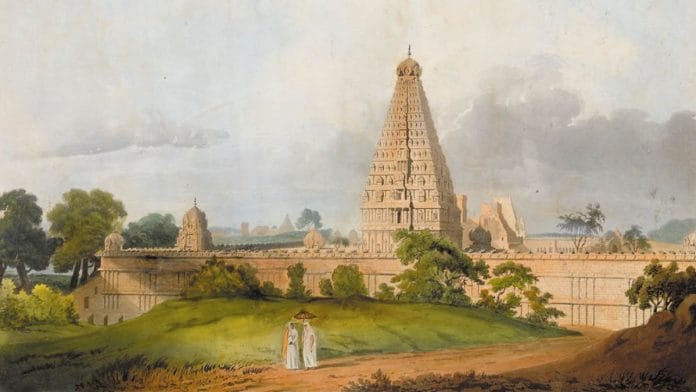

It is a headline that could have happened in 2026. A temple committee caught up in a scam. Two men murdered in the dead of night. Jewels meant for the deity vanishing into private hands. Inspectors arriving at midnight to find where the treasure had gone. Except the temple was on the Tamil coast, nearly a thousand years ago; the inspectors were the officers of a Chola king; and the whole affair survives as an inscription carved into stone. Just as shockingly, when the medieval culprits were finally brought to justice, they were not thieves or heretics who had crept in from outside. They were the temple’s own priests.
We tend to assume that temples in premodern India were pious houses of god, that their wealth was sacred, that it was donated for noble causes and honestly used by the faithful. Yet today, the temple trust of the Ram Mandir at Ayodhya, one of the country’s richest, is under investigation over missing offerings and jewels, and land purchased at many times its worth.
Not long ago, the self-styled godman Jaggi Vasudev of the Isha Foundation spearheaded a “Free Tamil Nadu Temples” campaign, later echoed by the Art of Living’s Ravi Shankar. The campaign argued that temples wither under government supervision and should be managed by devotees. While we might like to believe that spiritual enterprises float above the grubby ledgers of corruption and scams, the medieval evidence warns us of the exact opposite.
Temples and properties
To see why, we have to picture what a great temple actually was in South India, around the year 1100. By this time, the Kaveri Valley was studded with rapidly growing temple complexes, ringed with lofty walls and gopurams, frequently with markets and residential layouts nearby. Surrounding them were hundreds of acres of prime agricultural real estate partitioned by mazes of canals, bushes, and trees into fields. A single temple might own land in dozens of villages, not necessarily the ones closest to it. It might be visited by donors who journeyed for days or weeks, offering gold, animals, land, jewels, or bronzes. Substantial endowments were required to pay, for example, Brahmin ritual specialists working in multiple sub-shrines, import fineries such as camphor, and support an extensive workforce. Even a modest shrine held land, lent money, and employed dozens.
The concentration of resources and people naturally drew both political and financial interest. The Madras Museum Copper Plates, issued in Kanchipuram in the late tenth century, inscribe an arrangement in which the Ulagalanda Perumal temple lent gold to local weavers and cotton-producing villages. (South Indian Inscriptions, volume III, 128.) Its accounts were maintained by the weavers and checked annually by the city’s senior merchants — an arrangement sealed with the authority of the Chola king Uttama (c. 973–985 CE). This is a relatively early example and somewhat exceptional for its manufacturing focus. Most temple inscriptions are more unwaveringly focussed on land-based endowments. Historian James Heitzman, studying the medieval Tamil temple landscape in Gifts of Power, found that the very word for private possession of land and other hereditary rights — kāṇi — was rare before the 980s, and then multiplied rapidly. Over the course of the Chola period, the vocabulary for land ownership and rent grew alongside the expansion of temples.
The idea of gifted land might conjure the image of a plot of earth passing out of the hands of a devout farmer and into the keeping of the pious temple managers and their loyal staff. In practice, Heitzman demonstrates, “gifts of land” were effectively assignments by the wealthy of a portion of the revenue derived from a plot — rather than the field itself. 12th century realtors could be as shark-like as today’s. Many inscriptions, studied by epigraphist Noboru Karashima in his book Ancient to Medieval: South Indian Society in Transition, mention buyers swooping in on villages facing drought, floods, or tax-induced bankruptcy. Often land was bought at large auctions (peruvilai) named after a king and conducted by royal officials.
This purchased land, when gifted to a temple, was known as devadāna — “given to the god”, declared tax-free by the king in return for the payment of a lump sum in cash. In other cases, the taxes due to the king were assigned to a temple instead. However, many inscriptions further specify that devadāna land was kudi-ninga — “cultivator retained”. Which is to say, the donor bought land (often cheap), paid taxes to the temple rather than the king (typically receiving temple honours as reward), and then had landless tenants cultivate it — keeping most of the actual crop, and the right to sell the land when property values rose.
Temple inscriptions suggest that these institutions weren’t passive recipients of real estate. Temples could be, and in many cases still are, a region’s single largest owner of arable land. Karashima, in his History and Society in South India, examined the great Shiva temple of Jambukeshvaram, on the island of Srirangam. Across the twelfth and thirteenth centuries the temple administrators directly bought chunks of villages in the name of the god. In one acquisition, thirty-nine separate sellers, over five transactions, sold land they had themselves bought up from earlier holders. (Annual Records of South Indian Epigraphy (ARE) 1937–38 nos. 32–36). Any similarities to ongoing temple land scandals are purely coincidental.
Also read: An X post, SIT, and finger-pointing—the Ayodhya Ram Temple donation case raises many questions
Interventions and evictions
Kuḍi-ninga was one of many types of devadāna temple land, one in which the land changed hands, profits were made, while the actual people who tilled the soil stayed the same. Only the primary recipient of the harvest changed. Another type, altogether more worrisome, was kuḍi-nīkki, which came with the eviction of the farmer.
Karashima found several examples of this at Kilpaluvur on the Kollidam river, where farmers were driven away in huge numbers as military magnates consolidated land. The situation was so alarming that several 12th-century Chola kings attempted to restore property rights to the displaced farmers and banned “lordly families” (rajakulavar) from buying land at auctions. (ARE 1926, nos. 259, 257). Later inscriptions suggest it was all in vain: the cultivators who returned soon surrendered their lands, again, to the armed warlords. It is unclear whether this was voluntary.
The case with which we opened this column — a 12th-century scandal at the Sayavanam temple in present-day Mayiladuthurai District — offers another example of royal intervention (ARE 1911, no. 267). A surprise midnight inspection found that some of the Shiva-brahmanas, temple priests, were behind the sordid theft of the jewels. They were fined 180 gold coins, only 20.5 days of temple income, as punishment. Chola-period inscriptions contain many other examples of royal officers intervening in temple affairs, fining priests or managing committees for fudged accounts, or treasuries that did not match the gifts inscribed in stone. The medieval temple was not a sacred sphere left to police itself.
So, were kings the crucial counterbalance? It is an alluring image, but the sequence of events suggests otherwise. As mentioned above, villages were often forced to sell communal lands in the first place because of heavy royal taxes, sometimes in auctions presided over by royal officials, named after the king. Once communal lands had been converted into private property, it was usually royal officials who approved tax-exempt status and a “cultivators retained” or “cultivators removed” designation. In fact, in Heitzman’s analysis of the temple inscriptions at Tiruvidaimarudur and Tirukkoyilur, the main class of donors of tax-free temple lands were wealthy people bearing court-granted honorifics!
Scams and community intervention
Effectively, the medieval super-rich gamified the king’s tax demands, and the merit and honour generated by temple patronage. The quiet conversion of everyday, village-owned, taxable land into holy, privately-controlled exempt land was among their favourite instruments. Ironically, royal officials wielded it for them, as they, too, benefited from the system. The result was the simultaneous erosion of the revenue base of the Chola state, the blooming of beautiful temple-complexes, and the crushing of the landless farmer. By the early 13th century, Karashima writes, a full-blown agrarian crisis was driving families into bankruptcy. People were selling themselves into bondage. The Chola kingdom collapsed into turmoil, as Pandya and Hoysala armies invaded. Smaller temples suffered greatly; established ones, such as the Jambukeshvaram, further consolidated their land portfolios.
The grandfather of Chola studies, KA Nilakanta Sastri, wrote of a particularly massive scandal that erupted in Sivapuram, near Thanjavur. (The Cōḷas, citing ARE 1927, no. 279). In the chaos of the 13th century, a pair of Brahmin priests seized control of the temple and hired mercenaries from Karnataka — perhaps the chaff of a roving Hoysala army — to extort the sum of 50,000 gold coins from the surrounding villages. (Pegged only to the value of gold, not purchasing power, that’s between Rs 100-200 crore). They also stole from the temple, refused to pay tax, and gave a necklace intended for a goddess to their concubine. It was the village assembly, outraged, who finally took charge of the situation, accusing the priests of treachery against Shiva and the king, and stripped the culprits of all their properties. (Ironically, Sivapuram saw another temple scandal in the 1970s, when an unearthed Nataraja bronze was replaced with an imitation.)
Following the collapse of the Chola state, there were many instances of collective action to restore temple services, both by traditional village assemblies and regional super-assemblies of dozens of caste groups. In the long term, however, the structural changes to land ownership were irreversible. Temples gradually became open to patrons of more diverse backgrounds, but in general, landowning elites continued to hold pride of place.
The historical record does not make the case for the government bureaucrat over the temple committee. Instead, it warns us that both had a vested interest in benefiting materially from temples, as did some of the wealthiest medieval patrons. Contemporary debates about temple autonomy miss this nuance. God is perfect in the hearts of his faithful — but that perfection rarely extends to the political patrons, or the managers of the offerings.
Anirudh Kanisetti is a public historian. He is the author of ‘Lords of Earth and Sea: A History of the Chola Empire’ and the award-winning ‘Lords of the Deccan’. He hosts the Echoes of India and Yuddha podcasts. He tweets @AKanisetti and is on Instagram @anirbuddha.
This article is a part of the ‘Thinking Medieval‘ series that takes a deep dive into India’s medieval culture, politics, and history.
(Edited by Prashant Dixit)
Expected from crypto writer. If Free temples is wrong because management is susceptible to corruption, how come churches are independent, especially the most powerful Catholic ones? They too should be probed and brought under govt control.
Thefts were probed, brahmins were booked and punished 1,000 years ago – a point which the sangh parivar apologists for the Ayodhya scam, who are trying to justify it as a crime by the hindus for the hindus should learn a lesson from. no law-abiding society can pardon crime as an internal communal matter.