






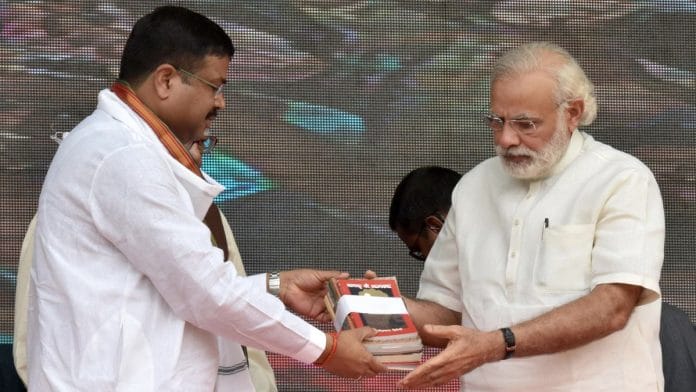

Prime Minister Narendra Modi must be hurting. Never in his 25 years at the helm in Gandhinagar and New Delhi did he have to sacrifice a minister under duress. What to speak of those working directly under him, he wouldn’t let go of chief ministers even if they become real estate moguls like Mohan Yadav in Madhya Pradesh or use their offices to allegedly award government contracts worth hundreds of crores to family members like Pema Khandu in Arunachal Pradesh.
Not that PM Modi doesn’t sack people. When needed, he has dumped CMs and Union ministers more often than people usually change their cooks and drivers. But he doesn’t sack them on public demand—not immediately, for sure. It’s a question of his Iqbal or authority.
That’s why Education Minister Dharmendra Pradhan’s ouster is so unusual. Why did PM Modi capitulate before Gen Z so easily? I guess he must have been briefed about cockroaches. According to a study on “little mighty” cockroaches, published in the scientific journal The Innovation, they have four biological traits—heavy appetite and starvation tolerance, robust innate immunity and detoxification ability, developmental plasticity, excellent fecundity and strong regenerative capacity.
Think of each of these traits figuratively and metaphorically, and you will know why these ‘little mighty’ cockroaches at New Delhi’s Jantar Mantar shook up a titanium-coated PM. When Congress leader Mani Shankar Aiyar called him a neech aadmi (petty person), Modi and the BJP made this a huge issue in the 2017 Gujarat election. Rahul Gandhi was convicted and sentenced to two years of imprisonment for associating the ‘Modi’ surname with thieves.
And here these cockroaches were using the worst expletives against the PM and making them viral on social media, but the BJP and the government bore it in silence. PM Modi must have realised that while Gen Z was out there demanding the education minister’s resignation, their real target was him (the PM). It had to be contained right there.
I am sure every minister in the government and every BJP member must be seething with rage. They should look at the brighter side, though. Gen Z have done them a favour, jolting them out of their comfort zone probably in time to smell the coffee. The Modi government’s refusal to take accountability for anything was making it look arrogant.
From Manipur to Pahalgam
Hundreds of people died in train accidents. The political accountability was limited to photo-ops at the accident sites. When people died in a stampede at a railway station in the heart of the national capital, the political accountability was limited to paying compensation to the grieving families. Many families were paid in cash within hours of the stampede. How so much cash was arranged so quickly remains a mystery. Well, with lakhs given in cash, the grieving families had to leave Delhi with the dead bodies as soon as they could.
India suffered an international embarrassment at the AI Summit due to the Chinese robodog. Ministerial accountability was beyond question, of course. Do you remember what happened to the IndiaAI Mission CEO, Abhishek Singh? Last March, he was appointed director general of the National Testing Agency, barely four weeks before it conducted the controversial NEET-UG examination that has cost Pradhan his job.
The people had no idea what would take PM Modi to fix political accountability. Communal riots in northeast Delhi during US President Donald Trump’s visit apparently weren’t big enough. Nor was the intelligence failure in Pahalgam. Nor is the virtual geographical bifurcation of Manipur along ethnic lines and the continuing violence there.
These are just a few among a myriad of examples. Pradhan must find it unfair. So many of his Cabinet colleagues have gotten away with much, much worse. Interestingly, if the NEET-UG examination had happened in the computer-based test (CBT) format, the risk of a paper leak would almost certainly have been lower. Guess why the CBT format was not used. Because the JP Nadda-led health ministry rejected the proposal.
So, Nadda is as much to blame for the paper leak. Pradhan can’t say that about his former party president, of course. Nadda, along with Union Minister Jitendra Singh, later negotiated a deal with the Cockroach Janta Party, resulting in Pradhan’s resignation. Pradhan can take solace in the fact that his resignation has finally kicked off the process of political accountability in the Modi government. Ministers are likely to be more vigilant now. The Gen Z must get the credit for this.
Also read: Modi govt has finally learned that common sense works better than arrogance
Jobs, not slogans
The second good thing the cockroaches have done is to remind the BJP-led government that Amrit Kaal and Viksit Bharat slogans have failed to impress the Gen Z. The aspirational students and youth who propelled Modi to power in Delhi in 2014 aren’t happy with slogans, window-dressing and patchworks. Look at how the government reacted after the setback in the 2024 Lok Sabha election—a grand announcement of an internship scheme (PMIS) in the first post-election Budget.
Finance Minister Nirmala Sitharaman laid out the vision—one crore youth to get internships in 500 companies over the next five years. The government meant to sweeten the offer with a monthly stipend of Rs 5,000. The government didn’t say it, but those internships were understood to convert into jobs.
Two years later, the PM or the FM doesn’t talk about the PMIS—like a lot of other things. Just 16,000 youngsters joined physically in the first two pilot rounds, with a substantial number dropping out midway. The government increased the stipend to Rs 9,000. Yet, in the third pilot round, just around 10,000 candidates have physically joined. One doesn’t know how many of them would quit midway. Essentially, more than 26,000 youngsters chose to become interns under this much-hyped scheme in two years against the target of one crore in five years. Let’s not even talk about the dropouts. The PMIS is a glaring example of the huge gap between hype and reality.
The Prime Minister distributing a few thousand appointment letters here and a few there, every now and then, with so much fanfare, doesn’t inspire much confidence. Not because the government won’t make public the details of those purported appointments. We have learnt to live with whatever numbers the government gives us. What doesn’t inspire confidence is the sight of PM Modi distributing 51,000 or 71,000 appointment letters every few months in a country where 20,000 to 27,000 people enter the labour market every day.
A substantial chunk of those are the so-called Gen Z, born between 1997 and 2012. According to the 2023-24 Periodic Labour Force Survey (PLFS), India has an estimated 29.94 crore working-age Gen Z individuals (aged 15-26 years), The Hindu reported.
Also read: A leaderless swarm brought down Pradhan—India’s youth and the new grammar of accountability
Sounding the alarm bells
The Modi government’s usual counter to questions about its performance is to blame it on the previous governments’ failures and misdeeds for ‘70 years’. There has been a whole new generation of people—who were not even in their teens in 2014—who have ‘seen’ only the Modi government. They seek accountability from this government only. Telling them about what Modi’s predecessors did won’t cut much ice.
And then there is another generation who was about to enter or just entered the job market in 2014. They used to scream in frenzied anticipation and delight every time Modi spoke about rising India. This generation has waited for that India of their dreams to deliver for them for the last 12 years. There are, thus, two generations of students and youth who are growing impatient.
Cockroaches have done well to make the government realise that slogans and big talks aren’t good enough for them. Government data can’t make people forget their lived experiences. Sounding the alarm bells is the second good thing Gen Z has done for the Modi government.
Their success is also a reminder to the government narrative-managers and optics-experts that people are getting weary of the same ‘foreign-funded’, ‘anti-national’ rhetoric. They might have seen those youngsters hurling invectives at PM Modi and proudly declaring before cameras that they were anti-national. Conspiracy theories and the opposition’s alleged misdeeds of the past aren’t so effective after 12 years. Gen Z has finally awakened the ruling party leadership to it.
And the fourth good thing they have done is get the Rashtriya Swayamsevak Sangh to speak up. RSS chief Mohan Bhagwat minced no words in his message to the government.
“The new generation asks questions, and one has to provide the underlying logic for everything. There is a great need to offer warmth, dedicate time, and engage in dialogue. It should be about discussion rather than dictation, and consensus rather than orders. Nowadays, conversation has stopped even within families, this needs to change,” said Bhagwat on Friday evening.
It was the Sangh’s way of telling its ideological protege to course-correct—something that happened after a long time.
PM Modi and the BJP have many other things to thank Gen Z for. That’s a discussion for another day.
DK Singh is Political Editor at ThePrint. He tweets @dksingh73. Views are personal.
(Edited by Saptak Datta)
The Indian government machinery doesn’t work until a crisis occurs. Politicians with low IQs cannot anticipate and prevent problems. Instead of debating in Parliament, they waste time and money on protests. They take refuge in patriotism and the Constitution while consigning the people’s problems to the dustbin.
Not sure the right lessons will be learnt.