




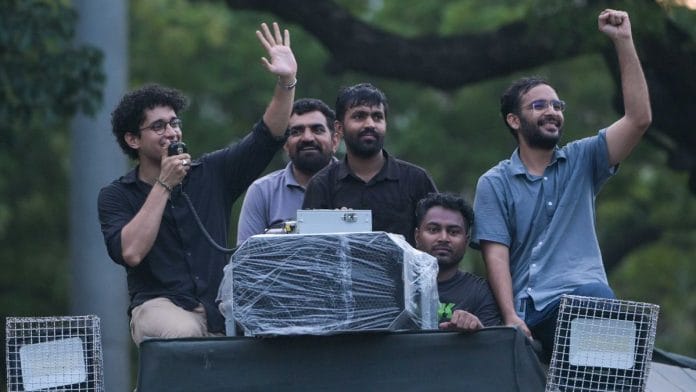

What does the success of the student/Cockroach Janta Party agitation tell us about the state of today’s India? It may be a while before we can come to any significant conclusions. But here are some preliminary thoughts.
Without wishing to deny Prime Minister Narendra Modi’s popularity in the country (polls keep demonstrating that he is India’s most popular leader), it’s time to admit that his power stems from two different sources.
Yes, many people love him. But those who don’t are scared of him. Rightly or wrongly, there is a perception that any person or group that opposes the government will pay a terrible price: arrests, raids, jail without bail, censure from employers, police brutality, etc.
It’s too soon to say that this perception has gone. But what is clear is that, sooner or later, every Goliath will meet his David. The success of these protests, during which every single day the demonstrators would chant insults directed at the PM, shows that things are changing. Even the newspapers, which are generally tame and careful, decided to accord massive coverage to the protests and to criticise the government editorially.
A decade and a half ago, this would not have been significant: the Delhi protests and the Anna movement were huge media stories. But in this day and age, such open shows of dissent are relatively unusual.
It’s not that media proprietors have stopped being frightened of the government or no longer seek favours. It is just that sometimes a movement captures the public imagination so completely that no proprietor can get away with blacking it out.
The issues
The protests gained their strength from two separate factors. The first was the stated agenda of paper leaks. But there was a second undercurrent to the agitation. People were opposing what they saw as the government’s arrogance; its belief that it could do whatever it wanted because it had the police and paramilitary forces on its side.
For many days, the government refused to resile from its hardline stance, believing that once its policemen had cracked a few heads with their lathis, the demonstrators would give up and go home. After all, one of the government’s proudest boasts is that it is unaffected by protests.
But nobody in power was smart enough to see that if the protests are about your arrogance, the worst way to respond is with even more arrogance.
In the end, the humiliating climb-down led the government to lose more face than it would have if it had simply taken some of the demands on board earlier. The problem was not that former Union Education Minister Dharmendra Pradhan refused to resign (he is a pro; he knows that sooner or later he will be back). It was that the PM believed that he would seem weak if he agreed to sack Pradhan.
Sometimes common sense works better than obstinacy. It’s a lesson this government has finally learned.
Also read: A leaderless swarm brought down Pradhan—India’s youth and the new grammar of accountability
The student factor
When political parties stage agitations, we are cynical about their motives and treat each protest as just another show. But when the protests come from apolitical young people, we treat them very differently. At some level, we feel that these could be our own children or our younger brothers and sisters. We don’t treat them with the scepticism with which we regard political workers. We are much more concerned about their issues, their welfare and their safety.
These protests touched a chord because we did not know much about the protesters. There were very few familiar faces or professional agitators. This gave the protests an Everyman quality. These were, it seemed, ordinary young people fighting for a future that the government was determined to deny them.
The mistakes
Location matters. You can get away with firing pellet guns in Kashmir. You can get away with letting Manipur burn. But everything you do in the centre of Delhi attracts too much attention, and you have much less room to manoeuvre. I am not sure the government realised this.
The rules of social media have changed too. Ten years ago, you could hire assorted keyboard goondas to abuse people on Twitter and intimidate them. Now Twitter matters much less (it isn’t even called Twitter any longer) and nobody is intimidated by control room tweets.
That has taken the edge off some of the BJP’s social media clout. Even the old strategy of bombarding people with daily WhatsApp messages is failing because the messages are so full of lies that people have stopped paying attention.
As these protests show us, the old ways are dying faster than most of us realise. Take one instance. The politicians went to do deals with social activist Sonam Wangchuk because he was a known quantity, someone they could negotiate with. I have no idea why Wangchuk, for whom I had great respect, agreed to talk to politicians when he had rejected so many attempts by supporters of the agitation to call off his fast.
But not only did he succumb to the government’s blandishments, he also agreed to break his fast on camera while ministers beamed. Moreover, he abandoned most of his early demands and settled for very little.
This made no difference to the protesters, contrary to the government’s expectations. They held their nerve and got their way within a day or so. But it exposed the claim that Wangchuk was the leader of the protesters and revealed his irrelevance.
In desperate attempts at recovery, his wife began posting against Hindutva and Vishwaguru using language that seemed oddly inappropriate to these protests, where religion had never been an issue. People claiming to support Wangchuk defended him on X, though, oddly enough, his strongest defenders included BJP handles, which, I guess, tells its own story.
Also read: How student protesters rewrote the language of political dissent—with humour
State violence
Whatever your views on the protests, it is clear that the police and paramilitary forces used excessive violence. Nobody has been held responsible for the brutality, presumably because the orders to beat people senseless with sticks and clubs and to fire pellet guns into their faces came from the politicians.
The violence may well prove to be the government’s biggest mistake. People will not forget what was done to the young protesters. In particular, they will not forget the way in which women were disrespected. The evidence is there for all to see on video. Yet even police officers who were caught slapping young women on camera have faced no action.
This will taint the government forever. India rarely forgives people who molest or disrespect women. The 2012 Delhi bus gang rape case damaged the UPA and the RG Kar case led to Mamata Banerjee’s defeat.
The media
I don’t want to get into a dog-eat-dog area, but the hostility towards what the protesters called godi media was all too visible. The news TV channels have shrunk so much in terms of viewership and influence that, as they spin their lies night after night, you get the distinct feeling that the only viewers they have left are the government’s watchers. They will have to continue to appeal to that select audience because the rest of India has moved on.
I don’t want to make too many claims about the future of the government, but some things seem evident. The government can treat the Election Commission as its domesticated pet. It can buy conscienceless MPs and MLAs. It can ignore Parliament.
But dissent has its own power: in the streets if not in government offices and legislatures.
And politicians will have to listen.
Vir Sanghvi is a print and television journalist and talk show host. He tweets @virsanghvi. Views are personal.
(Edited by Saptak Datta)
It is a victory of anarchists over democracy.
I think you grossly underestimate the hold of traditional media among the older than 30 years and outside upper middle class drawing rooms. Vernacular TV media is large and equally sycophantic.
People who don’t have common sense, have low IQs, and possess no employable skills join politics. Expecting common sense from them is unrealistic.
I agree the government has seemed arrogant on many issues including the E20 ethanol blending. But the opposition with their weak leadership and politics is creating an environment for the government to get away with whatever they want. Come next election and many people will again have the same dilemma who except modi? There is absolutely no one to ask anything to the opposition to get their houses in order so when the time comes they are ready to reap the benefits. That vision and hunger is absent in the current opposition which is also equally worrying.
Why were the protesters insisting on DP’s resignation? What was the Govt’s arrogance in it? No minister was benefitted by paper leak. It was allegedly leaked by a paper setter. But it was a guess paper not the copy of the actual paper. Whole thing started from CJI’s remark and the minister got sacrificed. It seems many media people who are anti BJP have enjoyed it and supported the misguided youth who were not even the NEET candidates. I am not pro-BJP. But I find the past incidents very ludicrous.
Vir Sanghvi… isn’t he is the classic “dramatic weathercock” of political journalism—the moment a stray cloud appears in the sky, he declares a category 5 hurricane, completely forgetting what he wrote just less than a week ago.
When a protest is building up, his narrative is “The government is facing an unprecedented, historic existential crisis it has never encountered before!” The moment the government negotiates, manages the ground, or the protest winds down, his narrative instantly shifts to “See? Arrogance surrendered to common sense! Just as I, the wise court philosopher, foresaw!”
It’s the quintessential “Darbaari game”…heads I win (I predicted the crisis), tails you lose (I lectured you on common sense), and either way, I get to preach from an elevated moral pedestal….keyword “moral”. Alright!!
Fills my heart with incredible pain to read that this is Delhi. Not Kashmir, where pellet guns were extensively used, costing many young people their eyesight. Or Manipur, which can burn. Well, there is no normalcy, no restoration of statehood, seven years after Abrogation of Article 370. And the Meitis, Kukis, even the Nagas cannot stand the sight of each other, want partition of a state which had only three million people. One week of Internet in central Delhi becomes newsworthy. The duration in Kashmir entered the Guinness book of records.