






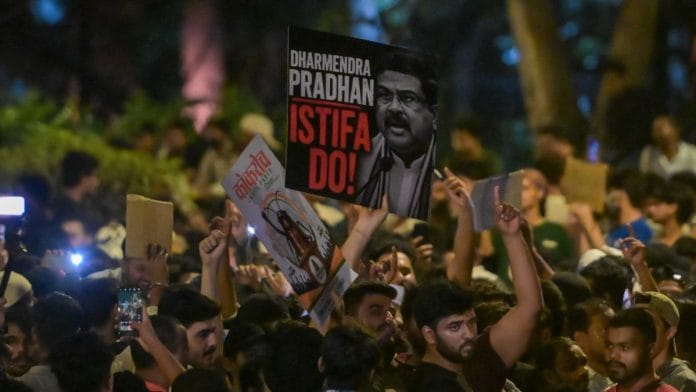


The resignation of Union education minister Dharmendra Pradhan will be remembered as a key event in the history of independent India. Since 2014, the Union government has operated on a neo-doctrine of absolute unaccountability and unresponsibility. The studies show that there was a predictable modus operandi at work: weather any popular storm, outlast the frantic cycle of television news, dismiss protestors as partisan actors, and most importantly, label dissent as the handiwork of some sponsored foreign elements.
A key aspect of this toolkit was to never sacrifice a minister under public pressure. Yet, hours before a critical third round of negotiations with the organically formed Cockroach Janta Party (CJP), the armour of a State that refused to show vulnerability—helmed by a person with a 56-inch chest—dissolved entirely. Pradhan has done more than abdicating his office. He has validated a generational revolution in how civic accountability is to be extracted from reticence in modern India.
Since the very start of the CJP-led protests, the political strategists in New Delhi misread the undercurrents. They viewed the spreading youth anger as a localised grievance that standard administrative measures and brute repressive force could easily contain. But they failed to recognise that the many failures of national-level entrance examinations had caused deep socioeconomic trauma, as evidenced by the reels and placards of this movement. A compromised exam system disrupted the aspirations of millions of students nationwide.
To appreciate the historical significance of the present moment, one must look beyond standard institutional explanations and focus entirely on the unique, self-organised energy of the youth demographic.
A departure from post-Independence playbook
Student-led dissent helped form the fabric of India well before Independence. But these student protests almost always operated in the shadow of institutionalised politics and its masters.
In the mid-1960s, powerful student agitations in Tamil Nadu permanently altered the nation’s linguistic and political map. In the 1970s, the Navnirman Andolan in Gujarat and the historic JP movement in Bihar mobilised thousands of young minds. They came together as a common force against corruption, shaking the foundations of central authority and reshaping the political landscape. Decades later, the anti-corruption upsurge of 2011, though now mired in controversy, showed that youth energy, if channelled in the right direction, could completely disrupt the status quo.
But all the landmark moments listed above depended on the stewardship of veteran Opposition politicians, structured organisational hierarchies, and mainstream patronage of political parties to translate street anger into tangible legislative results. Students were generally used to provide muscle and numbers, but the moral force was provided by the seasoned stalwarts who also steered the political direction.
The 2026 youth mobilisation is an entirely different phenomenon. This student-led movement was a raw and fiercely independent rebellion. Learning from past machinations, it consciously blocked traditional political factions from co-opting its agenda. Though there were calls later on for engagement from Opposition leaders, the movement refused to be used for anyone’s political gain or to settle scores with the Union government. The students didn’t seek to remove a regime and install an Opposition alliance in its place. Instead, they demanded immediate accountability from the State and its institutions.
For the first time in modern Indian history, a new social movement emerged, characterised by an unorganised, leaderless coalition, crowd-funded by ordinary people who believed in the power of democracy. It operated purely on shared anxieties of the future, especially careers and livelihoods, and digital solidarities on social media. The result was that it forced a powerful, highly secure Cabinet minister to resign. This shatters the long-held elitist view among some political theorists that a people-led movement cannot achieve victory in India without patronage from traditional parties.
Also read: How student protesters rewrote the language of political dissent—with humour
The rise of the leaderless swarm
A key question to ponder is this: In what way is this mobilisation different from previous social movements? The answer is the recent youth movement’s reliance on decentralised network tactics rather than hierarchical, top-down, diktat-based structures. This generation completely discarded the charter of traditional social movements, their protracted styles, and the gradual negotiation model. Instead, it treated dissent as a collaborative, open-source democratic project. It leveraged the power of the internet and its neo-global culture to translate complex policy failures into clear, lucid arguments.
If one looked at the physical layout of the protests at Jantar Mantar, one would see this paradigm shift reflected. Lacking the political party structure typical of such events, the site displayed thousands of students wearing mock corporate identification badges that read “Certified Public Nuisance”, alongside the hand-drawn cockroach art. They reclaimed an elitist insult that had sought to diminish their struggles, labelling them as cockroaches that have and would continue to infest the system. The students used encrypted messaging platforms and controlled simultaneous sit-ins across cities. This bypasses conventional state monitoring mechanisms.
A major X factor of this movement was that it remained leaderless, dynamic, and fluid. So the government was confused, and it could not disrupt the momentum with age-old tactics, relying on its Althusserian State apparatus to show its might and its tendency to perpetrate legitimate violence. The visuals from Jantar Mantar showed that the State’s traditional tactics were rendered obsolete by Gen Z protestors, who used spontaneity and meta-variations the government couldn’t match.
The anxious generation
The anger powering the rebellion is not merely ideological. The primary reason for this anger is intimately tied to the anxieties of India’s younger lot. For the middle class, as well as those working tirelessly to join it, competitive examinations such as NEET and JEE are a social contract between them and the State. It is an understood deal that a student has to sacrifice their youth. Then comes the grind of studying for 18 hours a day. Since this is not sufficient, the family has to put its modest savings aside to pay for coaching institutes. After all this, the one duty the State has is to provide an uncorrupted, neutral arena to ascertain the merit of these students. The repeated failures of the National Testing Agency (NTA) eroded students’ faith.
The crisis in India connected the youth to a broader global phenomenon. Around the globe, a deeply anxious generation is losing faith in institutions. The leaderless, highly adaptive nature of the Indian youth mobilisation mirrors the flexibility seen in Hong Kong’s Umbrella Movement, the use of digital technology and social media during the Arab Spring, and in the recent youth-led protests in Kenya. In all three cases, the formal institutional channels became completely unresponsive to public grief. And so, the digital metamorphoses onto the street.
Also read: From JNU to Jamia & now Jantar Mantar—Delhi Police faces similar questions over use of force
The limits of tactical surrenders
Pradhan’s departing statement says a lot about the considerable thought process and calculated political nature of his exit. He has foregrounded his resignation as a sacrifice. By saying that the resignation is an attempt to stop external forces from exploiting student unrest, the Union government is attempting to regain its lost moral high ground. But this deployment of rhetoric can’t hide reality. By using Pradhan as a political lightning rod, the government is hoping to preserve its corroded bureaucratic framework.
But the youth on the streets understand the symbolism behind Pradhan’s resignation. They will be forced to wage a much longer struggle for institutionalisation, transparency, and accountability. The major demands of the student movement remain firm and entirely non-negotiable. These include financial compensation for the families of students who died by suicide, legal amnesty and the withdrawal of all criminal charges filed against young protesters, and a total, comprehensive structural reform to overhaul the NTA.
Until yesterday, political analysts were writing off India’s younger generation as politically passive. They labelled this ‘Young India’ a distracted generation addicted to short-form digital media, deeply fractured by identity lines, and not capable of sustained or patient civic methods of deliberation. The recent historic victory has shattered this cognitive dissonance. The youth have proven that they are adaptive, sharp, and uniquely lethal, especially to the hegemonic, rigid, top-down power apparatus.
The events leading up to and on 25 July 2026, and the lessons they impart, stand as a stark warning to all. They echo that the future, well-being, and aspirations of the nation’s youth can never again be treated as collateral damage, and they will not stop until their destined goal is achieved, come what may.
Nikhil Sanjay-Rekha Adsule is a lawyer, an alumnus of TISS, Creighton Peden Scholar, USA, and a Senior Scholar at IIT-Delhi. He tweets @Surajya_Raje_. Views are personal.
(Edited by Prasanna Bachchhav)
Oh My…these are some budding Darbaaris being prepared to continue the legacy..
Well, I only see an opinion writer here. When he or she wraps a street protest in high-concept academic vocabulary, they aren’t describing what’s actually happening on the ground…they are writing fan fiction for their own ideological wishlist. Ok!!
You will see an inflation of every meme-worthy slogan into “History”. Another example…in this romanticized world, people don’t just protest bad administration, policy blunders, or paper leaks…no, they are “reclaiming the constitutional soul of the republic.”
Coming back to the topic…look at this guy… treating a crowd shouting in the street like it’s some holy divine awakening. According to our resident court romantic, a basic protest isn’t just everyday politics… no, no… it’s the youth “rewriting the grammar of accountability” and saving the world, one tweet at a time.
It must be real nice living in a fantasy land where actual laws, administration, and real-world systems don’t exist. Where you think complex government machinery gets fixed by throwing a tantrum and writing dramatic essays… instead of doing the actual, boring work of running a country.
But sure, let’s pretend every local squabble is the second coming of the French Revolution. Acknowledging real-world pragmatism would ruin his cute little fan fiction…
Bottom line: Total delusional nonsense… taking basic street noise and dressing it up as world-changing philosophy, brought to you by a guy who couldn’t manage a lemonade stand if his life depended on it.
Pradhan is being unnecessarily villified.
As if he was leaking the papers.
He was the one who fixed the problem.