





First, they save your life.
In the early hours of 18 July at Jantar Mantar, New Delhi, plainclothes policemen swiftly enshrouded the platform where Sonam Wangchuk rested on the 21st day of his hunger strike. The white sheets veiled the actions of the Delhi Police. They spirited the Ladakhi educationist, inventor, and activist into an ambulance without a proper stretcher.
The symbolism of spotless white sheets cloaking the “kaali kartoot” of disrupting a peaceful protest could not have been sharper. It should have served as a warning to the young students who gathered at the protest site on Monday morning that violence was on the cards.
Wangchuk has been on a protest fast for the last three weeks, joining the Cockroach Janta Party’s (CJP) agitation to demand Union Education Minister Dharmendra Pradhan’s resignation over a series of entrance exam paper leaks and controversies around CBSE results. The police were acting on the order of the Delhi High Court and admitted Wangchuk to Safdarjung Hospital, where doctors first refused to share his medical reports with his wife, Gitanjali Angmo, and later wouldn’t permit her to see her husband with her phone. They also wouldn’t allow Wangchuk’s own doctors – who had been giving him a clean bill of health over the previous few days – to see him.
By Saturday morning, as calls for a march to Parliament scheduled for 20 July intensified, Wangchuk’s body came to personify an emergency. As thousands of bodies poured into India’s streets on Monday, his body is being kept alive by the very state he accuses and demands accountability from. Up until that point, this had been the only other sign of engagement that the protesters had witnessed from the government – the first was being tagged the classic “foreign elements” and hurdles in the country’s progress.
Pradhan himself labelled the CJP “B team of disruptive elements” and suggested that they “raise slogans for those who want to divide the country”. If anything, Pradhan’s refusal to engage with protesters and resign from his position has only united the country.
600 kms down south
In the two days since Wangchuk was carried off, the crowd at Jantar Mantar has only grown. Students have been joined by ex-servicemen, retired schoolteachers, and parents whose children died by suicide in the aftermath of the leaked NEET paper. CJP founder Abhijeet Dipke stopped eating as well after the police picked up Wangchuk, but ended it on Monday. Solidarity fasts have started up in several other cities.
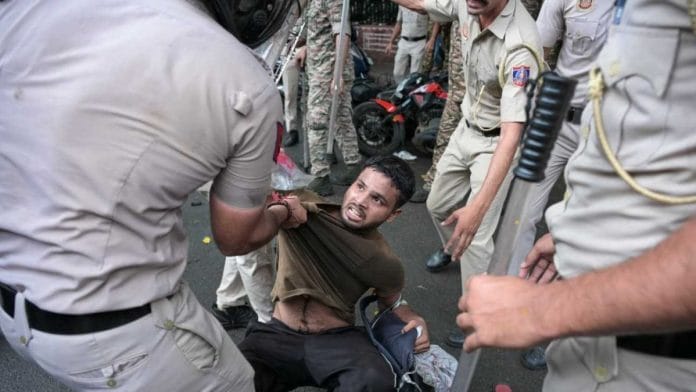
Last morning, the opening day of the Monsoon Session, as protesters set out to walk the short distance from Jantar Mantar to Parliament, the Delhi Police invoked Section 163 of the BNSS, shut down the metro stations closest to the sites, and called the march an “unauthorised procession”. To meet the unarmed protesters, the Delhi Police deployed more than 2,000 personnel, welded steel barricades, water cannons, and tear-gas vehicles.
As videos from the protest streamed in through the day, we watched these instruments being used on Indian children. Young men and women were tear-gassed, their skulls split open with batons, their footwear left behind in the crush — screaming and bewildered by their country’s response when all they had asked for was that their examinations be conducted properly. A new generation of Indians is discovering that this is how the state often responds, when it responds.
The day after forcibly removing Wangchuk from Jantar Mantar, the state repeated the exercise, this time 600 kms south. Since early July, tribal families from the villages that will be submerged by the Ken-Betwa link’s Daudhan reservoir have been camped on the Barana riverbank in Chhatarpur.
The protesters had started a Chita Satyagraha and lay in the river on funeral pyres; they had also knotted nooses around their necks, staging their own deaths. These protests were launched after their Jal Satyagraha — where members waded into the river and stood until the water reached their chins — received little attention.
On 19 July, police and officials abruptly cleared the protesters, citing rising water levels in the river, and detained their leader, Amit Bhatnagar, who has also been on a hunger strike for two weeks.
Call it engagement if you like, because the state is not falling over itself to offer dialogue or negotiation. When a citizen lies down in the path of a project, or stops eating in the capital’s power centre, a hulking machinery stirs to life: Concerns about the protesters’ “health” bring in doctors and ambulances, the courts are forced to take notice, there is some hand-wringing from well-meaning mouthpieces.
Many parts of this apparatus move, except the one that could actually end the protest. But a demand granted to one starving body turns into a lesson that other bodies will remember and invoke. Accountability produced even once under pressure is a concession. It’s an admission that democratic forms of protest work – which the state then owes to every andolan or satyagraha that follows.
That’s a precedent no government can afford to set — especially not one that has clarified it’s not a cowardly coalition that believes in “tyaagpatras” (resignations). But it can outlast anything a citizen has to give, including their lives.
Also read: Modi govt can’t see the difference between confidence and arrogance. What it means to people
A familiar script
None of this began with this government, and it will not end with it. Manipur’s Irom Sharmila refused food in November 2000, days after the Malom massacre, and did not eat again for 16 years, demanding the repeal of the Armed Forces (Special Powers) Act. For most of that decade and a half, she was held in a ward in Imphal, with a tube running down her nose, fed against her will. Between feedings, she was charged with attempting her own suicide under Section 309 of the IPC.
Successive governments at the Centre came and went — Atal Bihari Vajpayee, Manmohan Singh, followed by Narendra Modi — but the tube stayed. Sharmila broke the fast in 2016, though the AFSPA remains in force. She had then said: “People remain negative toward me; they want to think of me with the tube, without any desires, just as a symbol of resistance. This is my right to choice. I have the right to be seen as a human being.”
The fisherfolk of Idinthakarai were met with the same silence. When the hamlets around the Koodankulam nuclear plant in Tamil Nadu rose up in peaceful protest in 2011, against a reactor going up on their shore, the UPA government re-discovered a foreign hand. Manmohan Singh, then the PM, informed Science magazine that American and Scandinavian NGOs were bankrolling the unrest. The Home Ministry had frozen the bank accounts of several NGOs. Nearly 9,000 villagers were booked with colonial-era sedition cases for the crime of protesting for their safety.
Where bodies cannot be criminalised, they can be out-waited. The Narmada Bachao Andolan spent three decades seeking fair compensation for the people whose land would be lost to the Sardar Sarovar dam. The state responded with committees and Action Taken Reports, while successive state governments oscillated between supporting and opposing the movement until the dam was finished.
The survivors of the 1984 Bhopal gas leak — poisoned under a Congress government — have watched multiple union governments change. As of 2023, their petition for better compensation has been rejected by the Supreme Court. Every once in a while, a pandemic will do what a government doesn’t, as the anti-CAA protesters of Shaheen Bagh saw.
Also read: Sonam Wangchuk’s hunger strike exposes the limits of moral protest in today’s India
The exception
Each of those dispensations thrives on the same old reflex, couched in fresh vocabulary. Each government inherits from the other the belief that it never has to give in.
Except when it came to the repeal of the controversial farm bills. While the bills were acknowledged as progressive, they were railroaded through Parliament without adequate dialogue with the community they were meant to serve. When farmers massed at Delhi’s borders in the winter of 2020, the government did begin to negotiate with union leaders. Eleven rounds of talks were held, and the government acceded to minor points of the bills. But the result was an ongoing deadlock.
While the massive protests were unfolding, the government and media machinery unleashed the discrediting campaign we’re witnessing even now. These weren’t farmers at all — they were, as the government told the Supreme Court in as many words, infiltrated by Khalistanis. In the telling of a rotating cast of ministers and party spokespersons, they were the “tukde-tukde gang, urban Naxals,” supported by China and Pakistan, and according to the PM — who did not once meet them — andolanjeevi, i.e. professional agitators and parasites.
The IT cell did its bit: Amit Malviya put out a clip that Twitter itself flagged as manipulated media. Photographs from a 2013 rally were passed off as fresh proof of separatism. A chorus of cricketers and Bollywood stars posted messages of #IndiaTogether and #IndiaAgainstPropaganda on cue. In November 2021, however, the three laws were repealed.
It was no small victory for India’s farmers. It was won through a year of siege at the capital’s edges, enduring one punishing winter and an equally gruelling summer, with some 700 people dead, before the state gave way.
The CJP protesters, too, will hopefully get what they came for, despite the violence at Jantar Mantar – if they can sustain the movement long enough for the government to blink. That’s the only thing they need to remember. Power counts on the crowd to thin out, for the fast to break, and for young bodies to give in to exhaustion. It has all the time in the world. Does the CJP?
Karanjeet Kaur is a journalist and a partner at TWO Design. She tweets @Kaju_Katri. Views are personal.
(Edited by Saptak Datta)
The cover photo says it all. Hard to believe that this dodo is a student who had his heart broken because of NEET.