








In the 2016 film Sultan, Anushka Sharma’s character gives her wrestler-husband Sultan—played by Salman Khan—a stinging rebuke for ‘earning’ arrogance while she wanted him to earn respect: “Maine tujhe izzat kamaane ko kaha tha. Tu toh guroor kamaa ke aa gaya Sultan.” Many Indians may relate to her better now.
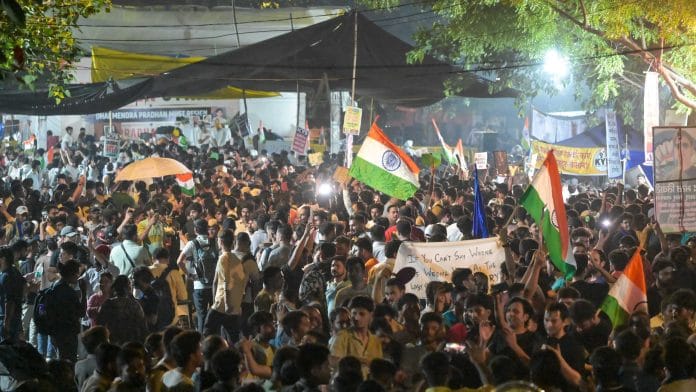
On Monday, the might of the State was on display as the police lathicharged and used tear gas to prevent thousands of young demonstrators from reaching the Parliament to protest against irregularities in medical entrance examinations and demand the resignation of Union education minister Dharmendra Pradhan. Activist Sonam Wangchuk, who was on fast for three weeks before being forcibly taken to Safdarjung Hospital, couldn’t join them as he said he was under ‘illegal detention’.
Even as thousands of students were struggling to cross police barricades to reach the Parliament, Prime Minister Narendra Modi delivered his customary address before the start of the session. He made no mention of what was happening to India’s youth barely a few hundred metres from where he stood. As if they didn’t matter! Lauding the successful launch of a rocket by a Hyderabad-based company, he took a not-so-veiled swipe at Rahul Gandhi, saying that the feat was achieved by those with an average age of 28 years, “not some 56-year-old young man”. It was out of context. The joke was supposed to be on the 56-year-old Leader of the Opposition in the Lok Sabha. But its timing—with the State’s brute power on display against students and youth in the national capital—seemed to be a reminder of the 56-inch chest, a metaphor for a strong and decisive government.
Manmohan Singh’s ‘mistake’?
Let me first play the devil’s advocate. Aspiring doctors, students, and youth in general need to understand that PM Modi doesn’t speak on anything that is negative about his government. He doesn’t want to repeat the mistakes made by former Prime Minister Manmohan Singh and then-UPA chairperson Sonia Gandhi, who easily buckled under the Opposition’s pressure and yielded to public outrage. Remember how many Union ministers and chief ministers they sacrificed: external affairs minister Natwar Singh over Oil-For-Food scandal; Union home minister Shivraj Patil for 26/11 terror attack—actually for changing his clothes way too often during that crisis; Maharashtra CM Vilasrao Deshmukh for its inept handling—actually for giving a tour of terror-hit Taj to his actor son Riteish and filmmaker Ram Gopal Varma; Deshmukh’s successor Ashok Chavan for the Adarsh scam; Union law minister Ashwani Kumar for alleged interference in a Central Bureau of Investigation probe; and many more.
A senior Congress leader once told me about his conversation with Sonia Gandhi, who apparently conceded to him that asking the Union ministers and CMs to resign was a mistake, as it only made the Opposition more strident. I wouldn’t call it a mistake, though. A democratically elected government must respond to public sentiments even if it has to pay a political cost. The Modi government obviously doesn’t see it this way.
Also read: Why is CJP talking more about Rahul Gandhi’s absence than Dharmendra Pradhan’s ouster?
Lakhs of students and their families may be feeling outraged over the NEET-UG paper leak and lapses and irregularities in other examinations. The Modi government won’t, however, yield to their demand for the education minister’s resignation, as it would be a sign of weakness. How did the show of respect for public sentiment serve the Manmohan Singh government? It only made people more demanding and unforgiving, making the UPA government look increasingly weak. The UPA government folded under public support for Anna Hazare’s fast-unto-death within 12 days and yielded to his demand. This laid the foundation for the UPA’s eventual ouster. Do you even remember if the Lokpal exists today?
Anyway, this should explain the Modi government’s refusal to even acknowledge the protests by the Cockroach Janta Party (CJP) and Wangchuk’s three-week-long fast. When it threatened to become a ‘nuisance’ in front of Parliament, the police just bundled Wangchuk out to a hospital. His wife wants to shift him to a private facility, but the authorities won’t let her do that.
The government was obviously taken aback on Monday. It probably didn’t expect students and youth from across the country to move beyond social media and descend on the country’s capital in thousands in support of Wangchuk and the CJP. Health minister JP Nadda had to give an audience to a CJP delegation as the police lathicharged and tear gas didn’t seem to break the morale of young protesters. The only other time the Modi government buckled in the past was when it had to scrap the farm laws due to farmers’ prolonged protests on Delhi’s borders. I am not sure yet if the government finds Monday’s protest electorally alarming enough to make a second exception.
The Modi government needs to do a rethink. Listen to what these young protesters are saying. It’s not just about the NEET paper leak anymore. It’s not even about Dharmendra Pradhan. Among the protesters were teenagers who have passed out of prestigious public schools in the national capital and even got admission in Delhi University. They weren’t affected by the paper leak, but they were coming to Jantar Mantar to do what many of them said was their ‘moral duty’. The government’s refusal to even engage with protesting students and Wangchuk is precisely what has triggered these teenagers and youth. Members of students’ organisations affiliated to some political parties did lend support, and some parties did bring in their supporters, but it would be a mistake for the government to look at the crowds on Delhi roads as the work of the political Opposition.
Also read: Sonam Wangchuk’s hunger strike exposes the limits of moral protest in today’s India
Bubbling beneath the surface
The NEET paper leak is just the latest trigger. The huge gathering seems to be a cumulative effect of small grievances that have been building up. When protesters talk about the government’s refusal to engage with the youth, they are only voicing their frustration with a system in which they have no say.
Take, for instance, the government’s diktat about the three-language policy in CBSE schools, which stipulates two native Indian languages, with English virtually becoming a foreign language. I have met so many students and parents, including many Modi supporters, who are upset with this imposition. They see it as a virtual imposition of Sanskrit and an exclusion of foreign languages. Say, if a child is studying in a Delhi school, they would opt for Hindi as one of the native languages and English as the third language. As for the second native language, the choice is severely limited. Students may want to opt for Kannada, Tamil, Telugu, Bengali, Gujarati, or Marathi as the second native language. A school would find it difficult to hire teachers for each of these languages. It’s easier to hire a Sanskrit teacher to meet the second native language criterion. And what if students—and their parents—want a foreign language to be taught in the school? They can’t, because the government won’t let them.
Did the government ask these parents and students what they wanted? No. If someone aspires to become a doctor and join King George’s Medical University in Lucknow, they must become a vegetarian first. Because UP governor Anandiben Patel is a vegetarian. While the Bharatiya Janata Party (BJP) leaders went on a non-veg binge before the West Bengal Assembly elections, one of the first things the party did after coming to power was to exclude eggs from mid-day meals in schools. Were the parents consulted? No. One BJP-ruled state after another has been bringing laws to regulate live-in relationships, prescribing fines and imprisonment for not registering. Were the youth—or their parents—asked if they would like the government to pry into their bedrooms? No. People have other grouses, too. To cite just one instance, they don’t know what to do with their cars as the government’s sudden decision to increase ethanol blending to 20 per cent has reduced the vehicles’ mileage and could potentially damage them.
These are just a few of many, many grievances the youth have. They hear just one response from the government: “I am your benefactor. I give your parents free foodgrains, free medical facilities, cash, and what not. Don’t ask questions. We know what’s good for you. Ask not what the government should do for you, but what you can do for us.”
PM Modi may want to rethink such messaging.
DK Singh is Political Editor at ThePrint. He tweets @dksingh73. Views are personal.
(Edited by Prasanna Bachchhav)
Great article, its almost surgical in its precision. Historically, student uprisings had always had that immense charishma or the potential, whichever word you may use( for your convenience) to a ‘shake up’ at least. In the immediate past we have trends like:
The Paris Protests (1968): Started as university strikes against old school rules and grew into a massive national worker strike that nearly brought down the French government.
The Soweto Uprising (1976): Thousands of Black students in South Africa marched against being forced to learn in Afrikaans, sparking a nationwide turning point against apartheid.
Tiananmen Square (1989): University students in Beijing led massive, peaceful demonstrations calling for free speech, democratic reform, and government accountability in China.
Kent State University (1970): US military forces shot and killed four protesting students during anti-Vietnam War demonstrations, sparking a nationwide strike of 4 million students.
Really well thought and written article, I do agree with your opinion. Wining state after state is giving impression to BJP about everything being good and a fake, inorganic anger on social media, but dissatisfaction and anger has build up since long, CJP was a trigger.
Think of all the blunders, catastrophes and scandals this government has indulged in: demonitisation, botched implentation of GST, complete inompetence during Covid, electoral bonds, PMCARES fund, exam leaks, falling bridges, stolen donation, leaking temple, dirty rivers, just to mention a few. And they still won elections at the national and state levels. Don’t know if people in this country care about anything at all beyond mandir-masjid, love jihad, “infiltrators”, and other such nonsense.
Why should govt listen ? Allow to govern for 5 years else throw them out . In name of freedom and democracy it has become lawlessness and contempt for anything govt .
People are corrupt in country , so what will a minister resignation do . Let him fix loopholes
Huge gathering which openly attacked police is an indication of arrogance of the crowd as well who feel they can act with impunity. Familiar script gas been witnessed far too many times. Nobody is fooling anyone. If education system is in question, how come the real culprits who were running coaching institutes are not questioned by so called protestors ? Is this how coaching institutes were churning out toppers all this while ? By getting papers leaked ? Piggy backing on a genuine issue to spread anarchy is not a sign of peaceful protest. In fact, it questions the very legitimacy of protests. These very journos were silent when protestors were lathicharged a few weeks back in Punjab. People have become experts in camouflaging their intense biases and even hatred towards democratically elected representatives and cloaking them in blanket of “peaceful protest”.
People have unrealistic expectations from the banana govt.
Delhi is in our family’s veins. Some things moved me very deeply. The anti Sikh pogrom in 1984. The communal riots after the CAA movement. Now these haunting images today, of how protestors were dealt with by the police. They will be seen within the country and all over the world. They do not belong to the world’s largest democracy.