




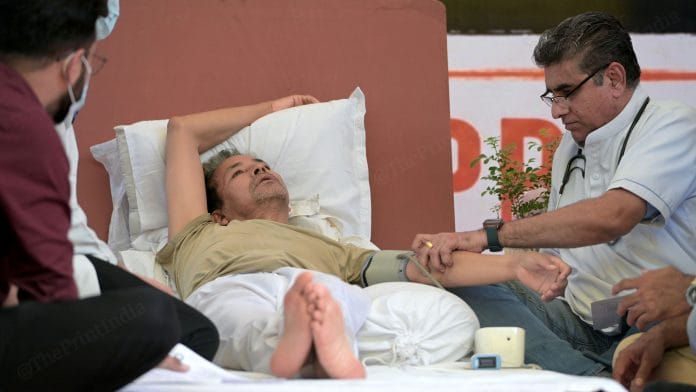

Twenty days. More than nine kg lost.
Lying on a thin mattress atop a makeshift stage at Delhi’s Jantar Mantar, under two pedestal fans battling the 40-degree heat and humidity, activist Sonam Wangchuk greets every visitor with folded hands. Visibly frail and speaking with difficulty, he still manages a faint smile.
“I am not in good shape, but not so bad either… I am not dying,” he says.
“My body is losing muscle, but my heart is still working. Don’t ask me to break my fast. Instead, join me on the march to Parliament on July 20,” he appeals in a video message.
Even on the 21st day of his indefinite hunger strike, Wangchuk remains resolute in his demands for the resignation of Union Education Minister Dharmendra Pradhan over the NEET paper leak controversy and sweeping reforms to India’s examination system. He undergoes daily medical examinations and survives on a few sips of water mixed with salt.
Yet, despite his visibly deteriorating health, no representative of the government has reached out for dialogue.
That silence raises a larger question: does a moral protest still have the power to compel those in authority to engage? The answer appears to be no.
There was a time when Gandhian fasts compelled governments to negotiate because they generated overwhelming public pressure. Anna Hazare’s anti-corruption movement in 2011 is the most recent example. Today, however, the landscape has changed. Public attention spans are shorter, and social media buzz often fails to translate into mobilisation on the ground.
Wangchuk’s agitation itself reflects this shift.
It has unfolded largely in the virtual space. There has been an outpouring of support, appeals for him to end his fast, and endorsements from politicians, but much of it has remained confined to X and Instagram. There seems to be a stark gap between digital activism and physical participation.
At the same time, governments have become more insulated from symbolic protests.
Although hunger strikes remain a powerful moral statement and can bring national attention to an issue, like it has to Wangchuk. But in today’s environment, symbolism alone may no longer be enough to force action. A hunger strike today is far less likely to compel governments to negotiate than it was a decade ago.
This is what makes Sonam Wangchuk ThePrint’s Newsmaker of the Week.
‘Not new to fasts’
Fasting and activism are nothing new to Wangchuk. They run in his blood.
His father, Sonam Namgyal, a Congress leader and minister in the erstwhile Jammu and Kashmir government, undertook hunger strikes in the 1980s demanding Scheduled Tribe status for the people of Ladakh. One such fast drew the attention of then Prime Minister Indira Gandhi, who personally offered him a glass of juice to break his fast.
Following his father’s footsteps, Wangchuk has undertaken several hunger strikes, demanding environmental protection and constitutional safeguards for Ladakh. His most recent fast, in September 2025, ended with his arrest under the National Security Act. He remained in detention for more than six months.
Since 2023 alone, Wangchuk has undertaken at least five major hunger strikes. These include a five-day climate fast in January 2023, a 21-day fast in March 2024, a 16-day fast in October 2024 following the “Delhi Chalo” march, and another hunger strike in September 2025, all of which were centred on Ladakh.
In recent years, Wangchuk has also emerged as one of the government’s most vocal critics on issues concerning Ladakh.
He has opposed large infrastructure projects, including the proposed 13-gigawatt hydropower project in Changthang and large-scale solar developments, arguing that they threaten the region’s fragile Himalayan ecosystem.
He has consistently demanded constitutional safeguards for Ladakh under the Sixth Schedule, stronger protections against unchecked industrialisation and mining, and a more sustainable tourism model.
The Sixth Schedule empowers tribal communities with a degree of autonomy in governance, enabling them to manage their own affairs and resources. Tribals are estimated to make up more than 90 per cent of the population in Ladakh.
The transition of Ladakh into a Union Territory (UT), following the abrogation of Article 370 in 2019, residents expected better administration, representation in Parliament, access to government funds and resources. But after the central government declared Ladakh a UT without a legislature, protests began demanding autonomy, jobs and safeguards for their land and culture, leading to a full-blown protest with over 20,000 people joining Wangchuk in his hunger strike.
Born in the village of Uleytokpo in Ladakh, Wangchuk studied at Vishesh Kendriya Vidyalaya in Delhi before graduating from the National Institute of Technology, Srinagar, in 1987. He then returned to Ladakh and, along with his brother Sonam Dorjay and like-minded colleagues, co-founded the Students’ Educational and Cultural Movement of Ladakh (SECMOL) in 1988. The organisation works with students who have failed the Class 10 examination, providing bridge courses, life skills and counselling.
For his work, he has won many accolades, including the Governor’s Medal for educational reform in Jammu and Kashmir and the Ramon Magsaysay Award for his innovations and contributions to society.
Also read: Diljit Dosanjh’s Satluj is Punjab’s biggest controversy. How it got here
‘Government’s critic’
Wangchuk’s relationship with the government has been marked by a recurring cycle of engagement and confrontation.
At various points, the Centre has opened channels of dialogue, prompting him to suspend protests. But when talks have stalled, he has returned to the streets or to fasting.
That pattern was evident last year. In September, Wangchuk was arrested under the National Security Act (NSA) on allegations of inciting a crowd during protests in Leh.
Months later, the government revoked the NSA and ordered his release, saying the decision had been taken in view of the law and order situation in Leh and to foster “peace, stability and mutual trust” in Ladakh. The Ministry of Home Affairs also said the move was intended to facilitate constructive dialogue with stakeholders in the region.
Following his release, Wangchuk welcomed the decision and expressed hope that meaningful engagement would resume. A breakthrough soon followed.
Today, however, Wangchuk once again finds himself at odds with the government. This time, however, over an entirely different issue. Yet, unlike previous occasions, there has so far been no sign of dialogue.
It is clear that Wangchuk’s influence does not stem from electoral politics but from moral authority—earned through decades of work in education, innovation and environmental conservation in Ladakh.
Whatever one may think of his methods, the issue he has raised is genuine and affects millions of people. It is too important to be ignored. The government’s responsibility now is to engage and explain its position on legitimate public concerns. Constructive engagement is not an admission of failure or a sign of weakness. Public issues like these deserve dialogue, not silence.
(Edited by Saptak Datta)
Sonam Wangchuk was removed from Jantar Mantar by Delhi Police and taken to Safdarjung Hospital on 18 July 2026, just two days before a planned peaceful march to Parliament. Authorities said the move was necessary because his health had deteriorated after 21 days of fasting and that they were acting on medical concerns and court directions. However, Wangchuk’s supporters allege that the intervention effectively prevented the planned march and infringed upon his right to peaceful protest.