





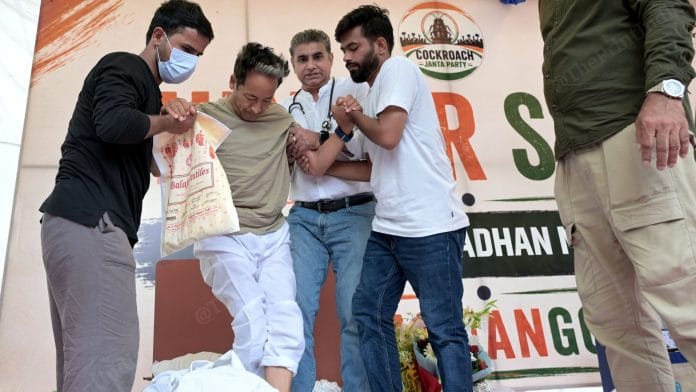


I hope that by the time you read this column, Sonam Wangchuk will have ended his fast. He is too good a person for us to lose.
But if you follow the social media commentary about Wangchuk and the protest he is a part of, you will notice two things.
First, people seem more interested in stopping Wangchuk from further damaging his health because of the fast than they do in talking about his agenda. Given their regard for Wangchuk, I can understand the concern. But I suspect he may have been happier if his agenda had made the headlines rather than his health.
Second, the primary demand from some of the protesters and those who support them is that Rahul Gandhi should speak out in their favour and perhaps visit Wangchuk. Perhaps Gandhi will make some statement or go and meet the protesters. Or perhaps the government will make some gesture in an effort to persuade Wangchuk to end his fast.
Nevertheless, I find the turn of events slightly mystifying. When the Cockroach Janta Party (CJP) made its debut on social media, the response it evoked became a global news story. The general tone of the coverage was that something significant was happening in India. The mainstream Opposition had failed to successfully oppose the government, and so, a spontaneous youth movement had sprung up. It could only grow in strength.
Maybe. But the reality is that the movement’s supporters seem focused on being endorsed by the same mainstream Opposition they were supposed to become an alternative to.
If India needs a CJP because Gandhi has failed to hold Prime Minister Narendra Modi to account, then why does the CJP itself need Gandhi?
Also, as far as I can recall, a key demand of the protesters was that education minister Dharmendra Pradhan must resign because of the mess the Indian examination system is in. But you now hear protesters talking more about Gandhi’s absence than about Pradhan, who continues to flourish in office. What happened to the need to reform the examination system?
It may be unfair to judge the CJP and its leaders at this early stage. Perhaps they lack the experience to exhibit the kind of focus a movement of this nature needs. And it’s entirely possible that as time passes, they will get better at this. But who can deny that something seems a bit off when a movement meant to harness the disillusionment of India’s youth seems to regard its primary objective as getting the leader of the Opposition to come and get Wangchuk to give up his fast? What happened to all that stuff about opposing the government, guys?
Why the Anna movement worked
One reason why we are surprised by all this is that many of us believed that this round of protests would have the same effect as the India Against Corruption campaign. That movement was allegedly led by Anna Hazare but actually masterminded by Arvind Kejriwal, who served as Hazare’s ventriloquist and used it as a stepping stone to become a politician with his own party.
Though the BJP will never admit this openly, without the so-called Anna movement and Kejriwal’s cunning, Modi would never have swept the general elections that followed. It was Kejriwal and his pals who finished off UPA-2 and created the public perception of former Prime Minister Manmohan Singh as a joke figure who presided over a scam-ridden government.
But times have changed. The Anna movement succeeded because of a combination of factors. The scam stuff stuck because it was coming from the CAG, a man who was supposed to have access to all the figures needed to keep a watch on the government. Because of the supposed credibility of the source, all kinds of nonsense about ‘presumptive loss’ was accepted as fact. Many of the alleged scams—the 2G scam or the coal scam, for instance—turned out to be either made up or exaggerated. Even the BJP government’s prosecutors were not able to make the charges stick in the courts. Nevertheless, the supposed scams were responsible for destroying the reputation of the UPA.
It also helped the Anna movement that this was the heyday of news TV and shouting anchors. As each ‘scam’ unfolded, the channels exploded with outrage. A succession of previously obscure panellists from the Anna gang (many of whom later went on to join or support the BJP) appeared on TV to denounce the UPA’s corruption. Prashant Bhushan came to be regarded as the fount of all legal and constitutional wisdom.
Also read: Sangh Parivar is acting as police, lawyer and judge in Ram temple scam. It’s the accused
Modi won’t repeat Manmohan Singh’s mistakes
The UPA was already in trouble when the protests started. Sonia Gandhi was unwell, and went abroad for treatment for long stretches. Manmohan Singh was not adept at political management and soon lost control of his cabinet. Nobody in his government understood social media and when he became the target of organised attacks, he had no idea what was happening. As the protests mounted, he was so appalled by the charges that he went into silent mode and failed to provide visible leadership.
Given this set of circumstances, it is not entirely surprising that the Anna movement polished off the government and left India longing for strong and visible leadership—which Modi provided.
It’s instructive to remember these particular circumstances to understand why it is so hard for this round of protests to have the same impact as the Anna movement.
First, none of the organisers seems to have Arvind Kejriwal’s cunning and his grasp of strategy. Kejriwal kept the movement focused on a single issue: corruption. He hammered away at this day after day. When he had facts to buttress his case, he still distorted and exaggerated them. When he did not have facts, he made them up anyway.
Second, the idea that an official figure such as the CAG could hold press conferences to accuse the government of corruption now seems totally unbelievable. Such a CAG would not last for more than five minutes with this government. (Consider the speed with which the vice president was despatched.)
Third, the Rottweilers of the TV channels have turned into pussycats when it comes to discussing the current government’s performance. And fewer people watch them anyway.
Fourth, despite the CJP’s early success on social media, there is no doubt that the BJP has mastered the medium in a way few political parties in the world ever have.
Finally, the big difference. Kejriwal and his colleagues went for Singh when he was already weakened. Contrast that with Modi, who continues to be so strong that he is still the most popular leader in India. And even those who don’t like him are scared of him.
The prime minister has seen the effect the Anna movement had on UPA-2. After all, he was its primary beneficiary. He is never going to make the mistakes Singh made. He believes that bowing to pressure from protesters or the media makes him weak. He rarely accedes to demands from quarters he regards as hostile (the turnaround on the farm laws was a rare exception).
Given all this, no protest movement in the Modi era is ever going to have it as easy as the Anna movement did with UPA-2. It’s not even going to be able to get its message across, because the media will play down its protests and its demands. And prominent people will be reluctant to say they support it.
None of this is to say that the CJP is doomed. Most popular movements take time to capture the public imagination. And this movement has only just started. It will get over these early mistakes, and as anti-incumbency grows, it could learn how to harness the changing public mood.
But let’s not make the mistake of thinking that it will be another India Against Corruption. That was a different era. And this is a very different prime minister.
Vir Sanghvi is a print and television journalist and talk show host. He tweets @virsanghvi. Views are personal.
(Edited by Prasanna Bachchhav)