




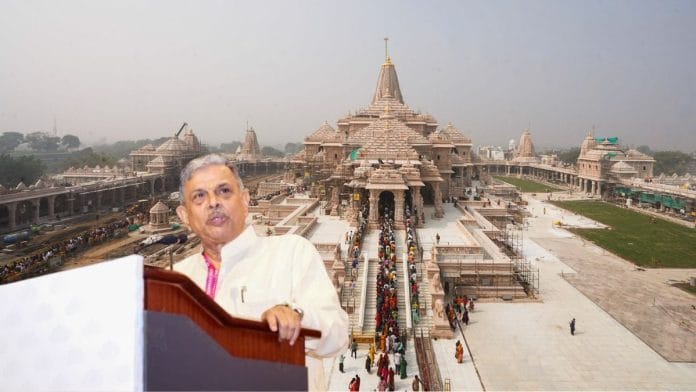

Finally, a senior-most person associated with the Ram Temple in Ayodhya, Nripendra Mishra, has addressed the theft and called it a kalank—a disgraceful blot. But those directly responsible for overseeing the temple administration are still in denial. The attitude of the Sangh Parivar leaders, in full control of the Ram Temple Trust, is a case in point. After keeping mum for a month, they spoke as though they bore no responsibility. RSS general secretary Dattatreya Hosabale condemned the matter but in the same breath said “anti-Hindu and anti-national forces” were “seeking to malign the Hindu religion and society by exploiting this unfortunate incident”.
Mishra, the temple construction committee’s chairperson, contradicted the stance taken by the Sangh leadership. But Mishra’s view is largely shared by the public.
The Sangh leadership appears more concerned with shielding its men from blame. Compounding failure with stubborn denial may prove a huge mistake.
They fail to ponder the obvious—Hindus from all over the country visit Ayodhya every day. News of the conduct and incompetence of RSS functionaries associated with the Temple Trust will reach every Hindu household across India and abroad.
Their incompetence is multi-layered. First, that such an ugly theft could take place under their watch. It indicates that they are incompetent to not just run a temple but, more importantly, to govern. The Sangh highlights Rai’s personal honesty, but that cannot compensate for incompetence. In governance, ensuring the security of society, justice, and order is far more important than personal honesty.
The Shri Ram Janmabhoomi Teerth Kshetra Trust was formed by the Union government following the Supreme Court’s 2019 Ayodhya verdict. Thus, the scam directly reflects on it, too.
In private conversations, Sangh folks have concluded that the Ram Temple theft affair may fade in time. But this stain will weigh heavily upon them. It is only the latest in a long series of failures, counterproductive actions, strange statements, shifting policies, and the steady decline in India’s prestige.
The Sangh Parivar has long described “character building” as a foundational goal. But after assuming power, its conduct has appeared quite different.
The Government of India argued before the Supreme Court in 2019 that voters do not need to know where political parties get their funds.
The Temple Trust could have offered an equally elegant argument: “Why should anyone need to know where the donated money is going?” It would have been in line with the former.
After all, both arenas are run by top RSS-trained men. Consequently, their judgement, philosophy, and outlook are the same, especially with regard to responsibility and transparency.
With such a cavalier mindset, the Ram Temple mishap should not appear exceptional.
Also read: Why the Ram Mandir Trust allegations strike at the heart of BJP’s politics
Even propaganda fails
Both the RSS and the BJP are involved in the affairs of the Ram Temple. In such circumstances, it is difficult to escape the fallout of the Ram Temple scam merely by blaming others.
More than corruption, this incident demonstrates the incompetence of the RSS-BJP: It proved incapable of managing a uniquely important institution. Yet, do not feel the seriousness of the matter.
Such an attitude has deeply saddened many Hindus. They are voiceless; they have no spokesperson. But they are sensible. They can see that leaders accustomed to appropriating credit for the work of others are now obstinately denying their own plainly visible failures.
None of the leaders who rushed to seize the credit for Ayodhya—sidelining the people who had worked for decades, and sat alone at the inauguration ceremony, publicised it on television, and then openly used photographs of the temple for electoral gain by distributing them from house to house—has issued any statement so far.
Leaders who frequently broadcast trivial sermons fall silent precisely when a response is expected from them. Whether they belong to the RSS or the BJP, whether the issue is domestic or international, they remain quiet and wait for the matter to cool down. This is again an example of them being clueless on various issues and evading responsibility.
After witnessing this attitude repeatedly, even the common man can spot it. Propaganda can no longer conceal that the emperor has no clothes. His cleverness, integrity, and competence are not what was advertised. No government can keep public opinion permanently in its favour.
Also read: RSS centenary isn’t a cause for celebration. It’s veered away from Hedgewar’s objectives
A policy of incompetence?
Ayodhya is also intimately connected with the politics of the Sangh Parivar and with its rise to the highest level of power. It is no ordinary place where such mistakes and neglect can simply be forgotten. Assuming the contrary reflects a certain mentality—an attitude of taking everything for granted. The Sangh clearly believes it has no alternative and that people will follow it no matter what it does.
But no one can determine when, or because of which event, the wind of public opinion may begin to shift. Even a small incident can suddenly lend new significance to an entire chain of preceding events. Then the image of those in power changes, almost on its own, and attempts to control it become futile.
At present, the attitude of the Sangh Parivar, its feeble statements, and its denial—all point in that direction. Had it spoken and acted by acknowledging the mistakes, weaknesses, and responsibilities of its own men, it would have appeared more credible. Instead, it acted as the police, the lawyers, and the judges all in one—when in fact it is the accused!
From Ayodhya to New Delhi, the responsibility and the mistakes are the Sangh’s, not those of the Opposition, the media, the Left, Islamists, or Christian missionaries.
Therefore, by accusing others of “conspiring” against Hinduism in this affair, its statements appear as bogus. Whether it’s done out of a desire to shield its own or simply because of incompetence, the impression may endure that the Ram Temple at Ayodhya has been in the wrong hands.
This episode will inevitably be viewed in the light of past accusations. Sangh leaders have been accused of embezzling donations meant for the Ram Temple as far back as 1991. Those allegations were made by Baba Lal Das, the chief priest of the Ram Janmabhoomi temple.
Thus the fundamental question becomes: Is it a policy, or sheer folly, to place unfit people in positions of great social or political responsibilities? After all, the RSS has younger, thoughtful, and upright people too. Why do such people always remain on the margins? Whether in the party, the organisation, or in governmental, educational, or cultural positions of responsibility, the same scenario is repeatedly visible.
Also read: Priyank Kharge is right about RSS transparency. He should ask the same of political parties
Unpredictable politics
By setting aside genuine questions and merely accusing others, the RSS leadership will end up alienating many of its own supporters as well. Even when the matter calls for cleaning one’s own house, denouncing others amounts to fleeing from responsibility.
The Sangh Parivar should not assume that Hindus are in its pockets. The BJP came to power largely due to the growing dissatisfaction with previous leaders. If the same dissatisfaction grows against the present leaders, then the same can happen to it.
The Sangh Parivar seems to be proceeding on the theory that it has now made comprehensive arrangements to prevent such a reverse. It appears plausible, too.
Yet politics also has an X-factor. When and how it may upset even the best arrangements is impossible to predict. In democracy, the management of public perception has to be carried out with such subtlety that people do not even realise they are being herded.
It is precisely on this point that the Sangh Parivar appears overconfident. It places excessive faith in its organisation, propaganda, political calculations, and management. That is why it continues hoping to succeed by hurling rote accusations.
It places great faith in its cleverness. But in a country as diverse as India, it is risky to regard anything as predetermined. One should remember: It is the drain that is built to carry dirty water out of the house that becomes the very channel through which dirty water from outside flows back in during a storm.
Shankar Sharan is a columnist and professor of political science. Views are personal.
(Edited by Theres Sudeep)
It wasn’t the job of RSS to manage the temple administration.
Such thefte are happening across temple due to poor temple governance standards.
Reforms are needed.
Linking RSS, is a political ploy.
Let us just say that statements by people like Mr Anupam Kher make a bad situation worse.