






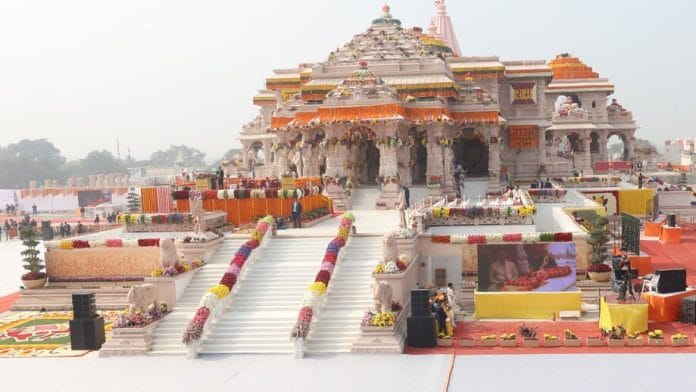


For four decades, the Ram Janmabhoomi movement—or the campaign to build a Ram Mandir in Ayodhya—was the defining calling card of the BJP-RSS-VHP combine. Apart from being a zealous political campaign, it was shrewdly projected as a so-called civilisational mission, a “peoples’ movement” to reclaim Hindu identity and to right the so-called “historical wrongs” of the medieval period and Muslim invasions.
In practice, it became one of the most consequential exercises in politico-religious mobilisation in independent India. Over the decades, “Hindu rage” was deliberately and systematically whipped up. Religious identity was weaponised and transformed into political identity. Secularism was portrayed as the enemy. Muslims were repeatedly cast as the hated “other”. The purpose: consolidate a Hindu vote and propel the BJP to national power.
As a young journalist, I remember well reporting on the Hindutva mobilisation of the late 1980s and early 1990s. I filed many reports on the feverish atmosphere and the thunderous slogans that echoed across north India: ‘Saugandh Ram ki khate hain, hum mandir wahin banayenge,’ ‘Jo Hindu hit ki baat karega, wahi desh mein raaj karega,’ ‘Jis Hindu ka khoon na khaule, jo Ram ke kaam na aaye…’
Lord Ram became not merely an object of worship but the central political symbol of a movement projected as an assertive “Hindu” resurgence against “pseudo-secularism”, against elite “Macaulayputras” (westernised Indians) and the alleged “appeasement” of Muslims.
I chronicled this transformation in my biography of former Prime Minister Atal Bihari Vajpayee. When the BJP was founded in 1980, Vajpayee declared that its guiding philosophy would be “Gandhian Socialism”. But Gandhian Socialism was an utter failure electorally. After successive defeats culminating in the BJP’s reduction to just two Lok Sabha seats in 1984, Vajpayee stepped aside, and LK Advani assumed leadership.
The road to New Delhi runs through Ayodhya
Desperately searching for an issue that could transform the BJP’s electoral fortunes, Advani lit upon the Ayodhya dispute, then largely a localised issue but already being fanned by the VHP. What followed reshaped Indian politics. A new entity trundled into public life: the Ram Rath. Rickety but menacing, decorated with religious motifs but carrying an out-and-out political message.
Through melas, yatras, religious congregations, processions and jagrans, the Ram Janmabhoomi campaign expanded into a nationwide political movement. The Rath Yatra became its defining image. The BJP’s landmark Palampur Resolution of 1989 formally embraced the Ram Mandir as its mission. From that moment, the road to Ayodhya became the road to New Delhi.
The BJP’s pivot from the more restrained Gandhian Socialism of the Vajpayee variety to the high-pitched Ram Janmbhoomi movement, spearheaded by Advani, transformed the BJP from a marginal political party into India’s dominant electoral force.
This history explains why the recent allegations—theft, embezzlement and misuse of funds—relating to the Ram Mandir Trust are so profoundly significant. These allegations are an earthquake. They strike at the very ideological foundation upon which the BJP has built its political identity.
The Ram Mandir was the RSS-BJP’s rallying point, its moral compass, its electoral launchpad and the vortex around which four decades of mobilisation revolved.
Allegations of corruption, therefore, threaten the credibility of the entire political project built around it. This is not merely a blow. It is an assault on the foundations, one with the potential to shake the entire edifice.
The Narendra Modi-led BJP cannot distance itself from this controversy. At every decisive stage, the party consciously made the Ram Mandir the centrepiece of its political identity. Senior BJP leaders marched alongside Advani during the 1990 Ram Rath Yatra. As general secretary of the Gujarat BJP at the time, Modi was one of the principal Rath Yatra organisers in the state before ultimately becoming its greatest political beneficiary.
As Prime Minister, Modi laid the foundation stone of the temple in the 2020 shilanyas ceremony. Four years later, he served as the mukhya yajman (chief patron) at the Pran Pratishtha, presiding over a consecration ceremony held just months before the 2024 general election. In any constitutional democracy, it is extraordinary for an elected head of government to conduct consecration rituals in a place of worship.
The ceremony was much more than a religious occasion; it was also a political spectacle. The Modi-led BJP cast aside all existing pretence of a separation between religion and politics. The Ram Mandir became inseparable from the Narendra Modi personality cult.
Nor was the intertwining merely symbolic. The Ram Mandir Trust includes long-serving RSS and VHP functionaries, religious figures associated with the wider Hindutva movement and senior bureaucrats from the Uttar Pradesh government. Modi’s former Principal Secretary, Nripendra Misra, oversaw the construction of the temple.
If the temple represented what Modi described as a great moment of “civilisational justice”, then it follows that the present allegations present a fundamental moral and existential challenge for the BJP.
For years, the BJP claimed that the Ram Mandir movement elevated its politics above ordinary electoral calculations. It portrayed itself as a quasi-religious custodian of “Hindu Dharma.” The Ram temple became a source of religious legitimacy unavailable to its rivals. That claim is now under a very dark cloud.
In its 2019 Ayodhya verdict, the Supreme Court described the demolition of the Babri Masjid as an “egregious violation of the rule of law”. Politically, however, the movement around that demolition became the BJP’s leap into national dominance. For this “egregious violation of the rule of law,” the Modi government has even awarded a Padma Bhushan—India’s third-highest civilian award—to Sadhvi Rithambara, a temple activist famous for shouting “ek dhakka aur do, Babri Masjid tod do” on 6 December 1992, the day when Sangh Parivar kar sevaks tore down the Babri Masjid.
Also read: How the Modi govt broke the decades-long Narmada deadlock
An unusual silence
Today, the allegations are multiplying. The Ram Mandir Trust faces questions over the 2021 land purchases. The Nirmohi Akhara has accused the VHP of financial mismanagement. There are allegations of digital fraud. Most serious of all are allegations that temple staff and Trust functionaries siphoned off millions from the offerings of ordinary devotees.
The mainstream media may seek to play down the significance of the Mandir scam allegations, but history offers a cautionary lesson. Major corruption scandals can be fatal. The Bofors controversy fatally damaged Rajiv Gandhi’s government, while allegations surrounding the Commonwealth Games and the 2G spectrum allocation destroyed the UPA’s second term. Corruption scandals can quickly puncture political narratives and erode moral authority.
The BJP’s response has been striking. PM Modi has not uttered a word and is still maintaining a studied silence on the Ram Mandir allegations. Home Minister Amit Shah, usually quick to accuse the Opposition and unleash central agencies against the Opposition with remarkable speed, is equally mute. Uttar Pradesh Chief Minister Yogi Adityanath has resorted to familiar shrill whataboutery, about the Opposition having its mouth “glued with Fevicol” over alleged irregularities in Waqf Boards.
What has the Waqf Board got to do with allegations concerning the Ram Mandir Trust? Diversion won’t work. The issue before the country is simple: were devotees’ offerings stolen and if so, who is responsible? VHP leader and temple trust general secretary Champat Rai’s resignation on “moral grounds” can’t be a convenient escape hatch or scapegoat. Accountability needs to travel to the very top, to those whose politics have been inseparable from the Ram Mandir.
The investigation raises many questions. The Uttar Pradesh government’s SIT appears less like an independent probe, more like an in-house exercise. More puzzling still, the FIR was registered only after the SIT submitted its preliminary report—and after a member of the Ram Janmabhoomi Trust lodged the complaint. That raises an obvious question: was the Trust or the Trust member who filed the FIR shown the SIT’s findings before the FIR was filed? Ordinarily, if a cognisable offence is disclosed, an FIR precedes the investigation, not the other way around.
Had allegations of this magnitude surfaced in an Opposition-ruled state, the Enforcement Directorate (ED) would likely have swooped in, invoking the Prevention of Money Laundering Act and pursuing the alleged proceeds of crime. Here, by contrast, the investigation appears carefully contained within the state government machinery.
Also read: The curious case of Priyanka Gandhi’s underutilisation in Rahul’s Congress
Mission or commissions
When the BJP claimed the Ram Mandir as its greatest political triumph, it invited the nation to share ownership of that triumph. It cannot now argue that accountability for the Mandir’s functioning belongs to somebody else. Modi and Shah’s silence is itself a political statement.
If allegations of financial misconduct are substantiated, then it will not simply be money that was stolen. It will be that public trust itself and public devotion have been raided over the years.
For four decades, the BJP claimed Hindutva was its “spiritual purpose.” Yet, today Hindutva has been exposed as hollow: a political project based on perpetual mobilisation, politics of rage, hate and grievance and of divisive polarisation. It has been post-Independent India’s greatest political sleight of hand, India’s Great Deception.
Politics and religion have been inverted by the Ram Janmabhoomi movement; the language was devotional; the methods were relentlessly political. Faith became a campaign strategy. The temple became less a place of worship, more an instrument of electoral conquest.
That is why the Ram Mandir corruption scandal is so consequential. It strikes at the ideological core of the BJP’s political project. A movement that claimed to embody ‘Hindu dharma’ now finds itself confronting allegations that cut to the heart of its own well-promoted image.
In the BJP’s quest for power, religion supplied the symbolism; politics reaped the dividends. Religious rituals were ostentatiously performed, but where were the values of religion? The values the figure of Lord Ram embodies—truth, honesty and compassion—were conspicuously absent from the politics the BJP conducted in Lord Ram’s name.
The BJP now owes the country an answer to a profoundly uncomfortable question. Was the Ram Mandir movement ever truly a mission, or was it always about commissions?
Sagarika Ghose is a Rajya Sabha MP, All India Trinamool Congress. She tweets @sagarikaghose. Views are personal.
(Edited by Saptak Datta)