





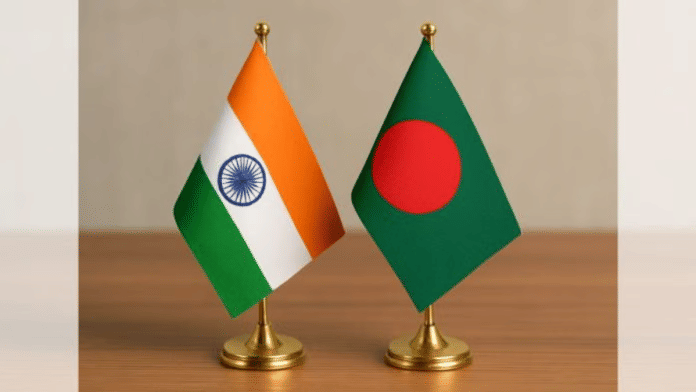


New Delhi: Negotiations over the future of the Ganges Water Treaty has become the newest diplomatic irritant in ties between India and Bangladesh. Dhaka has set up an internal expert committee and sent a request to open discussions surrounding the fate of the 30-year old treaty set to expire this December, ThePrint has learnt.
The request to hold discussions was sent on 8 June by Bangladesh, which has received no response from India, a person familiar with the matter told ThePrint. Government sources maintain that the discussions will occur through the appropriate mechanism—the Joint Rivers Commission—at a time which is mutually convenient for both sides.
Dhaka has undertaken steps to establish an internal committee to engage with New Delhi on various aspects of the sharing of transboundary rivers, given the geographical realities of 2026. The two countries share 54 rivers, and the Ganges Water Treaty signed by Prime Ministers Deve Gowda and Sheikh Hasina on 12 December, 1996, set the stage for bringing an end to the dispute over sharing of waters for a period of 30 years.
The treaty sets a minimum quantum of water to be released at the Farakka Barrage in West Bengal during the first six months of the year (1 January to 31 May) based on a formula and an indicative schedule from assessing the flow of water between 1949 and 1988.
If the availability of water at the Farakka Barrage falls below 70,000 cusecs, both nations get roughly a 50 percent share.
If the amount of water flowing is higher than 75,000 cusecs, India receives around 40,000 cusecs, while the balance flows into Bangladesh, except for a period between 11 March and 10 May.
During this period, both India and Bangladesh are guaranteed 35,000 cusecs of water for three alternating 10-day periods.
The treaty expires this year, but the agreement remains one of the key pillars of the India-Bangladesh relationship. The sense remains within New Delhi that the ministry involved, Jal Shakti, is ready to engage with Dhaka, under the appropriate mechanisms once the two countries can find mutually acceptable dates for the discussions to be held.
“We have several rivers, in fact 54 rivers that are shared between India and Bangladesh, and we have a Joint Rivers Commission, a structured bilateral mechanism to deal with issues pertaining to all the rivers that we share between India and Bangladesh. We will also be looking at these issues as part of our structured bilateral collaboration that we have on the issue of water, on the issue of rivers,” Randhir Jaiswal, official spokesperson for the Ministry of External Affairs (MEA) said at a regular press briefing on 2 June, 2026, when questioned on the renewal of the treaty.
Ties between India and Bangladesh have been strained for the better part of the last two years, since the ouster of former Prime Minister Sheikh Hasina on 5 August, 2024. Hasina fled Dhaka for New Delhi and remains in India.
The interim government (August 2024 to February 2026) led by Nobel Laureate Muhammad Yunus took a more adversarial stance against India, which left a number of pending issues and discussions unresolved.
Prime Minister Tarique Rahman, elected in February of this year, has taken steps to stabilise the relationship between the two countries. While certain high-level exchanges have taken place this year including the visit of Khalilur Rahman, Bangladesh’s foreign minister, to New Delhi in May, a number of irritants and challenges remain.
The fate of the renewal of the Ganges Water Treaty remains one of the more pressing issues between New Delhi and Dhaka. Prime Minister Rahman has been invited to visit New Delhi in September for the BRICS summit in his role as chair of the Bay of Bengal Initiative for Multi-Sectoral Technical and Economic Cooperation (BIMSTEC).
The Bangladeshi Prime Minister is expected to attend the BRICS summit, however, there has been no confirmation communicated to India as yet.
A number of issues remain in cold storage including the resumption of the consular dialogue between the two countries. The dialogue has been pending since Hasina’s tenure and is considered by Dhaka an important avenue to discuss the ongoing issue of illegal immigration.
India has consistently urged Bangladesh to hasten the verification procedure of individuals suspected to be Bangladeshi citizens who crossed the border illegally. More than 2,000 individuals remain in detention in India.
(Edited by Amrtansh Arora)