



When the world’s most influential central bank acted in accordance with widespread expectations, the Dow Jones Industrial Average declined by more than a thousand points. This phenomenon warrants investigation, as it has less to do with interest rates than with crude oil prices, determined eight time zones away, which subtly influence fuel costs and the government’s fiscal capacity.
The US Federal Reserve maintained its benchmark interest rate on Wednesday last week, marking the fifth consecutive hold, at a range of 3.5 per cent to 3.75 per cent. The markets had almost perfectly anticipated this decision. Nevertheless, the Nasdaq Composite Index decreased by 1.7 per cent, and the 30-year Treasury yield reached its highest level since 2007.
When an anticipated outcome results in an unforeseen market reaction, the focus shifts from the decision itself to the underlying rationale.
A decade-old argument, replayed
In 1977, economists Finn Kydland and Edward Prescott, who were later awarded the Nobel Prize, demonstrated that a central bank operating with discretion rather than adhering to a predictable rule tends to yield suboptimal outcomes compared to one that commits to a clear policy path. This issue is known as time inconsistency: a plan that appears optimal initially ceases to be so once individuals adjust their behaviour in response. Thus, credibility is derived from the rule itself rather than from ad hoc decision-making.
When individuals cannot predict the actions of a central bank, this uncertainty becomes embedded in prices, complicating efforts to control inflation.
Kevin Warsh, Chairman of the US Federal Reserve, is currently exploring the opposite approach by removing forward guidance from Federal Reserve statements and advocating that markets should respond to real data rather than attempting to interpret his future actions. During Wednesday’s press conference, he refrained from labelling the decision as a pause, instead describing it as “a rigorous review of the economic situation.”
Markets that are not provided with explicit signals do not passively await data; they construct their own narratives. Three regional presidents, Beth Hammack, Neel Kashkari, and Lorie Logan, dissented in favour of an immediate interest rate hike, marking the first instance since 2016 of a unified multi-member dissent rather than a division across different perspectives.
Dissent had been escalating for months, reaching four voices in April, but was consistently divided between dovish and hawkish positions. July is noteworthy not for the extent of the division. However, for the first time in years, the dissenters agree with one another.
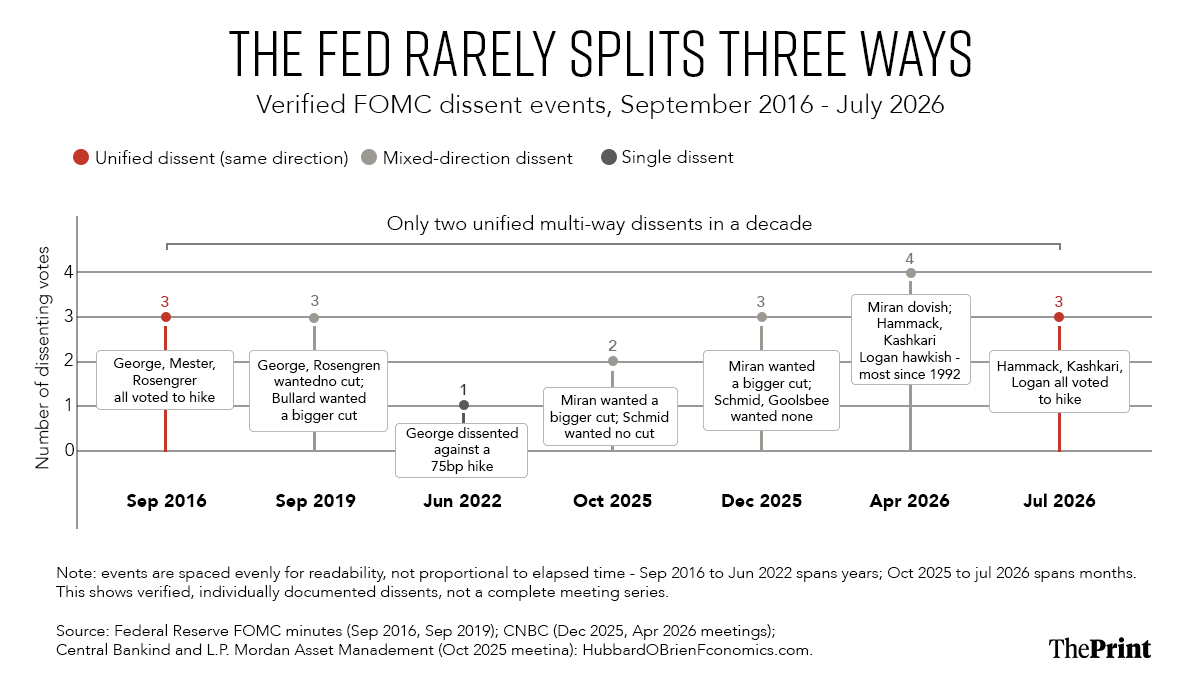
The elimination of guidance does not eliminate uncertainty; rather, it transfers it from the Federal Reserve’s statement to the market’s perception, where it tends to manifest as concern.
Also read: GrapeNet to US tariffs—India can win the export race by making compliance easy
Pricing fear, not barrels
The fluctuations in Brent crude prices have been influenced by factors unrelated to the actual extraction of barrels. The closure of the Strait of Hormuz in February led to a price surge, reaching approximately $117 in April, an increase of nearly $50, despite no reduction in supply.
This scenario exemplifies a war risk premium, in which prices are driven by the potential for disruption rather than by an actual supply deficit. Following the signing of a ceasefire in June, prices decreased almost as rapidly as they had increased, indicating that fear drove most of the price rise rather than market fundamentals.
When the conflict resumed in late July, the premium reemerged, causing Brent prices to exceed $90 by 30 July.
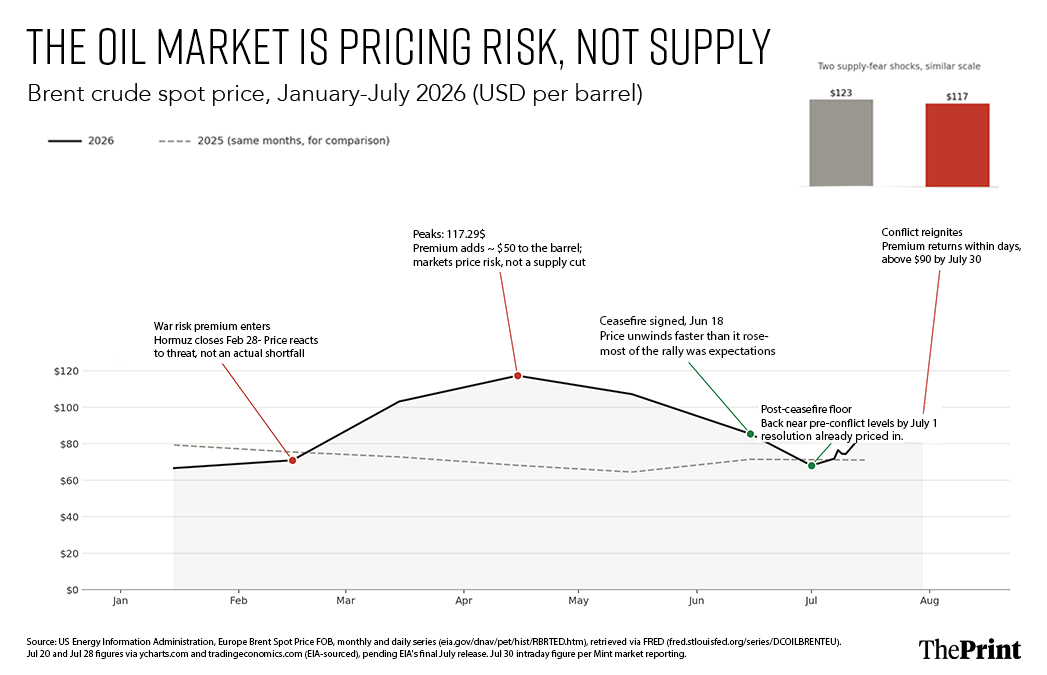
The current peak closely approaches the $123 level reached by Brent crude during the 2022 Russia-Ukraine crisis. Markets have now adjusted sharply due to geopolitical risks on two occasions over the past four years. This recurrence suggests a pattern, which can be anticipated even if specific crises cannot be predicted.
Also read: Why NSE must not be brought under RTI
Rebuilding India’s cushion
This is where the story becomes an India story. Presently, approximately 88.7 per cent of the oil consumed in India is imported, a proportion that has increased annually over the past five years. This statistic is corroborated by the government’s response in the Rajya Sabha.
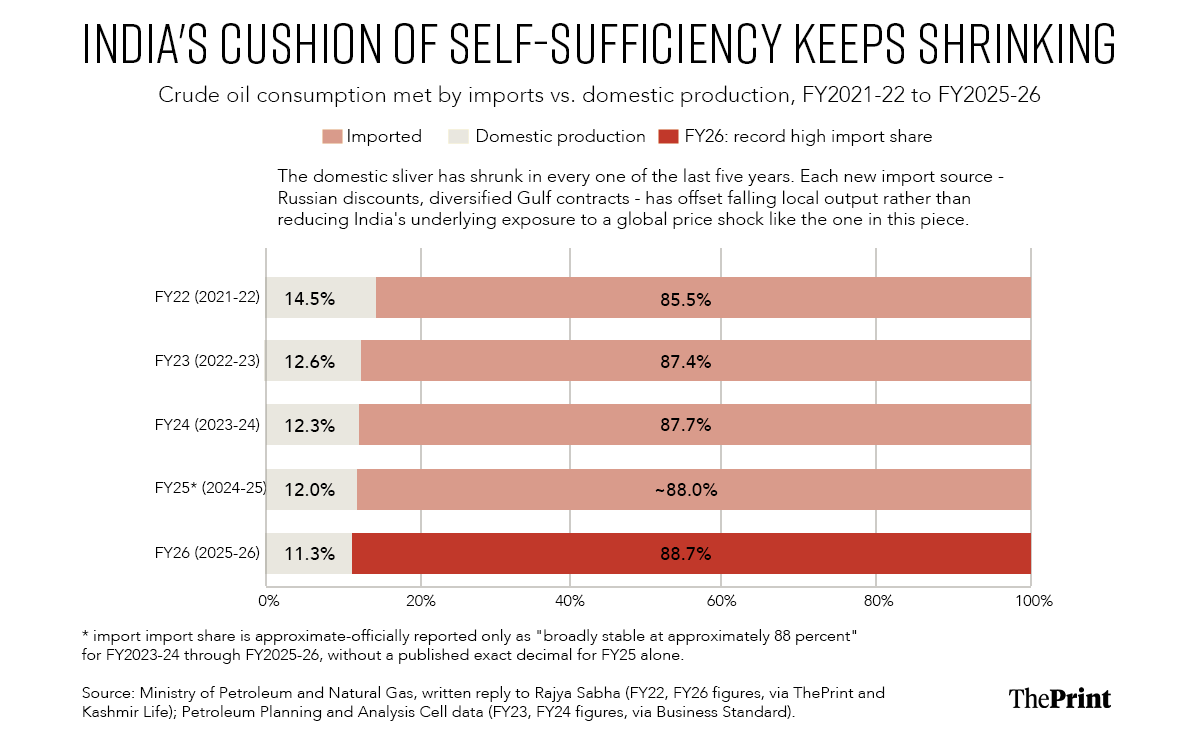
The chart illustrates the consistent annual reduction in the domestic buffer irrespective of the new supplier addressing the shortfall. Although Russian discounts and diversified Gulf contracts have maintained a manageable financial burden, they have not mitigated India’s vulnerability to such shocks. This situation calls for deliberate strategic policy rather than alarm.
First, attention should be directed towards reserves. Commodity economists have long emphasised the importance of maintaining physical inventory, referred to as a convenience yield, which provides an insurance benefit by ensuring availability when needed, independent of price. India’s SPR is intended to hold 9.5 days of net imports but is currently only about 64 per cent full, equating to merely five days of deployable reserves in a crisis.
The government’s more reassuring “74 days” figure is achieved by including ordinary commercial stock required for daily operations by refiners, not emergencies, and assumes full SPR, which is not the case. Prioritising the filling of existing caverns, before considering expansion, is the fastest method to address this shortfall.
Second, ethanol blending has resulted in an estimated saving of Rs 1.9 lakh crore in foreign exchange since 2014, demonstrating the efficacy of substitution. However, the recent public backlash regarding E20’s compatibility with older vehicles highlights the need for careful implementation in the next phase. Integrating this with compressed biogas and the adoption of electric two-wheelers would extend that substitution strategy beyond a single contested fuel blend.
Third, the principle of portfolio diversification, familiar in financial markets, should be applied to crude sourcing. A broader range of long-term, rupee-settled contracts need not replace Gulf or Russian barrels but ensures that no single geopolitical flashpoint, such as Hormuz, can independently influence the market.
While the Federal Reserve can afford to remain silent and let markets speculate, India cannot afford such silence regarding its fuel bill. The critical metric to monitor is not the federal funds rate but the price of a barrel of Brent and the remaining buffer before the next shock occurs.
Bidisha Bhattacharya is ThePrint Consulting Editor (Economics) and an Associate Fellow, Chintan Research Foundation. She tweets @Bidishabh. Views are personal.
(Edited by Saptak Datta)