



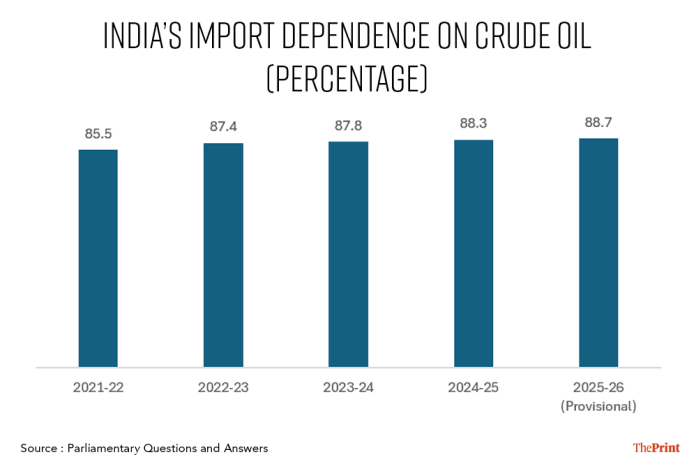
New Delhi: India’s dependence on imported crude oil touched a record 88.7 percent in 2025-26, even as domestic crude oil production continued to decline, the government informed the Rajya Sabha on Monday.
In a written reply to a question by Trinamool Congress MP Derek O’Brien, Minister of State for Petroleum and Natural Gas Suresh Gopi said India’s import dependence has steadily increased over the last five years from 85.5 percent in 2021-22 to 88.7 percent in 2025-26 (provisional).
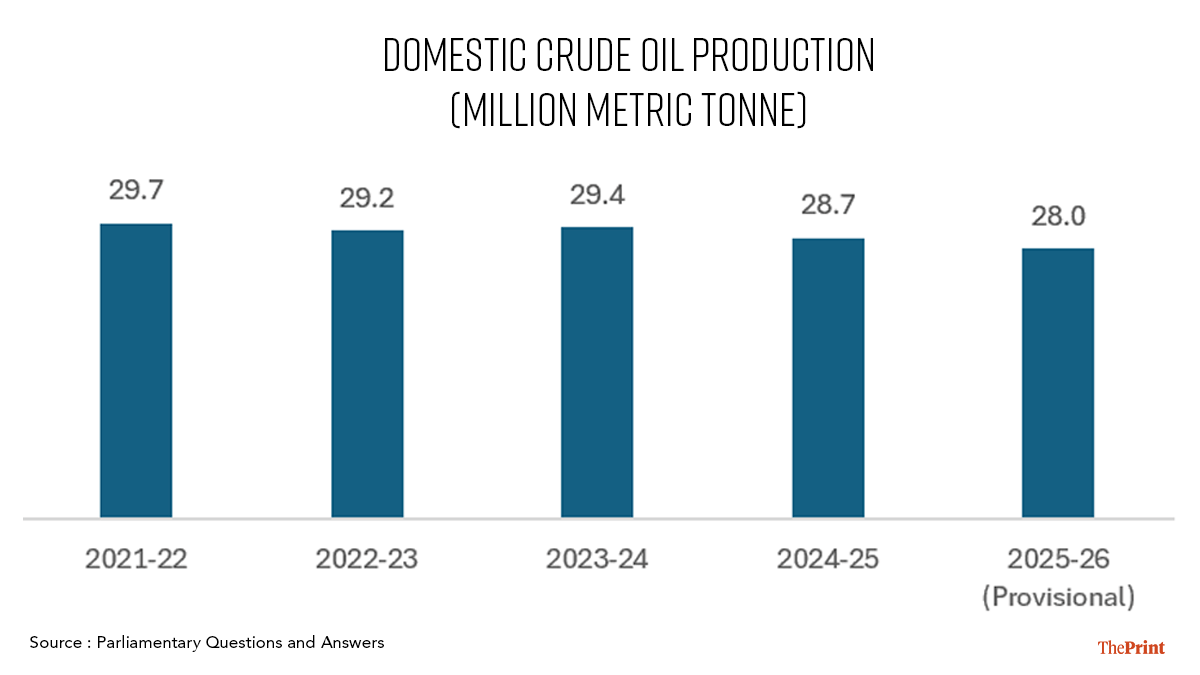
During the same period, domestic crude oil production fell from 29.7 million metric tonnes (MMT) to 28.0 MMT.
Explaining the decline in crude production, the minister stated in the reply, “Production of crude oil over the last five years has shown a slight decline in trend primarily owing to natural decline in mature and ageing oil and gas fields.”
However, production data for natural gas production showed a mixed trend. The net domestic production grew from 33,131 million standard cubic metres (MMSCM) in 2021-22 to 34,326 MMSCM in 2025-26, after peaking at 35,717 MMSCM in 2023-24.
The reply also added that state-run producers Oil and Natural Gas Corporation (ONGC) and Oil India Ltd (OIL) have largely managed to sustain production despite the ageing fields. ONGC has maintained average annual production of around 19.6 MMT, while OIL increased its production from 2.94 MMT to 3.44 MMT.
The government also said the annual decline rate in production from these mature fields has been contained at around 2 percent since 2014-15, compared to the global average decline rate of 6 percent for mature fields, citing the International Energy Agency (IEA).
The ministry also listed several factors that continue to affect domestic oil production, including increasing water production in aging wells, sand ingress, limited reservoir pressure and subsurface geological complexities that reduce the effectiveness of drilling and workover operations.
On the policy front, the government said it has introduced a series of reforms to encourage exploration and production. These include the Oilfields (Regulation and Development) Amendment Act, removal of restrictions on offshore exploration areas, transition to a revenue-sharing regime, large-scale seismic data acquisition and increased drilling activity.
The government said ‘various policy decisions and operational measures’ have been taken to boost domestic crude oil and natural gas production and reduce dependence on imports, with the objective of strengthening India’s energy security.
(Edited by Vidhi Bhutra)