





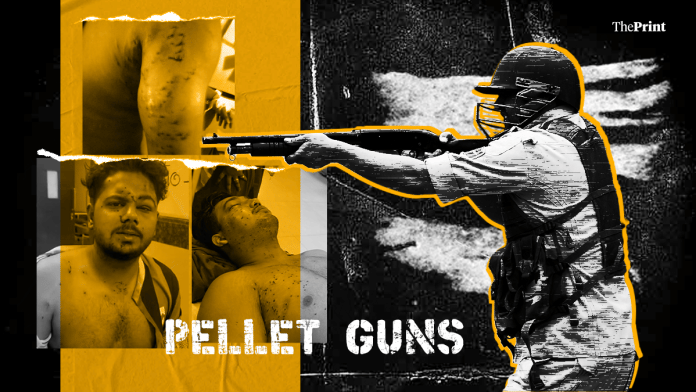

New Delhi: Fifteen years before student demonstrators faced pellet guns in New Delhi, an expert group formed by the Ministry of Home Affairs had warned that the so-called less-lethal ordnance being used by central and state police forces against rioters “were found to be causing lethal effects and therefore need urgent replacement with better and modern kinetic energy munitions”.
The expert group’s report recorded that birdshot pellets “might cause serious injury if they strike areas like the eyes and head”. The recommendations have lurched from committee to committee, however, with little on-ground implementation.
Although Prime Minister Manmohan Singh publicly committed to acquire less-lethal riot control technologies in the wake of the killing of at least 117 demonstrators—some by pellet injuries—in street battles with police in Kashmir through 2010, there was little urgency shown for reform, a senior police officer involved in the Bureau of Police Research and Development (BPR&D) research told ThePrint.
Following the Prime Minister’s speech, the BPR&D assembled a task force to recommend standard responses to riots, chaired by the Union Home Secretary, and with members which included the Director of the Intelligence Bureau and several high-ranking state government officials.
The Task Force report, submitted in February 2011, recommended retaining colonial-era regulations which permit police to use force even against protesters who are not using violence. The Task Force, though, also ordered that lethal weapons could only be used once non-lethal weapons had failed. The non-lethal weapons listed did not include birdshot-firing shotguns.
Later that year, the BPR&D, working with the Orkash Services, conducted a thoroughgoing survey of ‘less-lethal’ weaponry. The BPR&D circulated the study in 2013, after field-testing equipment at central police facilities in Bhondsi and Kadarpur, on the outskirts of New Delhi. “The violence in Kashmir had kind of tapered off, so there was no political push to acquire non-lethal equipment on a priority basis,” the senior police officer said.
The issue resurfaced in 2016, though, after another 85 people were killed in street violence, and several permanently blinded by birdshot. This time, then-Home Minister Rajnath Singh formed another committee to suggest options to birdshot fired from modified .303 rifles and pump-action shotguns. The committee’s recommendations—in essence, reiterating the options the 2012 report had listed.
Attorney General Mukul Rohatgi told the Supreme Court that no technology had been found that could replace the pellet gun, but that the government was developing a “secret weapon which could disperse crowds”.
Few states invested in the weapons recommended by the 2016 committee, a retired officer then involved with policing-related issues in Ministry of Home Affairs told ThePrint. The Rajya Sabha Standing Committee of Home Affairs recommended enhancing acquisitions of non-lethal weapons in 2021, only to be informed that it was not possible because of the “limited capacity of manufacturing within the country”.
The less-lethal illusion
Embarrassed by international and domestic criticism of the large number of deaths in the 2010 riots, Prime Minister Singh had told police chiefs “to revisit standard operating procedures and crowd control measures to deal with public agitations with non-lethal, yet effective and more focused measures”.
Apart from the 2011 BPR&D study, research conducted by the senior Punjab Police officer Rohit Choudhary also called for new riot-control tactics based on global best-practices, which emphasise negotiation and restraint over force.
Following the 2010 violence, police forces in Kashmir had turned to the birdshot-firing shotgun—a colonial-era weapon widely used by Imperial Britain for crowd control—in an effort to reduce deaths caused by bullets and rubber bullets. The riot-control guns used by police in India are direct descendants of the Greeners Police Gun, which fired a unique bottle-necked 12-bore cartridge.
British colonial manuals called for the gun to be deployed at ranges of 15 to 50 metres, less than which it could cause fatal injuries. The lathi, or cane baton, was being used at distances less than 15 metres.
Legal norms, historian Simeon Shoul has written, called on police to execute a lathi-charge when a crowd failed to disperse, and then fire buckshot. Failing this, the military would be called in to open lethal fire, using rifles, machine guns, and in some cases, air power.
Events in 2016 made clear the use of shotgun pellets made things worse, not better. That year, high levels of fatalities and blindings provoked deep public outrage, leading many young people to join protests against the government.
The BPR&D committee found that dedicated anti-riot units, like the CRPF’s Rapid Action Force, had far more lethal munitions than alternatives. Each of four companies of 120 personnel posted in Hyderabad, for example, had 24 7.62mm rifles, with 960 rounds of ammunition, as well as eight 9mm pistols, with 80 rounds of ammunition. Each company also had substantial stocks of rubber bullets and plastic birdshot shells.
Lacking training in controlling crowds without lethal means, the BPR&D found, put police in harms way—and likely led them to open fire. In one embarrassing instance, documented the report, an Indian police unit on a United Nations mission in Kosovo had to beg determined rioters not to hurt them, and was eventually rescued by a German team.
Tried, not tested
The BPR&D committee had conducted field tests with a variety of equipment it believed could be introduced into the arsenal of riot-control forces. SRG Group, a leading vendor of equipment to police forces, demonstrated rapid-firing plastic spheres which broke on impact, releasing a chemical irritant on target. There were also rubber balls fired with a pneumatic launcher, fired at speeds below the thresholds to cause serious injury. Tests were also conducted of better protective equipment for police, and shields which set off a non-lethal electric arc when touched by protesters.
Even though some police forces had begun using plastic and rubber bullets in an effort to reduce lethal impact, the BPR&D discovered that they could penetrate 75 inch thick plywood board at 100 metres—suggesting they were almost certain to kill or inflict serious injuries at those distances.
Little less-lethal equipment was available to these forces, though, other than tear gas—a blunt tool that often ended up blinding the police, which had few gas masks available. To make things worse, tear gas shells were often in short supply.
Field commanders the BPR&D investigators spoke to in Kashmir and Manipur found birdshot pellets ineffective when fired properly—that is, targeting the lower extremities of protesters—but too dangerous to eyes and vital organs if aimed higher. Even worse, the investigators found riot-control police in cities like Mumbai received inadequate training, and had no less-lethal tools on hand.
Among the most serious failures the BPR&D report pointed to was the inability to prosecute rioters. Even though technologies like closed circuit television and indelible dyes that could mark rioters were easily available, police remained loath to invest time and resources in taking cases to court, it said. This emboldened offenders and created a culture of impunity.
(Edited by Viny Mishra)
No mention about the 200 policemen who went home with cracked skulls and stitches on July 20. Somehow stone pelters have all leeway and latitude, and rights, to use big sharp stones as lethal projectiles while the baton wielding police waala is obligatorily implied to take the hit.
Why do you resort to half-baked coverages?