



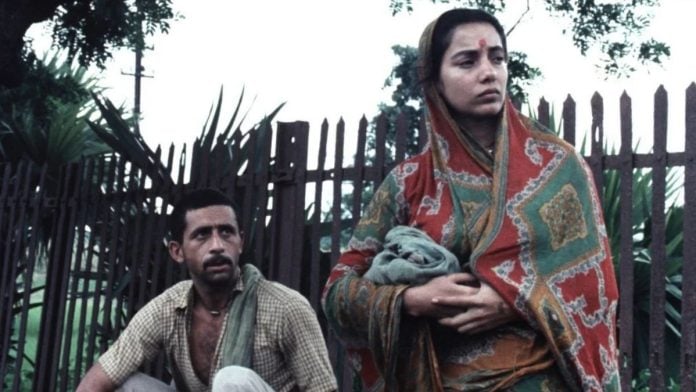
Bollywood in the 1980s was a mix of themes, from Govind Nihalani’s Ardh Satya (1983) to Umrao Jaan (1981) and Jaane Bhi Do Yaaro (1983). The decade was full of movies that contrasted with each other in every manner, from storytelling to cinematography. But in this period, Goutam Ghose’s Paar (1984) stood apart. Based on Samaresh Basu’s Bengali short story Paari, the film explores the lives of Dalit labourers in Bihar and shows what happens when they dare to raise their voices against oppression.
Paar follows Naurangia played by Naseeruddin Shah and his pregnant wife, Rama played by Shabana Azmi, who are forced to flee their village after a massacre triggered by villagers fighting for Dalit rights. Their struggle takes them from rural Bihar to the outskirts of Calcutta, where poverty, hunger and the absence of a support system leave them with few choices.
One of the film’s most haunting scenes is when Naurangia and Rama are forced to drive a herd of pigs across an overflowing river for money, in a desperate attempt to survive and find their way home.
For playing Naurangia, Shah won the Volpi Cup for Best Actor at the Venice Film Festival, becoming the only Indian actor to have received the award. In an interview with Sight and Sound, the British Film Institute’s magazine, Shah spoke about preparing for the character. He said he had to evoke the muscle memory of digging a hole in the ground to let water pass through and study the physique and body language of people who lived such lives.
“I had to look like a man who had not eaten anything but puffed rice and sugarless tea for years,” he said.
Also read: Want Lakshmi’s blessings this Diwali? Don’t kill her ride, the owl
Brutal realities that persist even four decades later
While the film’s characters are fictional, Paar captures the brutal realities of caste oppression, landlessness, exploitation and a system that often sides with the powerful. More than four decades later, the film has aged remarkably well.
What makes Paar unsettling is that it does not offer an easy resolution or turn its characters into revolutionaries and heroes. Naurangia and Rama were forced to endure indignity after indignity simply to stay alive.
In doing so, Ghose created a film that reminds us how little has changed for those at the margins of society, even after four decades. Every frame resembles a photograph, capturing people and their surroundings without distorting reality. Despite the film’s modest scale, the film has a visual richness associated with big-budget cinema.
This approach reflects Ghose’s experience in documentary filmmaking and his work as a photojournalist, which shaped his ability to capture reality with striking detail. His work also earned him international recognition. In 1997, Ghose became the only Indian director to win the Vittorio De Sica Award in Italy. He was later awarded the Knighthood of the Order of the Star of Italian Solidarity in July 2006, for his contributions to cinema.
While Naurangia and Rama struggle to survive, another character in the film, Ram Naresh, a Dalit labourer played by Om Puri, wins the panchayat election and becomes a symbol of hope for the villagers. With the support of the schoolmaster played by Anil Chatterjee, he challenges a system in which the upper caste landlords have controlled the village for generations. The schoolmaster believes that independence should mean something for the poorest too, and encourages the labourers to demand the minimum wages they are entitled by the government.
But this changing India is not something landlords are willing to accept. Bhola Singh, a powerful landlord played by Utpal Dutt, and his younger brother Hari Singh played by Mohan Agashe, see these demands as a threat to their authority. When the schoolmaster tries to negotiate on behalf of the labourers, Hari mocks him and later threatens him. The schoolmaster is eventually killed in what the police dismiss as an accident.
With justice denied, Naurangia and his fellow labourers decide to take matters into their own hands and kill Hari Singh. The landlords’ retaliation is brutal, their men set fire to the village and massacre its residents.
The film won several awards, including the National Film Award for Best Feature Film in 1985, along with National Film Awards for Best Actor and Best Actress. It also received a UNESCO award at the Venice Film Festival.
The tragedy is that a fight for basic rights ends with the very people demanding them pay the heaviest price. Ram Naresh’s election victory offers a glimpse of change, but the schoolmaster’s death and the massacre show how easily that hope is crushed when those in power refuse to give up control.
(Edited by Janaki Pande)