





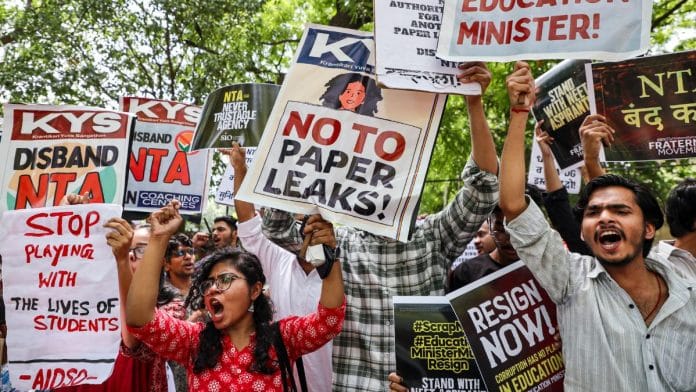


New Delhi: Twenty-six Central Bureau of Investigation (CBI) cases related to malpractices in admission and job-related examinations, including paper leaks, are languishing in Delhi courts for the last 23 years without a single one proceeding to trial, ThePrint has learnt.
Filed only months ago, the NEET-UG 2026 paper leak case will, however, be the first such case in two decades to be tried before the special court set up in the wake of nationwide outrage. Sources in the agency said charges will be framed once the special court takes cognisance of the CBI chargesheet, the essential step for the trial to commence. The CBI has filed chargesheets in all 26 pending cases, and will then seek their transfer to the special court for expeditious disposal, multiple sources have confirmed.
“There was a need for such a court as many of these cases are languishing in court. This is a good beginning. After the 2026 NEET leak case goes on trial, we will push for these cases to also be tried in the fast-track court,” a source in the agency said.
The 26 pending cases include alleged irregularities in the All India Institute of Medical Sciences (AIIMS) Post-Graduate (PG) Entrance Examination (2010 and 2011), the All India Pre-Veterinary Test (2011), the Graduate Level Combined Competitive Examination (2013), the Birla Institute of Technology and Science, Pilani entrance examination (2019) and the Joint Entrance Examination (2021). The oldest among them pertains to the Common Admission Test examination of 2003, which, like the others, is yet to reach trial.
Speaking to ThePrint, one source said that not all of the 26 pending CBI cases pertain to paper leaks. Instead, they cover a wider spectrum of examination malpractices, including admission fraud, answer-sheet tampering, result manipulation and job recruitment scams.
“For instance, the AIIMS PG Entrance Examination 2010 case pertained to an alleged admission racket involving the rigging of answer sheets and examination results. Similarly, several other cases involve manipulation of results, while in some—such as the CAT 2003 case—the question paper itself was leaked,” the source said.
The Delhi High court has designated one special court to exclusively hear offences under the Public Examinations (Prevention of Unfair Means) Act, 2024, and the Bombay High Court issued notifications designating special fast-track courts across Maharashtra’s judicial districts for offences under the Act.
‘The challenge’
The recent amendment to the Public Examinations (Prevention of Unfair Means) Act, 2024 aims to fast-track investigations and trials in exam paper leak cases through special courts, but comes with a significant limitation.
Cases involving alleged leaks that occurred before the law came into force cannot be tried under its provisions, meaning the ongoing NEET-UG 2026 paper leak is likely to be the first—and currently the only—case that can be prosecuted in the designated special court, sources said.
A legal expert explained that the Act does not contain any provision allowing older cases registered under either the Indian Penal Code (IPC) or the Bharatiya Nyaya Sanhita (BNS) to be transferred to these courts.
“In the absence of such a clause, previous paper leak cases will continue in regular courts, defeating the very purpose of creating special courts for speedy trials,” a legal expert said. “Moreover, these older cases are registered under either IPC or BNS, not under this new law so they will not come to these fast-track courts,” the expert said.
A second CBI officer, however, said the transfer of these older cases to the special court could be effected through an administrative notification issued by the high court. “To say that these older cases cannot be tried by the special court may be technically correct, but not necessarily in practice. There is nothing preventing the high court from transferring these cases to the fast-track court set up for examination malpractice cases. It is an administrative exercise and can be done,” the officer said.
A second legal expert, however, disagreed, saying such a move would require a legislative amendment. “The law would have to be amended to expressly provide that cases registered before the amendments came into force can also be tried by the designated special courts. Once that legal position is settled, the pending cases can be transferred,” the expert said.
(Edited by Nardeep Singh Dahiya)