







New Delhi: Typically, it’s investigators who ask suspects to take lie detector tests. But in an unusual twist, three accused in the NEET paper leak case have asked a CBI court to allow them to voluntarily undergo lie detector and brain-mapping tests to “facilitate the discovery of truth”.
The accused—Dinesh Biwal, Mangilal Biwal and his son, Vikas Biwal—filed the plea before the special CBI court in Delhi on Tuesday. ThePrint has a copy of the plea filed by their counsel, A.P. Singh.
The agency arrested all three from Rajasthan in May after it took over the probe into the question paper leak allegations. They have been in judicial custody since then.
Why did the three men choose to take such a dramatically different legal path?
Singh answered with a famous Hindi proverb, “Saanch ko aanch kya”, which translates to “The truth has nothing to fear”.
“We have always maintained that we were not involved in any malpractices and hence we are ready to cooperate with the probe to bring the facts to light,” Singh told ThePrint.
“We also agreed to provide voice samples earlier, and we are committed to cooperate with the probe to bring the entire facts into the public domain.”
Will the plea hold up in court? No, said lawyers.
Advocate Vijay Aggarwal dismissed it as a joke, saying it was a “laughable tactic” without any legal backing.
“The move has no legal validity. It won’t harm their case if they fail, and neither will they be on a stronger footing if they pass,” Aggarwal told ThePrint. “This is just playing to the gallery and a bid to draw media attention.”
The plea says that granting permission would neither prejudice the rights of the prosecution nor limit the rights of the respondents.
Instead, it would “facilitate the discovery of truth through lawful means while preserving the dignity, liberty and constitutional protections available to every individual”.
Paper trail
ThePrint earlier reported that Vikas Biwal came into contact with a Gurugram-based career counsellor, Yash Yadav, at a coaching in Sikar where Yadav promised to arrange question papers for the NEET-UG this year, which took place on 3 May.
Based on intelligence inputs from central agencies, the Rajasthan Special Operations Group (SOG) detained the Biwals for questioning and allegedly found that the family had three candidates for the exam. Apart from Vikas, two other candidates had also appeared in the examination.
According to the SOG’s preliminary probe, Dinesh Biwal procured the question paper for Rs 15 lakh from the Gurugram-based career counsellor, who had allegedly procured it from the main accused, Shubham Khairnar.
“Dinesh had procured question papers even last year from Yadav, and all four of the candidates from his family qualified,” a source told ThePrint earlier.
This year, Dinesh Biwal allegedly procured the questions on 29 April—four days before the scheduled NEET exam. Yadav sold the same paper to several individuals suspected to be residents of Bihar and Jammu and Kashmir, the sources said.
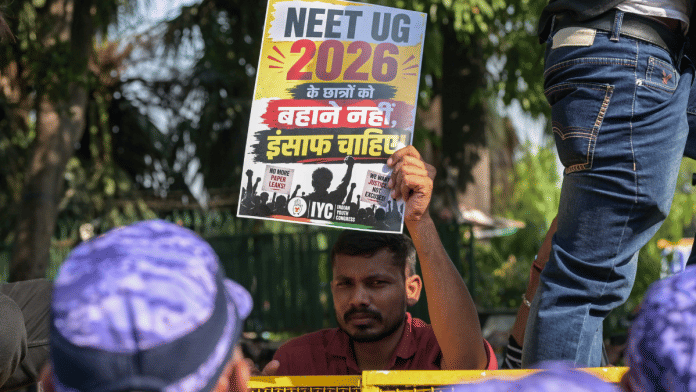
The NEET issue became a flashpoint across the country, sparking protests by thousands of students in the national capital and other cities, culminating in Education Minister Dharmendra Pradhan’s resignation.
Last week, the CBI filed a chargesheet against 13 arrested accused, including the three who filed the plea Tuesday.
The agency has also identified three subject experts on the National Testing Agency (NTA) panel – P.V. Kulkarni, Manisha Havaldar and Manisha Mandhare — as the main source of the leak of the question papers.
Kulkarni has been identified as the principal architect of the leak, as he had been on the NTA panel since 2019 and allegedly had access to full question papers in his capacity as a translator of question papers from English to Marathi.
Havaldar was on the NTA panel as an expert in Physics, while Mandhare was on the panel as an expert in Botany.
The CBI identified another businesswoman from Pune, Manisha Waghmare, as the key connecting link between subject experts on the NTA panel and beneficiaries of the paper leaks in Maharashtra and Rajasthan.
(Edited by Sugita Katyal)
Also Read: The pressure cooker life of a 16-year-old Indian student