






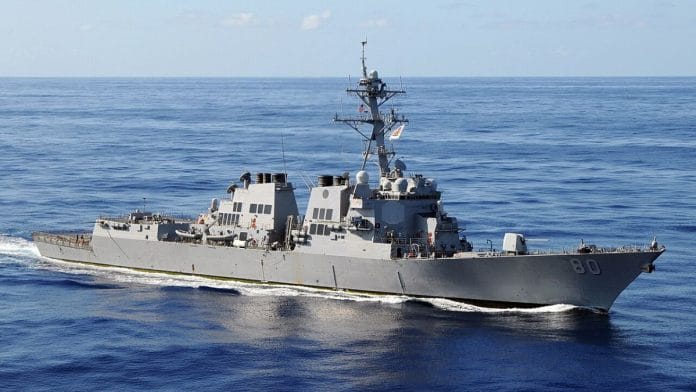

Deep in Xinjiang’s Taklamakan Desert, a full-scale replica of a US Navy destroyer sits where no warship has ever sailed. It is surrounded by sand rather than the Pacific Ocean. Satellite imagery has revealed what appears to be a full-scale model of an Arleigh Burke-class destroyer, one of the US Navy’s most important surface combatants.
Thousands of kilometres from the sea, the replica, built with exact dimensions, forms part of a broader effort to study one of the hardest problems in modern warfare—finding, tracking, and engaging a heavily defended naval target.
Chinese military commentary presents the replica as a way of testing the broader kill chain: whether China’s surveillance, tracking, and strike systems can operate together against a US naval platform protected by advanced sensors and defensive capabilities.
As one Chinese commentary put it, “This is not a target; it is a replica of the enemy’s main fleet in the desert.”
Built to test a harder problem
Chinese military discussions surrounding the desert replica focus on a challenge that goes beyond simply building a target. Earlier mock-ups could reproduce the outline of a warship, but Chinese analysts argue that modern naval platforms are far more difficult to replicate. They are moving targets, with distinct radar signatures, advanced sensors, electronic warfare capabilities, and layered defences.
Therefore, the structure includes radar-related features and launch-position markings, while its track system allows it to simulate a vessel moving at sea.
Chinese military writings also emphasise that realism extends beyond movement. Some accounts describe radar-reflective and electromagnetic features designed to recreate aspects of the maritime environment, allowing missile seekers and targeting systems to be tested under conditions closer to a real engagement.
The choice of an Arleigh Burke-class destroyer is also significant. Chinese military analyst Zhang Shuai argues that the class represents a particularly demanding target because these ships are central to the US Navy’s carrier strike groups, providing air and missile defence as well as anti-submarine warfare capabilities. Compared with the larger aircraft carrier replicas China has previously built, a destroyer presents a different challenge because of its smaller size, mobility, and advanced defensive systems.
This focus points to a broader theme in Chinese military discourse: the objective is not necessarily to sink a ship but to reduce its ability to fight. Disabling a destroyer’s SPY radar, vertical launch systems, or fire-control capabilities could weaken its role within the carrier strike group’s defensive network.
Chinese writings also emphasise the importance of linking reconnaissance and firepower, from satellites and surveillance systems to radars, intelligence networks, and missiles. Some analyses argue that large numbers of long-range anti-ship ballistic missiles could pose a serious challenge to carrier strike groups and their escorts, although such assessments depend on assumptions about intelligence, missile performance, and defensive responses.
Calling it a new landmark, a Zhihu post described these high-fidelity targets as providing a more realistic environment for practising reconnaissance and tracking, linking them to coordination between China’s reconnaissance assets and missile forces, including the Dongfeng missile family.
Also read: What PM Modi’s three-nation tour tells about India’s changing Indo-Pacific policy
More than a replica?
Chinese discussions surrounding these installations suggest they are more than simple replicas. They are presented as increasingly sophisticated test environments designed to help the People’s Liberation Army (PLA) study how to find, track, and engage an adversary under conditions that more closely resemble real combat. Publicly available imagery suggests the desert ranges have evolved from simple ship outlines into increasingly sophisticated multi-dimensional structures with moving platforms and features intended to recreate some of the challenges of operating against modern naval forces.
A prominent view within China is that Beijing is hardly alone in building military replicas. The US and other major powers have long constructed mock-ups of foreign ships, aircraft, and missile systems to test weapons, refine tactics, and prepare for conflicts they hope never to fight.
But the debate surrounding China’s replicas has moved beyond whether China copies. The more important question is what happens after the copy is built. For decades, China’s ability to reproduce everything from buildings and consumer goods to advanced technologies has been dismissed as imitation and cheap copies. Military replicas reveal a more consequential dimension where replication is seen as a tool of experimentation, adaptation, and preparation.
For China, a replica is turning into a laboratory where the PLA studies an adversary’s systems, tests its own capabilities, exposes vulnerabilities, and rehearses the sequence of actions required before a conflict begins.
The destroyer in the Taklamakan Desert is, therefore, significant because it represents a method of turning observation into operational knowledge. By recreating what it may one day have to confront, China is attempting to reduce uncertainty on the battlefield before the first shot is fired.
Sana Hashmi, PhD, is a fellow at the Taiwan-Asia Exchange Foundation. She tweets @sanahashmi1. Views are personal.
(Edited by Saptak Datta)