





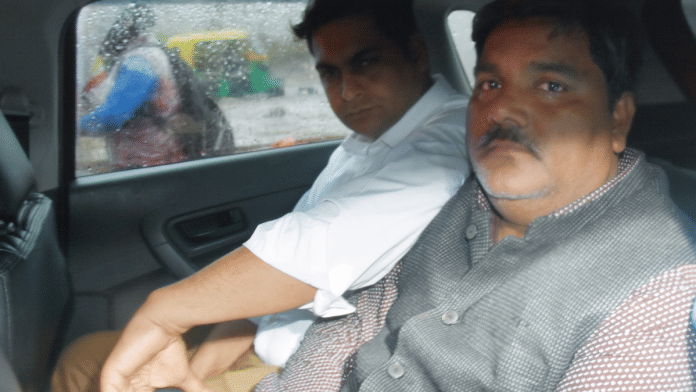


New Delhi: More than six years after Intelligence Bureau (IB) officer Ankit Sharma was killed during the northeast Delhi riots, a court here convicted former AAP councillor Tahir Hussain and four others, holding the prosecution independently established Hussain’s guilt beyond reasonable doubt despite shortcomings in the investigation and questions surrounding the FIR.
In a detailed 320-page order on Monday, Additional Sessions Judge Praveen Singh repeatedly underscored one principle that runs through criminal trials: procedural defects, however serious, cannot by themselves erase otherwise credible evidence.
The court said Hussain’s defence had highlighted several discrepancies in the investigation, but failed to show how any of them either prejudiced him or rendered the prosecution’s evidence unreliable.
One of the main challenges to the prosecution’s case by Tahir was that the FIR was filed at a later stage, and was possibly fabricated or “deliberately delayed”.
Rejecting this, the court said, “Even if an FIR is found to be fabricated, ante-dated or deliberately delayed, such a circumstance merely casts a greater responsibility upon the Court to scrutinise the evidence with greater care and circumspection”.
Independent of the FIR, if the prosecution succeeds in proving its case beyond reasonable doubt through reliable evidence, such defects cannot be regarded as fatal to the prosecution, the court said.
The court convicted Hussain under provisions relating to murder, rioting, rioting with deadly weapons, promoting enmity, assault and criminal force.
The other co-accused who were convicted included Haseen alias Mullaji alias Salman, Kasim, Sameer Khan and Shoaib Alam alias Bobby. Six others were acquitted by the court.
Also Read: Delhi riots conspiracy case trial is caught in a loop—500+ dates, 160+ adjournments and counting
Origins of the case
The case arose from an FIR registered at the Dayalpur police station on the complaint of Ankit Sharma’s father Ravinder Kumar.
According to the complaint, Sharma, an Intelligence Bureau officer, returned home from work on 25 February 2020, before stepping out again as violence engulfed northeast Delhi during protests and counter-protests by those supporting and opposing the Citizenship (Amendment) Act.
When he failed to return, his family began searching for him. The following day, locals informed them that his body had been spotted in the Khajuri Khas drain near Chand Bagh Pulia. It was later recovered from the drain.
The victim’s father alleged that Ankit had been murdered by Hussain and others who had gathered at the then AAP councillor’s office before disposing of the body. Hussain was later suspended by the AAP, and in March 2023, charges were framed against him and 10 others.
Hussain had argued that the investigation deliberately remained inactive until 6 March 2020 so they could fabricate evidence, tutor witnesses and build a false prosecution case.
One of Hussain’s principal arguments was that the FIR was registered much later than claimed by the prosecution and was deliberately shown to have been registered on 26 February 2020.
According to Hussain, had the FIR already been registered by the time the post-mortem was conducted, the relevant documents would have carried the FIR number instead of only the daily diary entry number. Hussain also argued that Section 157 of the CrPC, which requires prompt reporting and investigation of cognisable offences, had not been complied with.
Although the early registration of an FIR is intended to minimise the possibility of false cases or improvements in the prosecution story, the law is equally clear that delay or irregularity does not automatically vitiate an investigation, the court ruled.
Even if the FIR was registered at a later date, the court made clear that no benefit can accrue to the accused “unless it is further established that such irregularity caused serious prejudice to him or resulted in a miscarriage of justice”.
In the present case, the accused has failed to establish any such prejudice, the court noted.
‘Animus against Hindus’
The court convicted Hussain for three main reasons: eyewitness and circumstantial evidence consistently placed Hussain as part of the unlawful assembly at Chand Bagh Pulia during the violence, none of the issues raised by Tahir disproved the evidence led during trial, and the several defence theories were unsupported by evidence.
Although one key prosecution witness attempted to dilute his testimony during trial, the judge concluded that the witness had been “won over” and instead relied upon his earlier statement recorded before a magistrate under Section 164 of the Code of Criminal Procedure.
After examining the evidence and the witnesses in this case, the court noted that the prosecution had “successfully proved beyond all reasonable doubt” that at the time of the incident, around 5.00 p.m on February 25, 2020, Tahir was a member of a large crowd and unlawful assembly which, “with animus against Hindus, had assembled at Chand Bagh Pulia with a common object to commit rioting, loot, arson and to cause damage to the property and person of the members of the Hindu community”.
The court added that the members of this unlawful assembly knew that it was likely that in pursuance of the objectives of this assembly, death could happen and “someone could be killed”.
Tahir had also argued that there were several procedural flaws, such as a back-dated FIR , and the father’s original complaint was altered. He also said that the investigation was delayed, and there were discrepancies in the recovery of the body, but none of those issues, by themselves, disproved the evidence led during trial.
The argument that the father’s original complaint was changed stemmed from an earlier daily diary entry in which Kumar had allegedly stated that he did not suspect anyone. However, the complaint forming the basis of the FIR specifically alleged that Hussain and those assembled in his office had murdered Sharma.
However, the court noted that the victim’s father had testified that the night before his son’s body was recovered, he accompanied police officers to Tahir Hussain’s residence while searching for Ankit Sharma. However, neither Sharma nor his body was found there.
According to the court, this clearly established “that even before the recovery of the dead body, suspicion had already arisen regarding the involvement of accused Tahir Hussain, which explains why his premises were searched on the very day Ankit Sharma went missing”.
The court also noted that the investigating officer accused of manipulating the complaint had conducted virtually no investigation before the case was transferred to the Crime Branch. The new investigating officer, meanwhile, did not immediately arrest Hussain merely because his name appeared in the FIR.
These circumstances, the court said, undermined the suggestion that the FIR had been fabricated solely to implicate Hussain.
Finally, the court found that several defence theories, including the claim that the body recovered from the drain was not Ankit Sharma’s, were unsupported by evidence and appeared to be attempts to create doubt rather than establish it.
The court also rejected Hussain’s argument about the delayed investigation in his case, while adding that mere inaction could not automatically lead to the conclusion that investigators deliberately delayed the probe to manufacture evidence.
“Such an inference cannot be drawn merely on the basis of inaction unless it is further demonstrated, from the material available on record, that the intervening period was in fact utilized to create false evidence, tutor witnesses, or record statements tailored to a preconceived prosecution narrative,” the court said.
Hussain’s lawyers also claimed that the body recovered from the drain was not Ankit Sharma’s. To support this, they pointed to the absence of a mortuary ticket, and the fact that no family member was present when the body initially reached the hospital and a forensic report showing DNA from another unidentified individual on the blood recovered from a plastic sheet at the spot.
Rejecting this argument as well, the court said that Sharma’s body had been identified by his father and the medical and forensic evidence consistently established the chain of custody from the drain to the GTB Hospital.
As for the DNA report, the court said it merely established that blood belonging to two individuals was present at the scene.
“How would it lead to the conclusion that there was a second body recovered from that place is beyond my comprehension,” the court remarked, describing the argument as an attempt to confuse the court.
(Edited by Ajeet Tiwari)
Also Read: IB staffer Ankit Sharma, killed in Delhi riots, was stabbed 12 times & had 33 blunt injuries