






New Delhi: There is still no specific medicine to treat dengue, the Aedes mosquito-borne viral infection that causes fever, headache, muscle and joint pain and, in some patients, can progress to bleeding, shock, organ failure and death.
Now, a World Health Organization (WHO) analysis of the global dengue drug pipeline, published this month in The Lancet Microbe, has identified six candidates with evidence supporting further development, although only one of the six has reached Phase 3 trials.
Researchers searched the WHO International Clinical Trials Registry Platform (ICTRP), which brings together trial information from 20 registries across all six WHO regions.
The search retrieved 182 dengue clinical-trial records registered between 2005 and 2025. Of these, 74 had been last updated in 2024 or 2025. Researchers then identified 21 of these 74 records, involving 15 medicinal products being investigated for dengue treatment, for a detailed review, including assessment of available efficacy evidence.
Dengue is caused by four virus serotypes and transmitted by Aedes mosquitoes. It is endemic in more than 100 countries, with nearly half the world’s population in tropical and subtropical regions at risk.
Most infections are not severe, but some patients develop severe dengue. A subsequent infection with a different serotype can carry a higher risk of severe disease.
The WHO reported a sharp global rise in dengue in 2023, with more than 5 million cases and over 5,000 deaths across 80+ countries and territories. About 80 percent of reported cases were in the Americas. The WHO attributed the spread to factors including climate change, expanding Aedes mosquito ranges, urbanisation and population movement, and assessed the global risk as high.
In 2023, the WHO declared dengue its highest grade of emergency after a surge in cases and deaths. That year, India reported 2,89,235 dengue cases and 485 deaths.
The emergency “highlighted the absence of safe and effective dengue-specific treatments as a gap in the product landscape for care for people with dengue,” the WHO analysis said.
So far, dengue treatment remains supportive, with doctors managing fluids, symptoms and complications and monitoring patients for signs of severe disease.
Also read: India’s first dengue vaccine has been in the making for 17 yrs. DengiAll has the world excited
The 6 candidates, and who is developing them
The six candidates identified by the WHO are taking different approaches to tackling dengue. Some aim to stop the virus from multiplying, while others try to block the virus using laboratory-made antibodies or control the body’s inflammatory response.
One of the most advanced antiviral candidates is mosnodenvir (JNJ-1802), which works by targeting a protein called NS4B that the dengue virus needs to make copies of itself. The drug was developed by Johnson & Johnson (J&J) in the US, with research contributions from KU Leuven in Belgium.
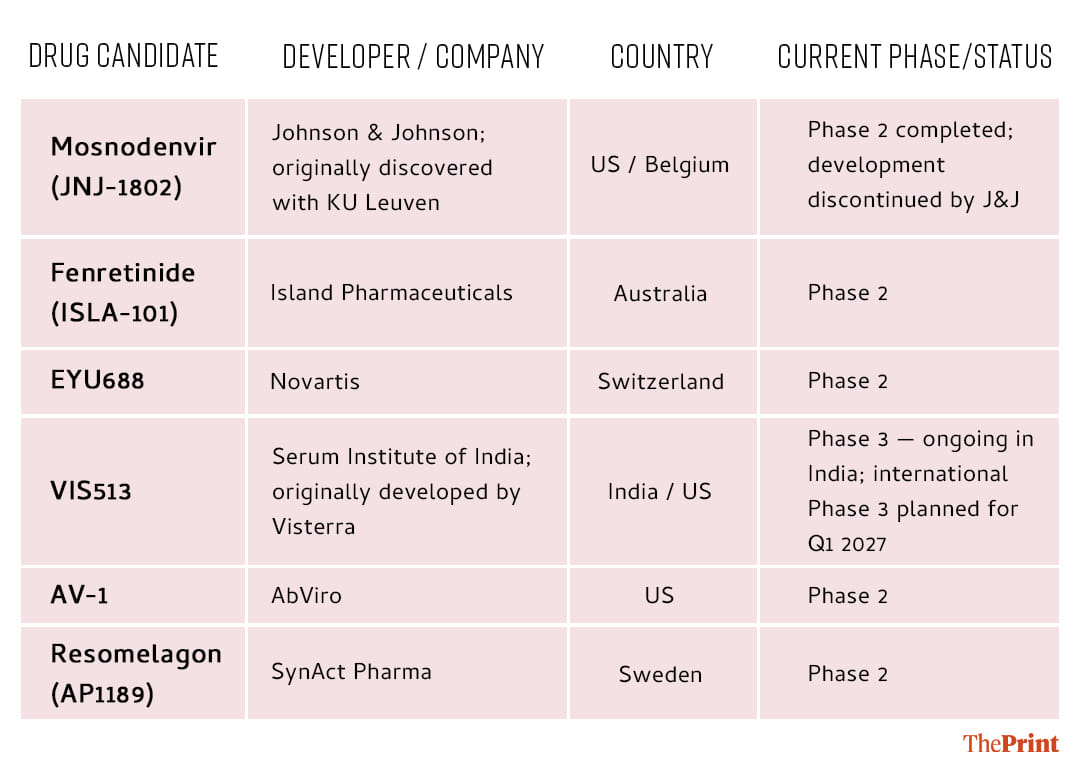
But its development has since stalled. J&J discontinued its Phase 2 field study in 2024 as part of a strategic reprioritisation of its infectious-disease programme. The company said the decision was not related to safety concerns.
Another approach involves using an existing drug for a new purpose. Fenretinide (ISLA-101), an older medicine, is being repurposed by Australia’s Island Pharmaceuticals as a potential dengue treatment and preventive therapy. Laboratory studies have shown activity against all four dengue virus types, and the company is now studying whether this can translate into a useful treatment in patients.
Like mosnodenvir, EYU688, being developed by Novartis in Switzerland, is designed to stop the virus from multiplying by targeting the NS4B protein. Unlike the two drugs that have already completed Phase 2 testing, EYU688 remains in Phase 2, where researchers are assessing whether it can reduce the amount of virus in the blood, shorten fever and improve other symptoms.
The other two candidates use antibodies rather than conventional antiviral drugs. VIS513, originally developed by US-based biotech company Visterra and later licensed to the Serum Institute of India (SII), is a laboratory-made antibody designed to recognise and attach to the dengue virus and block its ability to infect cells.
It has now become the most advanced out of the six drugs. Its Phase 3 trial in India is already enrolling adults and children aged five years and above. Separately, SII partnered with the Drugs for Neglected Diseases initiative (DNDi) in July this year for international testing. The larger Phase 3 trial, expected to enroll around 1,000 patients across Brazil, Malaysia and Thailand, is scheduled to begin in the first quarter of 2027.
The fifth candidate AV-1, being developed by US-based AbViro, is designed to attach to a protein on the surface of the dengue virus and prevent it from causing further infection. It is still in Phase 2 trials.
The sixth candidate, Resomelagon (AP1189), takes a different route altogether.
Developed by Sweden-based SynAct Pharma, it does not directly attack the virus. Instead, it aims to regulate the body’s inflammatory response to infection. This is important because an excessive immune response can contribute to serious complications in dengue. The drug is entering Phase 2 testing in Brazil.
When the WHO conducted its analysis, three candidates — mosnodenvir, fenretinide and VIS513 — had completed industry-sponsored Phase 2 trials in adults and had shown efficacy signals such as reduced amounts of virus in the blood or shorter duration of symptoms.
EYU688 and AV-1 were still being tested in Phase 2, while Resomelagon was entering Phase 2.
What happened to older drugs, and what next
The six candidates identified by the WHO emerged after years of attempts to repurpose existing medicines for dengue. The analysis looked at 13 Phase 2 or Phase 3 trials involving nine such drugs, but the evidence was either inconclusive or did not support further development.
Montelukast, commonly used for asthma and allergies, showed promise in a small trial but failed to reduce severe dengue in a larger study. Rupatadine, an anti-allergy drug, did not reduce progression to severe disease. Eltrombopag, used to treat low platelet counts, increased platelet numbers in dengue patients but did not reduce bleeding.
Other drugs, including celgosivir (an antiviral), chloroquine (an antimalarial), lovastatin (a cholesterol-lowering drug) and prednisolone (a steroid), also failed to show convincing benefits.
Ribavirin, an antiviral used for other infections, fared no better in early testing. It showed no protective effect against dengue in an animal study, and has no published human trial data to support its use.
These results highlight a key challenge in dengue drug development. Reducing the amount of virus in the blood does not necessarily translate into faster recovery or a lower risk of severe disease.
WHO therefore said future trials need to measure outcomes that directly benefit patients.
For non-severe dengue, WHO said that there is need for a safe treatment that works against all four dengue serotypes, shortens illness and, ideally, prevents progression to severe disease.
It should preferably be an oral, short-course treatment that is easy to administer, requires minimal specialised storage and is affordable.
For severe dengue, the WHO said, the priority is to prevent progression to organ failure requiring intensive medical support.
The WHO also recommends combining drugs where possible to reduce the risk of resistance, along with rapid diagnostic tests to confirm dengue infection and enable treatment at an early stage.
(Edited by Ajeet Tiwari)
Also read: India gets first dengue vaccine. It’s made in Japan