





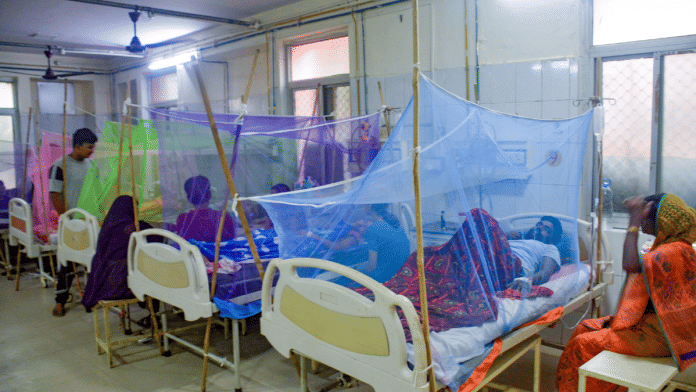


New Delhi: Every year, dengue infects millions of people. Most patients recover without complications, but some develop severe disease that can lead to plasma leakage, bleeding, shock or organ failure. Yet there is still no approved treatment that targets the virus after infection. Doctors can only manage symptoms and treat complications.
On Wednesday, vaccine manufacturer Serum Institute of India (SII) and the non-profit Drugs for Neglected Diseases initiative (DNDi) announced that they have signed an agreement to test an SII-developed monoclonal antibody treatment against dengue in an international Phase III clinical trial.
The study is expected to begin in the first quarter of 2027 and enrol around 1,000 patients in Brazil, Malaysia and Thailand. The SII is also conducting a separate Phase III trial of the same treatment in India.
The treatment is a monoclonal antibody — a laboratory-made protein designed to work like the body’s natural antibodies. It binds to the dengue virus with the aim of preventing it from multiplying and reducing the risk of patients progressing to severe disease.
The announcement comes as dengue continues to spread globally. According to the World Health Organization (WHO), more than 14.4 million dengue cases and over 11,000 deaths were reported worldwide in 2024.
Around 5.6 billion people now live in areas at risk of dengue. Once largely confined to tropical regions, the disease is expanding into new parts of the world, including Europe, driven by climate change and globalisation.
Dengue is a viral disease spread through the bite of infected Aedes mosquitoes, mainly Aedes aegypti. It does not spread directly from one person to another. Symptoms usually include high fever, severe headache, muscle and joint pain, nausea and rash, although many infections cause no symptoms.
In a small proportion of patients, the infection progresses to severe dengue, in which blood vessels become leaky, leading to plasma leakage, severe bleeding, shock or organ failure if not treated promptly.
“We need therapeutics that can prevent progression to the severe stage of the disease to save lives and reduce economic strain, not only on patients but also on public health systems,” Dr André Siqueira, Head of Dengue at DNDi, said in a statement.
He said treatments are particularly needed for children, pregnant women and older people, who face a higher risk of developing severe and potentially fatal dengue.
If successful, the antibody could become one of the first medicines approved to prevent dengue from progressing to severe disease.
Also Read: How Serum Institute, DNDi tie-up for affordable antibody will bolster global fight against dengue
Why there is still no treatment for dengue
Unlike diseases such as influenza or HIV AIDS, dengue has no approved antiviral drug that targets the virus after infection. Treatment is limited to supportive care. Doctors monitor patients for warning signs, administer intravenous fluids when needed, and manage complications such as severe bleeding, shock and organ dysfunction.
One reason developing dengue medicines and vaccines has been difficult is that the virus exists in four different serotypes, closely linked variants of the virus. Infection with one serotype provides long-term immunity against that type, but not the other three.
The first licensed dengue vaccine, Dengvaxia, is recommended only for people who have previously had dengue because it can increase the risk of severe disease in people without prior infection. Another vaccine, Qdenga, can be used more broadly, but its effectiveness varies depending on the dengue serotype and a person’s previous exposure to the virus.
Current efforts to control dengue rely mainly on reducing transmission by Aedes mosquitoes and using vaccines.
However, according to DNDi, vaccine coverage remains low in many countries where dengue is common, and vaccine effectiveness varies depending on a person’s previous exposure to dengue and the virus serotype. Treatments are therefore considered an important addition to existing dengue control measures.
What is the treatment being tested
The treatment being tested was previously known as VIS513. They have now called it monoclonal antibody treatment .
It is a monoclonal antibody, a laboratory-made protein designed to recognise and bind to a specific target. In this case, the antibody is designed to bind to the dengue virus and stop it from infecting more cells.
The SII has completed pre-clinical studies and Phase I and II clinical trials of the treatment. The company is currently conducting a Phase III trial in India.
For the international Phase III study, the SII will manufacture the medicine, supply study dosages and manage refrigerated transport to trial sites.
The DNDi will lead the trial with research partners including Fiocruz and the Federal University of Minas Gerais in Brazil, Siriraj Hospital at Mahidol University in Thailand, and Malaysia’s Ministry of Health.
“We will make all attempts to develop, produce, and distribute the vaccine and monoclonal antibodies all over the globe in an affordable manner, together with our committed partners, the Indian Council of Medical Research and DNDi,” said Dr Rajeev Dhere, Senior Scientific Advisor at SII.
The Phase III trial will assess whether the antibody can reduce the number of patients who progress to severe dengue.
According to DNDi, treatments are particularly needed for people at higher risk of severe disease. Children under 15 years of age are more likely to develop severe dengue, while pregnant women with dengue face an increased risk of maternal death and pregnancy loss.
The Phase III study is expected to begin in early 2027. The SII and DNDi have not said when the treatment could become available if it is shown to be safe and effective.
(Edited by Ajeet Tiwari)
Also Read: India sees alarming rise in dengue cases even before peak season, steady increase over past 4 years