






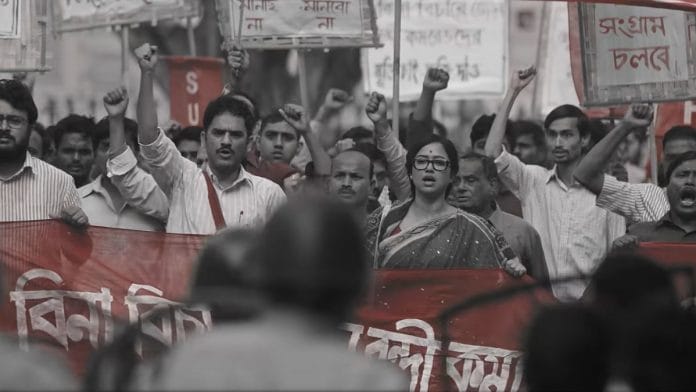

If the purpose of good fiction is to delve into deeper truths, then Srijit Mukherji’s new Bengali film Winkle Twinkle has hit the proverbial bull’s eye. Feted by critics and fans alike as one of his most nuanced works, the film tells the story of a communist who vanishes into thin air in 1976, only to resurface in 2002 without having aged a day.
As the modern-day Rip Wan Winkle tries to make sense of changed realities, Mukherji nudges the audience to look within. The viewers gets the sense that even as West Bengal’s political realities have swung from the Left to the Right, more than a few things remain unchanged. And even under the first democratically elected Hindu Right government in the state, Kolkata has not delinked itself from the communist.
Past-Forward
Mukherji’s political drama Winkle Twinkle, which released on 4 September, is a cinematic adaptation of Bratya Basu’s 2002 play of the same name. In the film, as in the play, young communist leader Sabyasachi Sen (Ritwick Chakraborty) mysteriously disappears in 1976 while trying to escape the police. It is the Emergency era, when political activists are routinely rounded up, thrown into jail, tortured, or simply killed in police encounters. As the years go by, Sen’s comrades and family move on, assuming that he died—until he resurfaces in the same area he had disappeared from, unaware of where he was all this time, realising the world has irrevocably changed.
At the time Sen is supposed to have disappeared, West Bengal was still under Congress rule. Chief minister Siddhartha Shankar Roy had political opposition not just from the communists of the CPI(M) variety but also from the radical Leftists who had internalised Mao Zedong’s 1927 statement that political power grows out of the barrel of a gun. Those young Naxals who resorted to violence to meet political ends were crushed with more violence from the political class that ruled the state.
In the film, Sen vanishes with the communist dream of a classless, casteless society. When he reappears in 2002, that dream has both been realised—as the communists come to power in 1977—and dashed to the ground, as Sen realises to his shock and horror that it has become increasingly hard to separate the comrade from the class enemy.
“As Sabyasachi (Sen) grapples to come to terms with the stark reality of how the ideals and politics he held so dear has failed, he feels all the more alienated and lost. Though he realises how consumption-driven society has abandoned the cause of collective welfare and equal rights, he never gives up on hope,” Sharmistha Ghosal wrote about the film in The New Indian Express.
And yet, hope is hard to hold on to as Sen finds that his old comrades have either become part of the new corrupt political order or are killing time as broken women and men. Worse, his own son, now a young man (Parambrata Chatterjee), has joined the Trinamool Congress—the primary opposition party in 2002—led by the young, former Congress leader Mamata Banerjee.
Sen has no idea what the Trinamool Congress is, but the name itself brings back unsavoury memories of Congress rule during which he disappeared.
“An interesting aspect of Winkle Twinkle is that Sen, as a comrade who returns, tries to awaken the conscience of some like his own son who have associated themselves with the Trinamool Congress. But Sen is also asking himself whether the Left parties have made no mistakes of their own,” senior entertainment journalist Bhaswati Ghosh told ThePrint.
For author and educationist Sarojesh Mukherjee, the film is set in a time when ideologies had blurred, loyalties had shifted, and yesterday’s class warriors had learned the comforts of power.
“What makes its satire both engaging and unsettling is its eerie resonance with present-day Bengal, where yesterday’s defeated wielders of power coexist with remarkable ease alongside their former adversaries—now their overlords. The old battle lines have blurred once again; what endures is the instinct to adapt, survive and, perhaps, belong to whoever holds power,” Mukherjee said.
Also read: Lines on a map won’t resolve the India-China conflict. It began as a Cold War contest
Left, Right, no others in sight
When Basu wrote and staged the play Winkle Twinkle, he aptly captured the disillusionment with the Left in 2002.
Basu, an acclaimed stage director, playwright, and professor, went on to become the education minister of West Bengal in the Trinamool Congress government. Because of the period in which the play is set, however, it misses the disenchantment and anger that later developed against his own government for a whole host of reasons, including the “cash-for-jobs” racket in state-run schools, which led to the party’s electoral downfall in May.
If Bengal waited 34 years to throw out the Left, it took only 15 to bring down the Trinamool Congress government.
Unlike Basu, Mukherji has not publicly stated his political position. In an interview to Ei Samay Online, the director said most people are confused about whether he supports the Right, the Left, or the Congress.
“Be it the Congress High Command, the Politburo or the BJP high command, I have seen how it is now taken well if one doesn’t toe the official party line,” Mukherji said in the interview.
Mukherji went on to talk about the disenchantment that builds around every political idea or party once it comes to power and stays in power over a long period, until a new political idea gains traction.
But by choosing to make a film on a 2002 play in 2026—when the BJP has come to power with a thumping majority for the first time in Bengal’s history, and the Left alliance has been reduced to two seats—Mukherji has paradoxically drawn attention to Kolkata’s continuing hangover with communism.
Academic and oral historian Avishek Biswas calls it “absent-minded communism”.
“No political dispensation, including the present one, has been careful enough to penetrate into that ideological hegemony. Hence, the Left is out of power but very much in the mind of the Bengali, even if subconsciously,” Biswas said.
What sustains this “absent-minded communism” is the “Trinamoolification” of the BJP or the mad rush among defecting Trinamool Congress leaders and workers to align with the new ruling power, even as old charges of extortion and corruption have come to haunt the new government.
Senior advocate in the Calcutta High Court and RSS swayamsevak Joydeep Sen told ThePrint that ideological wars have only just begun in West Bengal and communism will not be allowed to raise its head.
“Give the new BJP government in West Bengal time, and it will send communists back to where they belong, the dustbin of pre-1977 history,” Sen said.
Winkle Twinkle’s Sabyasachi Sen may not agree.
Deep Halder is an author and a contributing editor at ThePrint. He tweets @deepscribble. Views are personal.
(Edited by Prasanna Bachchhav)