






The bones of the dead lie heaped in piles, steaming blood is everywhere plastered, the earth is scorched dry, and no matter where you look, your heart aches,” wrote the harmonium-playing warlord General Ma Zhongying, also famously known as General ‘Big Horse’. “The celestial garden of refuge has become nothing more than the home of tearful gods and wailing spirits.”
Twenty-three years old in 1933, the General had spent the previous four years trampling across the cities and oases of Xinjiang, urging Kazakh, Uighurs, and Hui Muslims to rise against the ethnic-Han and recreate the kingdom of the medieval conqueror Taimur. Thousands died of war and famine; American diplomats reported that cannibalism had become commonplace.
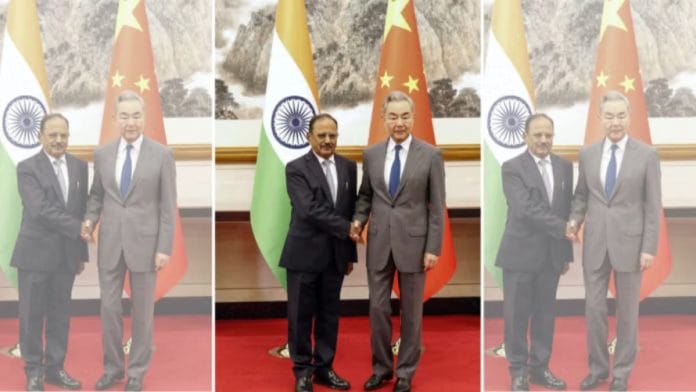
Ever since last month’s meeting between National Security Advisor Ajit Doval and Chinese Foreign Minister Wang Yi, speculation has mounted that the two countries are close to an interim agreement on marking the border in sectors where their claims converge. To some Indian commentators, it appears that China is using Prime Minister Narendra Modi’s too-eager reach for a diplomatic triumph to enshrine the gains it made in the war of 1962.
The China-India border conflict, though, has never been about the few dozen kilometres of desolate earth and ice that separates their claim-lines. Faced with the irreparable fracturing of its relationship with the Soviet Union, and the need to forward-deploy units in Xinjiang, the People’s Liberation Army (PLA) was also preparing for an American-backed invasion from Taiwan in the summer of 1962. Less than six months before the 1962 war broke out, tens of thousands of Kazakh and Uighur families fled Xinjiang for Kazakhstan, brushing aside border guards and Communist Party officials.
Yet, Beijing chose not to moderate its border claims. “Arrogant, devious, hypocritical and thoroughly unreliable,” Prime Minister Jawaharlal Nehru fumed, as he ordered Indian troops to assert their border claims by physical occupation.
Looking west, China had come to similar conclusions. Early in the autumn of 1951, the Indian government gave asylum to hundreds of Kazakh secessionists—the successors of the Big Horse’s militia—after they were chased out of Xinjiang by the PLA. The Xinjiang secessionist Yulbars Khan arrived in India soon after, and secretly met with Nehru. In 1950, agents working for Beijing had begun reporting—accurately, it is now known—that the CIA station in New Delhi was offering weapons and cash to initiate insurgency in Tibet.
The use of force along the Line of Control (LoC) was meant to send a message not just to New Delhi, but also to Taiwan, the US and the Soviet Union: China was prepared to take the risks that came with refusing to be coerced.
Cold War on the world’s roof
From the moment of its birth in 1949, the People’s Republic found itself mired in war against insurgents who had carved out an Islamic state in Xinjiang—the great plateau bordering British India, Tibet, and the Soviet Central Asian republics of Kazakhstan, Kyrgyzstan and Tajikistan, with routes east to Mongolia and old imperial Xi’an. Led by the low-born Kazakh bandit and rebel Usman Islamay—“Osman Batur”—the counter-insurgency war erupted in March 1949. At least 12,500 Kazakh rebels were slaughtered, together with thousands of PLA officers, communist cadres and civilians.
Late in the summer of 1947, the CIA officer Douglas Mackiernan had been assigned to serve undercover as vice-consul in Ürümqi.
The officer allied with Usman to locate samples of uranium-bearing rock in Xinjiang, critical to Soviet plans to build a nuclear-weapons arsenal. The CIA also gave Usman weapons and funds to fight the PLA. Mackiernan was killed by Tibetan border guards in 1950, as he tried to escape to India ahead of the PLA, while Osman was executed in Ürümqi’s public square a year later. The rebellions continued, though, running into 1954.
Events hardened China’s suspicions of India. Intelligence Bureau chief BN Mullik turned a blind eye as the CIA ran secret flights supplying insurgents in Tibet — leading historian John Garver to conclude that, whatever the truth, “Beijing believed that Nehru knew of and cooperated with CIA efforts.”
To the former Chairman of the Chinese Communist Party Mao Zedong, the threat seemed clear. The British had long discussed a buffer state in Tawang under the Panchen Lama—a British plan dating back to 1907. India had even considered helping Tibet resist the 1950 PLA invasion, only for its Generals to say the resources did not exist. Now, it seemed, Nehru was picking up the Raj’s unfinished business.
Also read: Xi has purged 100+ PLA generals. What it says about China’s military and Taiwan
Games empires play
Ever since the late 19th century, the British Raj and Imperial Russia had ensconced themselves in Kashgar, watching for signs of expansionist intent. The diplomat George Macartney lived there from 1890 to 1918, while Imperial Russian consulates enjoyed tax-free trade and extraterritorial judicial powers. The British, in turn, ran missions in Lhasa and trade offices at Gyantse, Yatung and Gartok.
The missions became independent centres of power as central authority crumbled across China, building client networks among local élites. Germany, Japan and Turkey all joined the race for influence after 1918.
Freelance adventurers found opportunity too. The writer Peter Fleming travelled from Beijing to Kashmir in 1935, using the trip to observe the political crisis in Xinjiang, while the geologist Sven Hedin travelled through war-torn Xinjiang in 1933-34, scouting for a road route that could link Hotan to Rutog. That road would be built by the PLA in 1953—leading China to assert its claims to Aksai Chin, and setting the stage for the war of 1962.
After the 1949 revolution, the communist leadership moved to sever ties between élites in its borderlands and foreign powers. The doors of George Macartney’s consulate in Kashgar’s famed Chini Bagh—which had hosted travellers from across the world—were shut down in 1949. The last British consul-general in Ürümqi was accused of espionage and expelled in 1950.
Also read: PM Modi’s Central Asia visit is a quest for a new Eurasian highway. Detouring around rivals
Kingdoms of sand
“Flogging eunuchs was part of my daily routine,” Emperor Pu Yi remembered as an old man, when he served as a gardener in the Forbidden City. “My cruelty and love of power were already too firmly set.”
Crowned at the age of three, Pu Yi was forced to abdicate six years later, in 1912. The multi-ethnic empire unravelled. Tibet expelled the Amban, or imperial Governor; the southern provinces declared independence; and rebellions flared across Xinjiang, as local warlords seized power. The Kashgar-based Russian emigré Paul Nazaroff recalled seeing “bundles of men’s amputated arms or feet nailed to the city gates, with notices stating whose members they were and why they were cut off.”
To no one’s surprise, rebellion swept Xinjiang and adjoining Gansu from 1929, after the Han bureaucrat Jin Shuren, the region’s de facto ruler, turned economic predation into an art form. Led by Yolbars Khan and the businessman Khoja Niyas Haji, popular anger crystallised into armed resistance that soon degenerated into ethnic cleansing. Ethnic-Han prisoners were forced to convert to Islam, while local Hindu moneylenders who financed the Silk Route caravans were massacred.
General Ma and other ethnic Hui warlords responded to the chaos by stamping out the East Turkestan Republic led by Khoja Niyas, and sacked Kashgar in a campaign they hoped would lead to the installation of the Kuomintang nationalist government as the rulers of Xinjiang.
Fearing the warfare in Xinjiang would inflame Islamic secessionism in its own Central Asian republics, the Soviet Union invaded Xinjiang to halt the advance of General Ma. The Red Army installed the warlord Sheng Shicai as its vassal. Following several years of faithfully implementing pro-Soviet policies, Sheng abandoned Moscow after the Nazi victories of 1942. The Soviets responded by throwing their weight behind Kazakh rebels, who went on to found the Second East Turkestan Republic.
Then, as now, the real issue was how power should be configured in Asia. The kind of strategic relationship India seeks with the US; the architecture of ties to partners like Japan or Australia; how China’s concerns about efforts to contain its rise ought to be addressed. To begin that conversation, the two countries will need to move past the anxieties and bitterness that shaped their past.
Praveen Swami is Contributing Editor at ThePrint. His X handle is @praveenswami. Views are personal.
(Edited by Saptak Datta)