






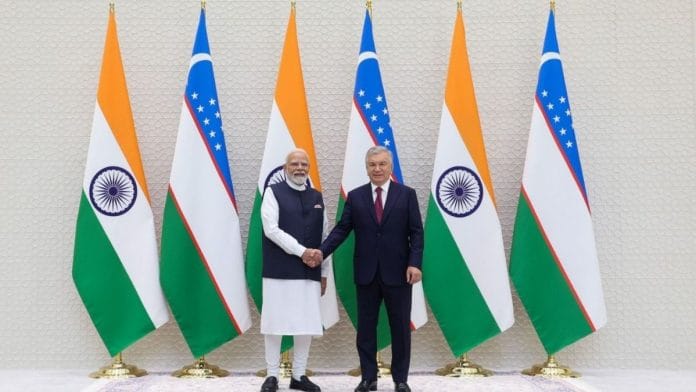

Prime Minister Narendra Modi is on a four-day state visit to Central Asia. He landed in Uzbekistan for a bilateral visit on 29 August at the invitation of President Shavkat Mirziyoyev. The discussions focused on Viksit Bharat 2047 and Uzbekistan 2030, and explored mutually beneficial avenues for strategic geopolitical alignment. This is Modi’s fifth visit to the former Soviet republic. Uzbekistan is also one of my favourite countries, being the first Central Asian Nation that I had the privilege of visiting as Minister of State for External Affairs in 2021.
From Tashkent, the PM travelled to Kyrgyzstan’s capital, Bishkek, where he is slated to attend the 26th SCO summit, at the invitation of Kyrgyz President Sadyr Japarov, and will also participate in the opening ceremony of the sixth World Nomad Games. During his visit, Modi will seek to advance India’s interests, promote economic and geopolitical regional cooperation, engage in discourse on democracy and push India’s anti-terror agenda.
But apart from maintaining diplomatic ties and friendly relationships, why is PM Modi’s Central Asia trip so important?
The SCO significance
The Shanghai Cooperation Organisation is a Eurasian multilateral grouping founded in 2001 by China, Russia and four Central Asian states to promote regional security, stability and economic cooperation. India joined the SCO in 2005 as an Observer.
It wasn’t until 2017, that India joined as a full member, at the same time that Pakistan did. Today, 10 member states form the SCO: China, Russia, Kazakhstan, Kyrgyzstan, Tajikistan, Uzbekistan, India, Pakistan, Iran and Belarus. Although, Turkmenistan is not a full member, it has been attending the SCO as a guest nation.
It is interesting to note how the SCO has expanded its membership to include countries that are geopolitically and ideologically diverse, as well as varied in size, yet it remains relevant in uniting an entire region. It raises the question: can the SCO become a mechanism that reduces the probability of conflict between member states and brings broader regional stability?
Also Read: India’s next tryst is the road to Viksit Bharat 2047
India’s need to remain relevant in the region
In the rapidly changing geopolitical scenario, India has to ensure that its own needs remain relevant. After all, the needs of 1.4 billion people cannot be swept under the carpet. And Central Asia is relevant to India for multiple reasons. It is a gateway connecting Europe. With the extremely volatile current geopolitical scenario, the traditional route for India via the Middle East stands compromised. Therefore, through Central Asia, India can find access to new markets and regain access to European markets.
The Central Asian republics, namely Kazakhstan, Turkmenistan, Uzbekistan, Kyrgyzstan and Tajikistan, have proven their agency and capabilities. They are demonstrating a growing ability to diversify their strategic and economic partnerships rather than aligning with a particular bloc.
The dynamics of the Russia-Ukraine conflict, the US-Iran War, and the Saudi-Pakistan-Turkey alliance have demonstrated that India needs to find every opportunity to move beyond a simple “outreach” and build genuine strategic interdependence. The objective is to position India as a valuable geopolitical partner for Central Asia that adds value through trade, knowledge sharing, technology, healthcare, critical minerals, digital infrastructure and connectivity.
A more deeply embedded Indian presence would strengthen our position in Eurasia. India’s role in the SCO then becomes more like that of a friend, who shares historical footprints in the region and still continues to work together as a strategic partner.
But it is also worth remembering the importance of the geography of connectivity.
For India, connectivity to Central Asia and further to Europe is a matter of strategic autonomy. Thanks to the creation of Pakistan, India lacks direct overland access to Central Asia and needs its own trade routes. India needs to work towards building a multi-faceted network of multiple resilient routes, such as maritime, rail, road and digital. After events in Hormuz and Chabahar, we have seen how geopolitical disruptions impair lives and the economy.
The objective for Modi’s SCO participation has, therefore, also been to create connectivity that cannot be held hostage to another country’s geopolitical crisis. Every viable alternative to and from Central Asia expands India’s room for diplomatic manoeuvre.
Also Read: India-Uzbekistan ink uranium supply deal, set $5 bn trade goal as Modi receives top Uzbek honour
A multi-faceted partnership
India hopes to become 30 per cent electric by 2030, a progressive goal keeping in mind the sustainability push. In fact, India is far ahead of many European nations since there has been a distinct policy shift away from fossil fuels toward cleaner energies. Central Asia has a robust reserve of critical minerals and strategic resources. These can help prop up India’s next phase of industrialisation.
Electric vehicles, renewable energy, electronics, data centres, batteries, defence manufacturing and more such industries relevant for Viksit Bharat 2047 are dependent on critical minerals. Kazakhstan is home to one of the largest reserves of uranium, along with substantial deposits of coal, lead, zinc, gold and iron ore. Turkmenistan has huge natural gas deposits. Uzbekistan is rich in gold and uranium, whereas Tajikistan has hydropower potential. Engaging with Central Asia offers India an opportunity to diversify sources of these minerals and reduce dependency on other global supply chains. This is where the SCO provides a useful platform not merely for discussing resources but also for facilitating investment, tech partnerships, processing capabilities and more reliable supply chains.
India’s objective should be to build long-term value chains with Central Asian partners rather than simply secure access to raw materials. Here, PM Modi’s inherent talent for building geopolitical relationships through personal engagement comes into play. Whoever controls the minerals, technologies and supply chains of the 21st-century green and digital economy will shape the energy narrative. For India, Central Asia could therefore become an important component of its economic and technological security.
India’s got talent. There’s no doubt about that. Indian doctors and techies are the workhorses that keep the US, UK and several other economies well oiled. India’s software guys can be found behind systems from Thane to Timbuktu. Not to mention the Indian labour that is propping up the large-scale development in mega cities such as Dubai, Kuwait, Abu Dhabi, etc. India could look toward Central Asia for a possible export opportunity for its immense talent. Uzbekistan is already targeting $5 billion in annual AI and IT exports by 2030, and Kazakhstan’s IT service exports exceeded $1.1 billion in 2025.
India’s engagement with digital payments and its success in this field is well-known. India possesses an unparalleled proposition: digital connectivity.
India’s experience with digital public infrastructure, real-time payments, digital identity, fintech and tech-enabled public services could offer Central Asian countries a practical model for expanding financial inclusion.
Whenever I travel to remote areas of the country, I am always pleasantly surprised to see how India has managed digital inclusivity for its citizens residing in far-flung corners where sometimes even roads don’t provide access. The SCO is, therefore, a useful platform for exploring cooperation in the fields of digital security and as technological dependence becomes prolific, so does the need for national digital security.
India’s opportunity lies in becoming a strategic technology and knowledge partner to Central Asia. PM Modi’s Make in India push for defence, technical and digital sectors could then convert into an export opportunity from India.
Also Read: Why is India importing foreign waste when it cannot manage its own? Madras HC has a warning
Finally, the talk on terrorism
“India has been an active and constructive member of the SCO since 2017. I look forward to advancing India’s vision for the region, anchored in Security, Connectivity and Opportunity, and to working with fellow members for a region free from the scourge of terrorism, separatism and extremism, which continue to threaten peace and stability in our neighbourhood and beyond,” said PM Modi as he embarked on his visit.
Today, it is pertinent to state that most countries suffer from the scourge of terrorism. Even the most neutral or politically “safe” countries have to, at the very least, ensure strict security at airports, museums, public buildings and such. No country can really afford to take a stand against the implementation of strong anti-terror measures.
India has been a target of cross-border terror since Independence. Our neighbour never loses an opportunity to harbour and give safe passage to terrorists.
Ironically, while the SCO has a formal anti-terror institution called SCO-RATS (Regional Anti-Terror Structure), a mechanism whereby member states cooperate on terrorism, separatism and extremism. This time it is Pakistan that has the chair on this and is hosting the next RATS Council Meeting in September 2026. It, therefore, becomes even more relevant for PM Modi to engage in dialogue with the member states and also seek the support of Russia and China to counter Pakistan’s terror strategy.
Meenakshi Lekhi is a BJP leader and lawyer. Her X handle is @M_Lekhi. Views are personal.
(Edited by Insha Jalil Waziri)