





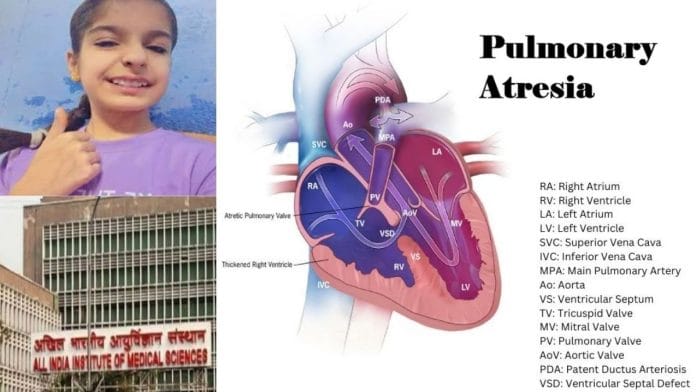

New Delhi: When Tanvi was two, her father Mukesh Pariyani first took her to All India Institute of Medical Sciences (AIIMS) Delhi for treatment of a congenital heart defect. What followed was more than a decade of hospital visits, tests and discussions around surgery.
Originally from Kota, Tanvi died at AIIMS on 1 September at the age of 15.
While her family has alleged that corrective surgery was repeatedly postponed over the years, AIIMS says the team treating Tanvi concluded in 2017 that corrective surgery was not feasible owing to the complexity of her cardiac anatomy.
Speaking to news agency ANI after Tanvi’s death, her father Mukesh Pariyani said he first visited AIIMS on 10 October, 2012 and was referred between departments for various tests. He alleged that surgery was discussed and dates were subsequently given, but the procedure never took place.
“They kept running tests, but the operation never happened; they just kept running tests…My child passed away. Who is responsible for this?…If my daughter could have been cured through an operation back in 2015, 2016, or 2017, why didn’t they perform it?” he asked.
AIIMS, however, has given a differing account.
It said Tanvi underwent detailed cardiac investigations in 2013, including CT angiography, conventional angiography and cardiac catheterisation.
According to AIIMS, the treating team concluded in 2017 that corrective surgery was not feasible because of the complexity of her cardiac anatomy, and she was advised medical management (non-surgical treatment). The family, it said, continued to seek opinions on whether surgery was possible.
An AIIMS estimate dated 31 January, 2014 recorded her diagnosis as “VSD + pulmonary atresia” and listed “unifocalisation & conduit” as the proposed surgery, with an estimated cost of around Rs 1.2 lakh. It also mentioned four blood donors.
On 2 September, AIIMS constituted a committee to examine the case in detail.
“The Director, AIIMS, New Delhi has constituted a committee to examine the matter in detail, review the sequence of events and establish the facts,” the institute said in a statement issued on 2 September.
AIIMS New Delhi Constitutes Committee to Review Clinical Course and Circumstances in Case of Patient Tanvi. pic.twitter.com/RUGRrrzFf9
— AIIMS, New Delhi 🇮🇳 (@aiims_newdelhi) September 2, 2026
The statement added that the committee will examine the “complete sequence of events, clinical records, investigations, treatment provided, expert opinions and the circumstances surrounding the patient’s death”. An autopsy is also underway, AIIMS said.
Also Read: Doctors still treat heart disease with trial and error. This start-up wants to change that
A complex, rare condition
The condition that Tanvi was suffering from is complex and rare. According to Dr Sanjay Kumar Chugh, director and unit head of cardiology at Aakash Healthcare Super Speciality Hospital in Delhi’s Dwarka, treating this condition is like trying to win a losing battle.
“These are complex situations and at that time one has to make the best decision based on how the child’s lung arteries are growing, how much the pulmonary pressures are rising, how good the blood circulation is,” he told ThePrint.
A VSD, or ventricular septal defect, is a hole in the wall separating the heart’s two lower chambers, called the ventricles.
Normally, the right side of the heart receives oxygen-poor blood from the body and pumps it to the lungs. The lungs add oxygen to the blood, which then returns to the left side of the heart and is pumped to the rest of the body.
The pulmonary artery is the main blood vessel that carries blood from the right side of the heart to the lungs.
In pulmonary atresia, the normal route for blood to leave the right ventricle and reach the lungs is blocked or has not developed properly.
Dr Chugh explained that the condition can therefore create a major hurdle in getting blood to the lungs. “When blood cannot reach the lungs normally, it cannot pick up enough oxygen. This can cause cyanosis, or a bluish colour of the skin and lips,” he said.
And when pulmonary atresia occurs along with a VSD, the anatomy becomes much more complicated than an isolated hole in the heart.
May need more than one operation
In a newborn with pulmonary atresia, doctors first need to ensure that enough blood is reaching the lungs.
Dr Varun Bansal, senior consultant, Cardiothoracic and Vascular Surgery, Indraprastha Apollo Hospitals, New Delhi, explained that in some newborns with pulmonary atresia, doctors use prostaglandin medicines to keep this vessel open temporarily and maintain blood flow to the lungs.
Once the child is stabilised, he said, surgeons may create another route for blood to reach the lungs using a shunt. “As soon as the child is a little better, more stable, then one would have to do some kind of a shunt procedure… So then you can allow the child to actually grow and once the child is a little grown up… that’s the time when definitive repair can be done,” Dr Bansal said.
The eventual treatment, however, depends on the anatomy.
In some children, the pulmonary arteries are very small.
Dr Bansal explained that the body may develop extra blood vessels from the aorta, the body’s main artery, to the lungs when the normal route is blocked. These are called major aortopulmonary collateral arteries, or MAPCAs.
If there are more than one of these vessels, surgeons may need to bring them together through a procedure called unifocalisation to enable better blood supply to the lungs.
They may then use a conduit, or tube, to connect the right side of the heart to the lungs, and close the VSD. “So, the surgery involves fixing several problems, not just closing the hole,” Dr Bansal said.
Medical experts ThePrint spoke to said that the anatomy can become more difficult to manage in children who reach adolescence without definitive repair, although the outcome varies from patient to patient.
Over time, as the child grows up, the pulmonary arteries may remain small, while extra blood vessels can develop. This can raise pressure in the lungs and put strain on the heart. “You might put in a conduit later but then you might find that the lung pressure is high and so now your heart is not able to take that…So it’s a very complex situation,” Dr Chugh said.
Dr Bansal added that these changes can make surgery harder in children in cases where the condition is diagnosed at a later stage.
What if two-ventricle repair isn’t possible?
If the right ventricle is developed enough and normal, doctors may be able to create a biventricular circulation, where both sides of the heart are used normally, with the right side pumping blood to the lungs and the left side pumping it to the body.
But if the right ventricle is too small, some patients may need a single-ventricle pathway, which creates a different route for blood to reach the lungs. This is only possible if the blood vessels in the lungs can handle the flow.
“In the most severe cases, when other forms of repair are not possible, doctors may consider a heart-lung transplant,” Dr Chugh said.
Tanvi was admitted to AIIMS on 24 August after her condition worsened and was being evaluated for a possible heart-lung transplant. According to AIIMS, she developed severe cyanosis—her blood oxygen level plummeted such that her skin and lips turned blue—around 2.50 AM on 1 September, with her oxygen saturation falling to about 48 percent.
She later developed a hypoxic spell, meaning a sudden and severe drop in the amount of oxygen reaching her body, followed by cardiac arrest.
“Oxygen support was initiated at around 3:30 AM… Despite immediate and sustained resuscitative efforts by the treating medical team, the child could not be revived and was declared dead at 5:06 AM,” AIIMS said.
(Edited by Amrtansh Arora)