






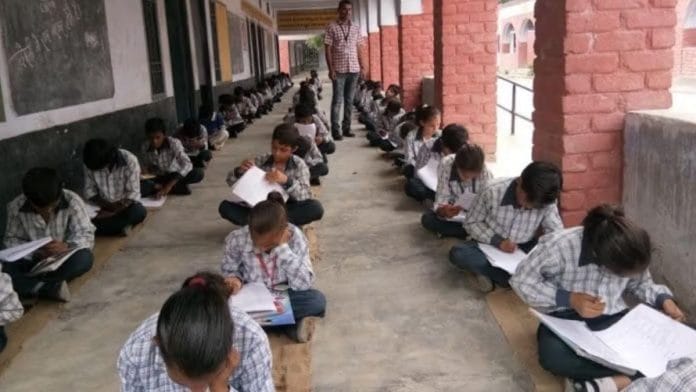

What comes to mind when you picture a broken education system? A crumbling wall? A dysfunctional toilet for years, or one that was never built? A leaking roof, a floor without desks, a room the monsoon has claimed for half the year? These images are vivid, and no, they are not dishonest.
Fixing our schools means more than mending broken walls and toilets, though mending them is a decent start. A good education system needs good schools, and what makes a school good is, by no stretch of the imagination, limited to its buildings.
The ongoing social audit of government schools under the “School Thik Karo” campaign is a sobering reminder: the system is failing our children at the basic level. The campaign, and the wider reporting around it, has surfaced school after school without toilets, electricity or benches, and in some cases without walls or roofs that hold.
On Independence Day this year, an eight-year-old child in Uttar Pradesh’s Sambhal died after a canopy over the school’s main gate collapsed. Failures like these are not administrative footnotes. They tell a child, in the plainest terms, how little the system values their education, or for that matter, their life. No child should have to choose between safety and learning.
So yes, the demand to fix schools and their infrastructure is fully justified, whatever one makes of the Cockroach Janta Party’s (CJP) particular methods. The audits ordered by state governments in the wake of the movement bear the demand out.
In Rajasthan, as many as 611 public schools are reportedly running without any building. In Himachal Pradesh’s Shimla district, 81 per cent of schools are said to lack clean drinking water and 43 per cent to have no safety fencing. Odisha has ordered a safety audit of all its schools.
What the government’s own Joint Review Missions and years of NGO work had long been saying, the CJP has pushed into mainstream consciousness. And yet the demand should not end at the school infrastructure, because historically that is exactly where it has ended, from the village all the way to the highest levels of policy: fix the premises, and consider the matter closed.
Something more important is missing from the conversation, and it is the very thing that should sit at its centre, the quality of education itself. The question we should also be asking is how the learning experience of millions of children in government schools can improve and come to resemble the best schools in India and the world.
Fixing what’s inside
In 2026, it is past time we understood the education problem for what it is: the ability of local and state governments to deliver high-quality education to every child. The countries with the strongest economies do this, and so do the systems that meet top global educational benchmarks such as the Programme for International Assessment, or PISA. A safe, well-equipped school achieves the first task, bringing children through the gate. Keeping them there, and making the years worthwhile, depends on education that is both equitable and good. Until we manage that, our system isn’t truly reformed.
As India takes its place as a global power, there is a pressing need to strengthen public service delivery, especially in education and health. Viksit Bharat 2047 rests on a simple premise: that a country’s progress is built by citizens who are educated in the fullest sense, and not merely literate.
In a country where 70 per cent of children from caste and religious minorities depend on government schools, the quality gaps show up in concrete, everyday ways. They show up as a textbook that reaches the classroom in October when the year begins in June. As a new curriculum or programme announced in a circular that never quite reaches the teacher meant to teach from it. As a school principal who spends more of her week on inspections and registers than with children. As a single teacher holding three grades together in one room, or losing more than a quarter of her time to non-academic work. As administrative and teaching posts that stay vacant for years. As reams of enrolment, attendance and demographic data travelling up the chain in duplicate and triplicate, coming to rest in a file, having changed nothing on the way.
Beneath all of it sits the plainest gap of all: however well a policy is drafted, unless it changes what happens between a teacher and a child in the classroom, children do not learn, and they find little worth staying for, however good the building around them looks.
As former public-school teachers ourselves, and from fifteen years of work in government school reform, we do not doubt the place of the teacher in any serious attempt at change. Classrooms that will raise the builders of Viksit Bharat can only be led by teachers who are themselves supported, motivated and always learning. We have to invest in them properly, value their standing in society, and protect their time and attention to teach.
Also read: Why ‘Reservation Hatao’ agitation at Jantar Mantar is a direct assault on women
The three levers of education
Three levers, in particular, deserve our collective attention.
Improve the quality of teacher recruitment
India has just more than 1.02 crore teachers (UDISE+ 2025-26). Alongside them, around 9.83 lakh sanctioned teaching posts lie vacant (Parliamentary Committee, Report No. 368), and more than 1,00,000 schools run on a single teacher. The first fix is visibility: a live, district-level vacancy dashboard showing sanctioned, filled and vacant posts by level and subject, backed by an annual teacher-requirement audit that prioritises underserved and migration-prone areas.
The second is harder. We select teachers almost entirely on an entrance test, as we would for any competitive exam. A teacher’s work turns on far more than command of subject content. It turns on the ability to deliver instruction, build connection and care within a community, hold positive discipline, and imagine a classroom where every child belongs. A written test measures none of this. That has to change.
Protect teachers’ time on task
Section 27 of the Right to Education Act already bars deploying teachers for non-educational work, save for census, disaster relief and election duty. The law should be honoured and made auditable: the duties a teacher may not be assigned set out clearly, and every deployment away from the classroom recorded, with the instructional days it costs counted against the 200 the Act guarantees.
This is not a high bar. A National Institute of Educational Planning and Administration time-use study found that teachers spend barely a fifth of their working hours actually teaching. Simply protecting the time the law already promises would be a substantial gain.
Double down on teacher support and coaching
There is a saying that the people who run education departments should be of only two kinds: teachers, and the people who support teachers. We are some distance from that. Academic supervision visits should become classroom observation with feedback, rather than report collection, so that an officer’s visit leaves the teacher with something to act on. The research is consistent that the single highest lever for classroom impact is coaching and mentoring, and yet none of our current structures does this well or methodically.
Our teachers need to be observed, given feedback, coached and supported regularly, on pedagogy as much as on subject knowledge, so that what happens between teacher and child begins to reflect what our newer policies actually ask for. We should also reward ongoing learning directly, by letting credits from bona fide professional courses count towards career progression.
The walls matter. Build the toilets, mend the roofs, put up the fences, and do it with urgency, because a child’s safety is above all else. A sound building, though, is only ever the ground on which a good school stands.
The harder and more important work must continue alongside and continue long after the building is fixed, in the quality of the teaching that happens inside it. If Viksit Bharat is to mean anything for the one in two children in India who have only the government school to rely on, that is where our attention, and our funding, must finally turn.
Madhukar Banuri and Siddesh Sarma are co-founders of Leadership for Equity, a not-for-profit that works with public education systems to improve school leadership and learning outcomes with a focus on foundational learning.
Views are personal.
(Edited by Saptak Datta)