




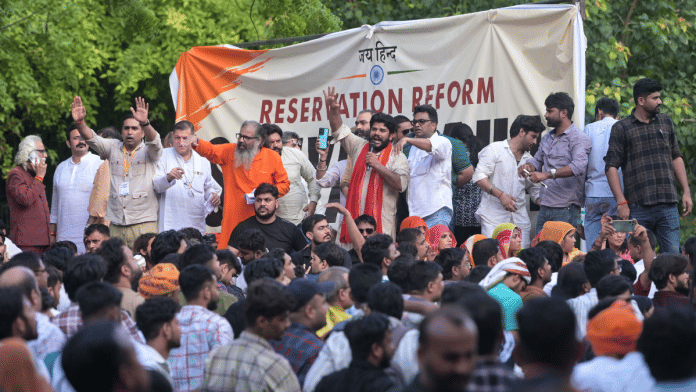

Delhi’s Jantar Mantar is currently hosting an angry performance. This agitation was initially called the Reservation Hatao Andolan, or RHA. It has now rebranded itself as the Reservation Reforms Andolan, or RRA. It has been a clever modification rather than an outright cancellation of affirmative action, which would have faced strong criticism from progressive sections.
What is involved are high-stakes ministerial huddles, a “cordial discussion” between the agitation’s leaders and the Union minister JP Nadda, along with quiet undercurrents of rifts within the leadership. Following weeks of street mobilisations and police detentions, negotiators are preparing for a crucial follow-up press conference on 7 September. As talks continue, both the ruling dispensation and the opposition seem dangerously blindsided to the implications of the proposed reforms, especially for women.
Today, every political party aggressively thumps its chest over Nari Shakti or slogans like “Smash Patriarchy” to court a newly assertive female electorate. But the actual policy text in the charter of RHA/RRA is completely amnesiac from a gendered perspective. If this movement succeeds in replacing India’s traditional caste-based reservations with economic filters, it will be a catastrophic regression for women, especially Bahujan women. It will reverse decades of hard-won literacy, autonomy, and intersectoral mobility.
Also Read: Students’ battle over paper leaks is becoming a caste war
Women as the last and least
The core lacuna of RHA is that it views Indian citizens in silos. It considers them isolated, gender-neutral economic entities. It ignores the foundational sociology of the Indian household: when opportunities and resources are scarce, women are always the last and the least to be considered.
The movement is banking on “One Family, One Quota” as a proposal. The logic given is that it prevents affluent families within marginalised communities from garnering all the benefits. It echoes the Supreme Court’s 2024 judgment on sub-classification and a “creamy layer” among reserved categories. It needs to be understood, however, that a strict horizontal cap on a rural or semi-urban Dalit or Adivasi household creates an intra-household zero-sum game.
When a marginalised family has only one ticket to systemic mobility, who ought to get it? In a male-centric society that sees sons as long-term social security and daughters as paraya dhan (alien wealth), the choice is obviously the son. This male heir will monopolise the lifetime benefit. Families are then likely to sacrifice their daughters’ higher education to prioritise their sons.
In recent times, the government’s All India Survey on Higher Education (AISHE) data shows that the Gross Enrolment Ratio (GER) of Scheduled Caste and Scheduled Tribe women in universities has risen. They have sometimes outpaced their male peers in specific states. A “One Family” cap will stop this progress in its tracks. It turns women into the sacrificial lambs of economic reform. It ensures that the heavy price of institutional “flattening” is paid by India’s daughters.
Giving papa a bureaucratic veto
The movement’s other demand—a transition to a purely economic model, expanding the existing Economically Weaker Sections (EWS) model—similarly weaponises patriarchy against young women across caste lines.
The argument rests on the assumption that the Indian household is democratic and harmonious. But in households, resources are rarely shared equally. In truth, the male patriarch of the Indian household serves as a financial dictator. He has full control of assets, land, and tax documents.
For young women, a caste certificate is an institutional right conferred by birth. It gives them a fixed identity that their family cannot strip away. An economic quota, though, requires declarations that only their fathers or male guardians may be able to provide. Under this system, a father can withhold his income documents, forcing his daughter to marry or conform to his wishes and thereby gaining absolute, state-sanctioned veto power over her future.
This turns a public right into a domestic hostage situation and institutionalises phallocentric coercion. It is detrimental to the employment landscape and to India’s Viksit Bharat economic goals, which also rely on women’s labour.
Also Read: BJP-RSS has a woman problem. Nari Shakti stops at beti, didi, behan
The myth and mysticism of ‘women’s empowerment’
Proponents of these reforms say that India is simultaneously expanding reservations for women, citing the Nari Shakti Vandan Adhiniyam for Lok Sabha seats in particular. They state that women are being protected through separate and exclusive reservations. This is a misnomer, as gender does not exist in a vacuum. It is lived through the prism of caste and class, as Dr BR Ambedkar pointed out in his 1916 thesis, Castes in India.
Horizontal reservations for women work only when they intersect with vertical caste quotas. Dismantling vertical caste protections and gender-based seats will lead to their capture by affluent, elite, dominant-caste women, particularly in urban areas. Women belonging to these castes and classes already possess immense cultural, linguistic, and economic capital. Armed with this capital, they can navigate elite competitive examinations and corporate structures.
Without intersectionality—the “quota within a quota” principle—a flat “women’s quota” becomes an elite hub for a few. The rural Dalit or Adivasi woman will find herself doubly excluded. She is locked out of general spaces due to deep-seated systemic bias and thrown out of women’s spaces due to class and educational deficits. This completely neutralises the historic and political gains of pre- and post-independence movements. It creates a facade of progressiveness while ensuring that the most vulnerable women remain fundamentally unrepresented in higher education and state systems.
Ambedkar once famously remarked: “I measure the progress of a community by the degree of progress which women have achieved.” As seen above, these parameters of the Reservation Reforms Andolan charter are catastrophic. They seek to reverse the hard-won rights that allow women, especially those who are marginalised, to bypass domestic gatekeeping, leave the private sphere, and enter public spaces on their own terms.
If the state buys these parochial arguments, it hands the whip back to traditional patriarchal authorities. Thus, both the ruling dispensation and the opposition parties must look past the mythical notions and sloganeering of “merit” discourse. Agreeing to this myth of a “merit” schema will deputise millions of patriarchs to act as gatekeepers at our universities. It ensures that the cost of “reform” is borne entirely by the very women our political slogans claim to protect. India was never intended to be, and should never be, known as the “Country of First Boys”.
Nikhil Sanjay-Rekha Adsule is a lawyer, an alumnus of TISS, Creighton Peden Scholar, USA, and a Senior Scholar at IIT-Delhi. He tweets @Surajya_Raje_. Views are personal.
(Edited by Asavari Singh)
KuchBhi.com. this is ridiculous opinion with no facts, no base, no logic, and no legal filters. It’s just a political propogenda. Serious things to think on are why even after 75 years we are not able to come up above the past difference? Why are we fighting for reservation when we can fight for our rights anyway? Why do not we learn to stand on our own feet and prove we are equal through merit and execution? At one place we say if castiesm is ended we will give up reservation but on other we support castiesm? Why this duplicacy in our behaviour. Can’t we prove ourself and claim our right?
People who belong to so-called upper castes fear losing their power and control. This is one of the reasons why women are often targeted, humiliated, and oppressed. I believe there is also a deep fear that if the caste system is dismantled, it will strike at the foundations of patriarchy.
If the caste system ends, they will no longer be able to consider people from other castes as “untouchable” or inferior, and the power and privilege they have gained from this social hierarchy will also be challenged. The fear of losing that power and privilege continues to trouble them.
You have written this article in a very powerful and thoughtful way. I feel that for people who strongly hold Brahmanical beliefs, this article may be as uncomfortable as a snake bite because it challenges deeply rooted systems of caste and patriarchy. I believe they will definitely feel the impact of your words.
All the best! You have written this exceptionally well.
The Reservation Hatao Andolan has ZERO to do with women, and ZERO to do with patriarchy.
Attempts by bloggers like Adsule to reframe this movement as “casteist toxicity” or a “patriarchal assault on daughters” are nothing more than bad-faith distractions designed to protect an un-audited system from basic governance check
The Reservation Hatao Andolan is a fully legitimate administrative audit movement. It exists today because young citizens are tired of 80 years of zero-audit policy fatigue, systemic paper leaks, and corrupt cut-off disparities that protect an untouchable political status quo.
Calling a basic government income certificate “giving papa a veto” is ridiculous. Almost every welfare scheme in India requires income proof. Capping generational hoarding through “One Family, One Quota” is about basic fairness. It protects the poorest rural families who have received absolute zero for decades while a handful of rich families eat up every single seat.
This RHA movement is a direct audit of a broken administrative system, and hiding behind women to protect a multi-generational gravy train is pure cowardice.
No Tattan Lal … Is is abysmal and dishonest.
Brilliant.