




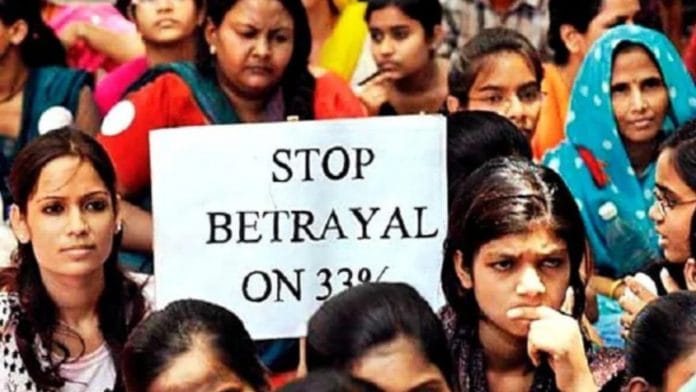

The patriarchy of the BJP-RSS is deeply entrenched. For the Sangh Parivar, free, independent women are Public Enemy No. 1. In fact, the BJP-RSS has a woman problem. They are okay with women as symbols, but deeply uncomfortable with women as autonomous citizens; they are full of barely concealed loathing for women they cannot define, discipline or contain.
The Narendra Modi government’s posters, slogans and endless “beti” this, “didi” that and “behan” this, conceal a cloying paternalism designed to keep women exactly where the BJP wants them. Preferably marked by sindoor and mangalsutras (the “acceptable” dress code), culturally compliant, and perpetually grateful for any visibility at all.
The Sangh Parivar venerates women as symbols, but distrusts them as individuals. Deification can become a form of entrapment. Satyajit Ray’s unsettling film Devi revealed how a father-in-law, convinced his daughter-in-law was a “goddess”, kept her virtually caged at home.
The Sangh mentality on women was recently exposed again in the right-wing hyperventilation over the actor Kriti Sanon after she appeared in a GIVA Raksha Bandhan ad wearing an Indo-Western outfit. The outfit promptly became a battlefield on which Hindutva warriors set out to “save” Indian civilisation. A shrill right-wing social-media uproar erupted as if Sanon’s clothing was a national moral emergency. BJP MP Kangana Ranaut demanded to know why anyone would tie a rakhi dressed in “a bikini or undergarments”. Faced with the outrage, the advertiser withdrew the ad.
The ad was erased. What was also erased was the BJP-RSS’s so-called pretence at being pro-women.
The attack on Sanon was a conservative witch-hunt dressed up as cultural concern. What offended the vigilantes was a woman’s freedom, a woman exercising free choice about her garments. How dare she be so free?
Also Read: Nehru built parliamentary democracy. Modi has spent a decade dismantling it
‘Empowerment’ with a male veto
This episode followed a pattern. BJP big shots regularly police what women wear. In 2014, Manohar Lal Khattar said women should dress “decently” and inveighed against “short clothes” worn because of “Western influence”. In 2021, Tirath Singh Rawat blustered against women wearing “ripped jeans”. By the way, patriarchy does not operate only through men; it also recruits women to police other women.
At the heart of the Sangh worldview is a simple refusal: women are not granted agency. At his recent women’s rally in Pune, Rahul Gandhi identified this trap. Women, he said, cannot be confined to the three identities of daughter, wife and mother. They belong first to themselves. His message was admirably unequivocal for a mainstream national leader: “Be loud. Be proud. Fight for your space in society. Smash the patriarchy.”
The meaning of violence against women extends beyond physical assault. Denying a woman education, employment, property, mobility, political power or the right to speak is also violence. A cage does not become benign merely because its bars are decorated with flowers and ribbons.
The BJP’s entire vocabulary for women runs through relationships with men. “Beti.” “Behan.” “Didi.” Women are judged by which man they are related to, not by what they say, think or write. For example, BJP trolls often respond to my writings by tagging my husband’s name. Why? What does my husband have to do with my work as a writer or in public life? Yet invariably the right wing counters my arguments by summoning a male relative, as if a woman’s words cannot be answered on their own.
Patriarchy’s favourite woman is forever somebody’s something. A woman who claims independence, who exercises real choice, doesn’t fit anywhere in the Hindutva imagination.
Last year, Chief Election Commissioner Gyanesh Kumar defended not sharing CCTV footage from polling booths for fear of violating the privacy of mothers, daughters, daughters-in-law and sisters. But privacy belongs to every voter. Why did Gyanesh Kumar reach specifically for the image of someone’s sister or mother? Why transform women exercising the public right to vote into sheltered female dependants whose modesty must be guarded?
The BJP will point to Beti Bachao, Beti Padhao, Ujjwala cylinders and welfare transfers. A gas cylinder can ease a woman’s labour, but it cannot substitute for freedom. A party cannot declare itself emancipatory merely by dispensing daily benefits while continuing to police women’s clothes, love, speech and ambition. Empowerment is not something a benevolent male-dominated government hands down. Empowerment begins when the male veto is removed.
A dangerous lakshman rekha
The denial of personhood, individuality and freedom to women is the reason the BJP has never produced an Indira Gandhi or a Mamata Banerjee. Indira Gandhi and Mamata Banerjee were not merely women occupying high office, but women who authored their own political projects and took charge of their own destinies.
Indira Gandhi was patronisingly dismissed as a goongi gudiya, a nasty slur. Yet she shattered that stereotype and emerged as a formidable political force. Mamata Banerjee built a political start-up from scratch, defeated the mighty 34-year-old Left Front (so-called “progressive” communists hurled dreadful misogynist abuse at her) and served three terms as chief minister, seven terms as MP and several times as Union minister. Indira Gandhi and Mamata Banerjee possessed, and possess, what BJP women lack and are denied — individual agency and autonomy. The freedom to pursue ambitions that are not defined and approved by men.
The BJP can be vicious about independent high-achieving women. West Bengal Chief Minister Suvendu Adhikari’s recent threat against Mamata Banerjee, the erstwhile mentor under whom he rose, is an example. Adhikari recently declared that Mamata Banerjee should remain at home doing Facebook Lives, and said that he would “make arrangements” so she could never come out into the streets. Why? How does anyone in democratic India get the power to order anyone else to stay imprisoned at home?
Would Suvendu Adhikari dare to tell a former three-term male chief minister to stay indoors and “take rest”? Adhikari unleashed patriarchy’s oldest, most venomous threat against Mamata Banerjee: order a woman to stay at home.
The same double standard surfaced during the July 2026 student protests. In a video appealing for “forgiveness” for protesters who had used swear words against him, Narendra Modi described it as a “cultural shock” that “our daughters” were using such language. Why “our daughters”? Why not young citizens? When men speak harshly, the offence is treated as mere incivility. When a girl speaks her mind, her gender itself becomes an offence — a fall from prescribed notions of womanhood. The 15-year-old Modi referred to was attacked mercilessly. She and her widowed mother faced such savage online harassment that they were forced to leave their home.
The message was unmistakable: cross the lakshman rekha and you, your face, your body, your family, home and entire future can all become targets. Your freedom exists on the patriarch’s permission and terms.
Also Read: Don’t be so quick to write obituaries for the Opposition. We’re still alive and kicking
The Sangh’s glass ceiling
The denial of female autonomy is built into the Sangh’s institutional structure. RSS membership is entirely restricted to men. Women are directed into the parallel Rashtra Sevika Samiti. They can serve the same ideological project but can’t enter the organisation on equal institutional terms.
What has befallen the BJP’s women leaders? The late Sushma Swaraj, her generation’s most eloquent parliamentarian, was sidelined. Swaraj was designated External Affairs minister, yet Modi personalised foreign policy around himself. Vasundhara Raje — arguably the closest the party has had to a genuine independent power centre, a two-time chief minister just as senior as Modi — has been kept at a distance by the Modi-Shah High Command. Former chief minister Uma Bharti, stereotyped as “unpredictable”, has also receded from the centre. None of them was ever allowed to step outside the box the BJP built for her, even when she had earned the right to.
Smriti Irani is deployed primarily as a combatant against the Gandhis. Delhi Chief Minister Rekha Gupta is a nominated face rather than a stalwart Delhi figure. Kangana Ranaut is known primarily for who she attacks. Nirmala Sitharaman, the finance minister, operates a ministry under the thumb of the PMO. Where does Sitharaman stand as an economic thinker? Is she a liberal, welfarist, free-marketeer or populist? She has never been permitted to articulate her own economic doctrine. “Modinomics” is spoken of, not “Sitharaman-nomics”.
The BJP has not produced a single woman with independent standing and a public philosophy of her own — no one who has built a political movement from scratch the way Mamata Banerjee has, no one who commanded power and popularity the way Indira Gandhi did.
Uttar Pradesh Chief Minister Yogi Adityanath recently invoked the Manusmriti to attack Rahul Gandhi over his remarks on gender equality, but have women in UP been genuinely empowered? According to NCRB data, UP ranks first in crimes against women.
Also Read: Don’t be so quick to write obituaries for the Opposition. We’re still alive and kicking
A 21st-century misfit
I have always argued that visibility is not equality and symbolism is not a power shift. This cynicism is clear in the Modi government’s approach to women’s reservation. Implementing the Women’s Reservation law passed in 2023 — providing for one-third representation of women in the Lok Sabha and Vidhan Sabhas — in the present 543-member Lok Sabha would mean a genuine redistribution of power. Women would get 181 seats, while 362 would go to men. Political parties would have to dislodge entrenched male incumbents and compel powerful men to cede actual space and share power. Yes, 181 women to 362 men is genuine power-sharing.
But that is precisely what the Modi government has sought to avoid by linking women’s reservation with the delimitation exercise. This could dramatically expand the Lok Sabha, possibly to around 816 seats. In an 816-member House, one-third reservation would give women 273 seats while the remaining 543 would go to men. The absolute number of seats held by men would actually increase. Entrenched men would retain their places while women would be merely accommodated in the massively expanded House — 273 women and 543 men is by no means a fair distribution.
It’s not a genuine transfer of power. It is the management of powerful men’s discomfort at the prospect of women entering Parliament in unprecedented numbers. As a columnist has written, it amounts to adding a “larger zenana wing to an enlarged patriarchal haveli” while leaving its male-dominated structure intact. Increase the size of the Ladies Compartment, but let the rest of the train remain with the men. This is not Nari Shakti. It is male appeasement dressed up as women’s empowerment.
On a different but equally urgent note, a huge burden would be added on the taxpayer by increasing the number of MPs to over 800.
The Sangh Parivar’s fixation with “love jihad” is another example of its entrenched patriarchy. It makes sense only if you assume women are incapable of making their own choices and are mere commodities to be protected from lustful Muslim men. The “love jihad” obsession infantilises women.
Interestingly, the same voices demanding that Hindu women stay within the lines of “tradition” in their clothing are often the same as those insisting Muslim women cast off the traditional hijab. Actually, women’s clothing is never about women. It’s about who gets to decide what women can wear.
The BJP-RSS’s patriarchy is cunningly disguised as “tradition” and “culture”. Instead, it is a violent woman-hating mindset intent on the denial of autonomy, individuality and freedom to women.
Real freedom means recognising every woman’s right to wear a hijab, or remove it, choose a sari or ripped jeans or a bralette — and change her mind without seeking anyone’s ideological permission.
Women’s bodies are not political territory. Women’s choices do not require cultural clearance from politicians, ministries, or social media troll armies.
The BJP-RSS’s patriarchy is a misfit in the 21st century. Rahul Gandhi is spot on: this patriarchy needs to be smashed.
Sagarika Ghose is a Rajya Sabha MP, All India Trinamool Congress. She tweets @sagarikaghose. Views are personal.
(Edited by Asavari Singh)
Patriarchy will stay as long as the sangh is funded by big money – and the congress committed a very big blunder by not forcing the r s s to register as a society in the beginning. Only the Gen z and the Gen Alpha can bring about a change in the future, hopefully.
Madam, First ask your role model Rahul Gadhi and his mother Sonia Gandhi to stop patriarchy and allow Priyanka Gandhi Vadra to take political leadership. Also in your state West Bengal, where women are worshipped, rape was used against women against political adversaries. It was started by CPI(M), and continued by your party TMC. So stop being a hypocrite and forgo double standards.
There have been some tall female leaders after Prime Minister Indira Gandhi. Ms Jayalalithaa. Ms Mayawati. Ms Mamata Banerjee. Self made in political terms. Else those we see in Parliament and elsewhere largely from political families. Seems to be woven into our society, not just one political party.
Those who live in glass houses, should not throw stones at other houses. RSS narrative may not be what the modern society expects, but as a silent spectator to the horrors forced upon Hindu women during TMC rule, your argument about female agency reeks of hypocrisy and double standards.
Standard politician stuff. Mud slinging is all that you politicians can do. Working for improving the country, welfare of citizens and creation of jobs, maintaining law&order, reducing corruption, they are all not even tertiary tasks for you people. And when i say politicians i mean all politicians.
The reality of women’s safety in West Bengal—from the systemic horrors of Sandeshkhali to the institutional cover-ups of the R.G. Kar hospital tragedy…is more than enough to haunt this cantankerous, cacophonous politician for the rest of her life. What an abysmal failure of leadership to lecture the nation on ‘female agency’ while serving as a silent spectator to the atrocities happening in her own backyard