






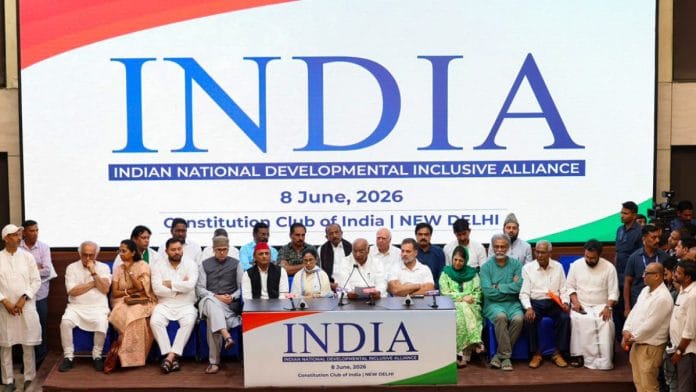


This seems to be the season of writing obituaries for the Opposition. “The end”, “it’s all over”, “there can be no revival”—are common refrains.
The commentariat is busy drafting death certificates. The Trinamool Congress has been defeated in Bengal. Mamata Banerjee, the Opposition stalwart no longer occupies the chief minister’s chair. The Congress is supposedly leaderless and directionless. The DMK has been displaced by a new force. Narendra Modi, we are repeatedly being told, is invincible.
The BJP is unstoppable. The Opposition is finished. The hand- wringing is endless. The lamentations are incessant.
But before we consign the Opposition to the political graveyard, let’s undertake a much-needed reality check.
In Bengal, the dominant narrative is that the BJP has decisively defeated Mamata Banerjee and the All India Trinamool Congress. Yet, beneath the headline lies a far more nuanced story.
The BJP secured 45.9 per cent of the vote in Bengal; the Trinamool secured 40.6 per cent. After fifteen years in office, facing relentless political, institutional and media hostility, up against a hopelessly biased Election Commission and a brazenly one-sided media, the gap between the “winner” and “loser” is just about five percentage points.
In absolute numbers, the BJP received 2.93 crore votes and the Trinamool 2.60 crore votes—a difference of roughly 33 lakh votes in a state of nearly ten crore people.
More significantly, if one aggregates the votes polled by the Trinamool, Congress and Left, the anti-BJP vote percentage remains higher than the BJP vote percentage. It’s crystal clear: More people voted against the BJP than for the BJP in Bengal.
Yes, under the first-past-the-post system, the BJP converted its vote share into a 200+ seat tally. But the notion that Bengal has suddenly become the Modi-led BJP’s citadel is simply not borne out by the numbers. Bengal has not wholeheartedly embraced the BJP.
Instead the state has witnessed a fiercely competitive election, where with the EC batting openly for one side, the BJP edged ahead.
Also read: Amit Shah, not PM Modi, is Mamata Banerjee’s real challenger in this Bengal election
Dubious election
There is another extremely important fact. The difference in total votes between BJP and TMC as I mentioned above is 33 lakh. But 34 lakh voters remain under adjudication following the highly controversial SIR exercise, and could not vote in the assembly polls. The partisan conduct of the Election Commission—two officers in charge of overseeing the elections have now joined the BJP government in Bengal as Chief Secretary and Adviser to the BJP Chief Minister—has dogged the Bengal polls from start to finish. If 34 lakh had not been deprived of their right to vote, the Bengal results might have been very different.
Ninety-one lakh names were struck from electoral rolls. Central forces interfered with counting processes, the AITC’s counting agents were beaten up as they sat at the counting tables and there were reports of highly questionable outcomes in closely contested constituencies.
The case of Rajarhat-New Town is particularly troubling. A last-minute surge from a predominantly Muslim booth swung the result to the BJP in circumstances that have raised serious questions. It is slated to become the subject of an election petition. The BJP “winner” from Rajarhat New Town secured the seat by 316 votes.
In Jangipara, where SIR-related deletions numbered over 17,000, the AITC candidate lost by 862 votes. If a handful of the deleted voters had been allowed to vote, the AITC would have won.
In seats where the scale of SIR deletions was far in excess of the victory margins, the results could well have swung the other way without the deletions.
Whether these reports ultimately stand legal scrutiny is for the courts to decide. But one thing is clear: The Bengal assembly polls of 2026 will remain among the most dubious, disputed and controversial verdicts in post-Independence India. To treat the Bengal result as an uncomplicated endorsement of the BJP is intellectually dishonest.
Also read: Opposition doesn’t know how to beat BJP. What it can learn from Hungarian Magyar’s playbook
Arithmetic, not hegemony
The second reality check concerns the BJP’s own mandate. Let us not forget that in the 2024 Lok Sabha election, despite the bombast of “Abki baar 400 paar”, the BJP secured only 240 seats. It fell well short of a majority. The government that emerged was not the product of a sweeping mandate but of coalition arithmetic. The BJP is in power because it is propped by Nitish Kumar’s JDU (12 MPs) and Chandrababu Naidu’s TDP (16 MPs). Without the JDU and TDP the so-called invincible Modi-led BJP would fall.
The popular mandate did not authorise one-party dominance. Yet the BJP is making a visible effort to manufacture a political majority through inducement, intimidation, coercive state power and the relentless use of investigative agencies. The attempt is not merely to win elections but to all eliminate the political opposition. Lacking a mandate from the people, the BJP is using ‘saam, daam, dand, bhed (persuasion, incentives, punishment, exploitation of differences)’ to subvert the people’s will in 2024.
The third reality check is geographical. For all its efforts to present itself as India’s unanimous choice, the BJP remains a marginal force across large parts of southern India. Its electoral strength continues to be concentrated in the Hindi-speaking heartland and adjacent regions. The Modi phenomenon, despite the rah-rah media narrative, is not uniformly national. It has geographical limits. Beyond the core Hindutva belt, the BJP’s appeal weakens considerably.
The BJP’s dream of permanent dominance rests heavily on the demographic weight of north India. That is arithmetic, not real hegemony.
Also read: There’s never just one cockroach. Abhijeet Dipke only turned on the light
Bruised, not buried
Meanwhile, reports of the Opposition’s demise are greatly exaggerated. The INDIA bloc may be bruised, but not buried. It is relearning the lessons of coalition politics. There was a high degree of camaraderie at the INDIA alliance meeting Monday morning. The Opposition alliance is now firmly in the process of resurrection. Across India, strong regional leaders continue to command loyalty. Experienced administrators continue to govern major states. The organisational footprint of the Opposition remains vast. After 15 years in power Mamata Banerjee still secured almost 41 per cent of Bengal’s vote.
In the 2024 Lok Sabha elections, the Congress upped its tally by almost 50 seats.
But perhaps the most important development is taking place outside formal party politics. The Opposition is no longer confined to opposition parties. Students and parents are enraged over examination paper leaks. Youth frustration is growing. The youth-led Cockroach Janta Party has just held a high-profile rally demanding the resignation of the Education Minister. Farmers continue to mobilise. Civil society groups are organising. Constitutional rights organisations are active. Across north India, protests have erupted around jobs, recruitment examinations and governance failures. It’s a noteworthy paradox: Electorally, the political Opposition may appear weakened. Socially and politically, however, the opposition space is larger than ever before, and growing.
Then there is the economy. The Modi government may be winning elections, but it is steadily losing the economic argument. Official GDP figures paint a picture of robust growth: The government recently released a report showing a 7.7 per cent growth in GDP. Yet, beneath these numbers lies growing distress. Private investment remains sluggish. Consumption is uneven. The rupee continues to weaken. Foreign capital flows are volatile, and FIIs are leaving India. Employment generation remains inadequate.
High-profile corporate scandals, like the recent shocking scam involving Rajesh Exports with alleged irregularities running into Rs 15.5 lakh crore has come to light in a SEBI interim report. The fact that none other than the Life Insurance Corporation of India—the custodian of the savings of millions of Indians—has been investing in Rajesh Exports is highly alarming.
Of course, the government’s formidable media machinery works tirelessly to celebrate the Modi personality cult and magnify every Opposition weakness. The media is laser-focused on the Opposition and keeps giving the Modi government a free pass. The government-subordinated media pumps out Modi-friendly coverage on an industrial scale.
But even the most compliant Modi-adoring sections of the media have been unable to ignore the reality of examination paper leaks, deadly fires, building collapses and glaring governance failures.
Reality has a way of intruding upon propaganda. History offers a final lesson.
As Indira Gandhi’s biographer, I am struck by the parallels between 2026 and 1972-73. After the triumph of 1971, Indira Gandhi appeared politically invincible. The Congress swept national and Assembly elections. The Indira cult dominated public life.
Then came the oil shock of 1973, triggering a deep global recession. Inflation soared. Economic distress deepened as price rise spiralled upwards. Student movements gathered momentum starting from the Nav Nirman movement in Gujarat. Within a remarkably short period, the seemingly invincible leader found herself cornered. In 1975, the Allahabad High Court judgment shook the Indira regime. The Emergency was declared on 25 June 25 and just two years later, in 1977, the impossible happened: Indira Gandhi was defeated.
The posters did not save her. The slogans did not save her. The publicity blitz did not save her. The cult of personality did not save her. History’s most enduring lesson is that no leader is invincible and no political order is permanent.
The next three years will be decisive for India. The battle is far from over. Which is precisely why the premature obituaries written for the Opposition belong in the dustbin. The truth is: Opposition zinda hai. The Opposition is alive and kicking.
Sagarika Ghose is a Rajya Sabha MP, All India Trinamool Congress. She tweets @sagarikaghose. Views are personal.
(Edited by Theres Sudeep)
What kind of world are we living in?
Aggregating TMC, Congress, and Left votes as a unified “anti-BJP” bloc is a classic post-defeat rationalization…those parties competed against each other, and there’s no guarantee their voters are transferable. The claims about SIR deletions and counting irregularities are mere allegations, as she herself concedes, they’re untested in court; an election petition over a 316-vote margin in one seat doesn’t invalidate a 200+ seat result.
And the Indira Gandhi parallel is the kind of historical analogy that’s suggestive but proves nothing… every losing side believes it’s in its 1973 moment.
Post-defeat opinion pieces by party politicians aren’t meant to be psephology; they’re morale documents, written as much for demoralized cadres as for neutral readers.
As always, cantankerous and cacophonous.
Pity what is happening to the TMC.
Okay, madam. Best wishes to you, Goddess Mamata, Sonia mata, and Rahul baba.