








Driving through the IA market in Kolkata’s Salt Lake ahead of the second phase of polling in West Bengal, I stopped to listen to a young politician’s fiery speech before a gathering of 40-50 people. He was Ranajit Mukherjee, the Congress candidate from the Bidhannagar constituency. I caught up with him later: “Do you really fancy your chances?” He was forthright: “No, but I am doing it for the next election. I want the people to know my face now. I will fight for them for the next five years. By 2031, the Congress will be a formidable force in Bidhannagar.”
A few days earlier, Rahul Gandhi had launched a broadside against Chief Minister Mamata Banerjee, saying that if she had run a clean government and not polarised Bengal, the BJP wouldn’t have gained an opening in the state. I asked Ranajit about Gandhi’s attack. Ranajit vehemently defended Gandhi, emphasising how being in alliances for two decades hurt the Congress. He found barely 20 party workers in the constituency to campaign for him.
“Rahul ji has done the right thing. It’s time the Congress stood on its own and brought back its voters and workers who left the party,” he said. The Congress stands to gain from Banerjee’s loss, as she was the one who appropriated its voters after quitting the party in 1997. “The BJP remains our principal enemy, of course,” Ranajit clarified hastily.
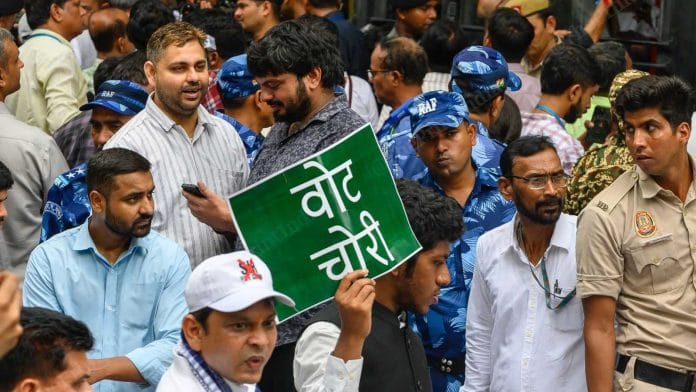
The Bidhannagar Congress candidate, who ended up with 1,498 votes, was obviously in a dilemma: whose defeat is better for the Congress—Mamata Banerjee’s or the BJP’s? His party high command is no less confused. Days after his tirade against Banerjee, Rahul Gandhi began chastising those “gloating about TMC’s loss” and alleging a “theft” of “Bengal’s mandate” by the BJP. An analysis of the results by my colleague, Moushumi Das Gupta, shows that there were 26 seats where the BJP’s victory margin was less than the number of deleted voters under dispute. There were 86 seats where the BJP’s victory margin was bigger than the deletions. But even without those 27 lakh controversial deletions, the BJP would have dethroned the Trinamool Congress government. Facts seldom come in the way of conspiracy theories as we know.
For Congress, it’s survival over revival
In Tamil Nadu, the Congress has dumped its old ally, MK Stalin’s Dravida Munnetra Kazhagam (DMK), and supported actor Vijay’s Tamilaga Vettri Kazhagam (TVK). The idea is to stay on the winning side. Not long ago, Rahul Gandhi-led Youth Congress leaders in Tamil Nadu delivered slogans about bringing back ‘Kamaraj rule’, referring to the period when the Congress ruled the roost in the state. Gandhi has forgotten about that mission now.
In 2018, then-BJP president Amit Shah had said that his party would rule India until 2050. That evoked wistful sighs in the ruling camp and contemptuous sneers from Opposition leaders. Eight years later, Shah’s prophesy comes to mind as the principal Opposition party keeps peddling conspiracy theories while trying to hang on to regional parties’ coat tails. Yet these are the very parties that brought the Congress down to where it is today. From the DMK to the TMC, the Samajwadi Party, the Nationalist Congress Party (NCP), the Rashtriya Janata Dal—you name it—the regional parties demolished the Congress brick by brick. It’s their current vote banks Gandhi should have been looking to reclaim if he wanted to revive the Congress. He has, however, chosen to make them allies—and even play second fiddle to them—in his ideological war against the BJP. Survival, not revival, seems to be the priority.
Does the Congress have a plan to defeat the BJP? It doesn’t, as is evident again from the latest round of elections. The party is hoping for a better show once Prime Minister Narendra Modi hangs up his boots. It hasn’t noticed that the BJP has become an electoral juggernaut and looks already prepared for the post-Modi era. It was the party’s chief strategist, Home Minister Amit Shah, who engineered the fall of the Mamata Banerjee government. And the Assam election was entirely Himanta Biswa Sarma’s show. There were similar stories in Haryana, Maharashtra and Delhi. The Opposition is also playing a waiting game because it doesn’t have a plan. A DK Shivakumar or Revanth Reddy here, and a Hemant Soren there might put up a fight, but the Opposition largely looks clueless about how to defeat the BJP.
Opposition leaders list a host of reasons or excuses for this—the BJP’s well-oiled organisational machinery, its vast resources, support of crony capitalists, compromised institutions, the Rashtriya Swayamsevak Sangh (RSS), biased media, and whatnot. The fact is that the Opposition in Hungary was also citing similar reasons—except the RSS, of course—to explain then-Prime Minister Viktor Orban and his party Fidesz’ iron grip on the country. Peter Magyar, a corporate lawyer who quit Fidesz to rejuvenate the inactive Tisza Party, took just two years to demolish Orban last month. Of course, PM Modi is not Orban and the BJP is not Fidesz. But there is a lot for the Indian Opposition to learn from Magyar. He refused to join hands with the traditional, fragmented Left-wing Opposition parties, which had come together to dislodge Orban from power in the previous parliamentary election in Hungary. Rahul Gandhi has chosen to go with the same old parties. One can also argue that Gandhi is not a breath of fresh air, like Magyar.
Also read: The siren that took 15 years to ring—Inside India’s emergency tech saga
Winning over rival voters
The Congress leader might have seen this headline in The Guardian: “Péter Magyar’s real coup was winning over loyal Orbán voters – not preaching to the converted.”
Gandhi has been preaching to the converted, taking positions that would endear him to the Left and liberal intelligentsia in India and abroad.
Hungarian political theorist Nóra Schultz, who authored the article, wrote: “Instead of dwelling on the obstacles or playing the victim card while talking to voters from the comfort of Parliament or Budapest-based TV studios (as so many of the so-called old opposition did), he began to tour the country and organise rallies, even in the Fidesz heartlands. His events featured Hungarian flags, folk songs, poems and historical references.”
Pointing out the role of national culture in Hungarian politics, she wrote, “Fidesz clearly tried to appropriate patriotic symbolism, and associate everyday things such as going to a football match with support for the right. The left-liberal parties were rightly critical of this. However, instead of offering an alternative vision of Hungarian national identity, they shied away from this issue for the most part, avoiding national symbols, conceding ground to Fidesz.”
Magyar focused on issues that mattered to the people in their day-to-day lives—cost of living, problems in public healthcare and transport, corruption, inflation, low wages, etc. Rahul Gandhi does refer to such issues, but mostly in passing and rhetorically. There is no sustained campaign.
Another article in The Guardian pointed to Orban’s vulnerabilities: “The communication machine that once allowed Fidesz to frame everything from migration to inflation as the fault of enemies of the nation gradually lost its grip on the public. The narrative of the external enemy became too inflated. After four years, warlike rhetoric lost its shock value.”
It explained how Magyar scrapped the traditional opposition playbook. “Instead of campaigning to the left, he laid claim to Orban’s political space. Tisza’s messaging was that Fidesz was no longer the true patriotic party and that Magyar’s Tisza would assume that mantle.”
Also read: Mamata’s ‘I haven’t lost’ verdict will haunt the BJP. Resistance is her grammar
Nationalism is BJP’s turf
One could argue that Magyar could claim that space because he was a former member of Fidesz and the Tisza Party was also centre-right. Rahul Gandhi’s Congress has actually moved from the centre to the left. Global investor Ruchir Sharma recently argued that the BJP was dominant because there was no competition on the right. Well, the Aam Aadmi Party’s Arvind Kejriwal did seek to occupy that space by reciting Hanuman Chalisa, praying with his family and Cabinet colleagues at the Ayodhya Ram temple replica in Delhi’s Thyagaraj stadium and later visiting the temple in Ayodhya, supporting the abrogation of Article 370, introducing patriotism classes in government schools, and staying away from Shaheen Bagh protests, among others. That could perhaps explain why the BJP went after him with a sledgehammer.
The Congress struggles to fend off the BJP’s charge of minority appeasement. Around 55 per cent of its newly elected MLAs in the four states are Muslims and Christians. Eighteen out of 19 Congress MLAs in Assam are Muslims, prompting even AIUDF president Badruddin Ajmal and the BJP’s Amit Malviya to call it the “Muslim League”. It’s unfair criticism, of course. There is nothing wrong in the Congress wearing secularism on its sleeve, advocating the minorities’ cause and soliciting their support. Where it plays into the BJP’s hands is when its government in Karnataka allocates Rs 600 crore for the development of colonies for minorities.
In the run-up to the Assam election, Congress president Mallikarjun Kharge promised to rehabilitate those who were evicted by Himanta Sarma government’s anti-encroachment drive. It came as a reminder of the Hungarian Left’s opposition to Orban’s anti-migrant border fencing. Similarly, a party that questions the achievements of Op Sindoor and talks about the downing of Indian fighter planes can’t counter the BJP’s nationalism pitch. Moreover, gleefully taunting PM Modi for being ‘scared’ of US President Donald Trump doesn’t really raise a party’s nationalist credentials.
The Congress doesn’t need to move to the centre-right to take on the BJP. It just needs to return from the left to the centre. After all, 63 per cent of voters didn’t choose what is seen as India’s only centre-right party in the 2024 Lok Sabha election.
DK Singh is Political Editor at ThePrint. He tweets @dksingh73. Views are personal.
(Edited by Prashant Dixit)
Mr. DK Singh has consistently batted on behalf of the TMC and Mamata Banerjee. In fact, ThePrint, as a media platform deliberately chose to not focus on the plethora of scams C was indulging in. It framed those scams as BJP’s conspiracy to create trouble in Bengal. BJP workers were subjected to egregious violence by TMC goons – murders, gangrapes and what not – yet ThePrint was silent. The silence of Mr. Shekhar Gupta signalled his tacit approval of the TMC’s unbridled corruption and hooliganism.
ThePrint’s coverage of Bengal over the last several years should ashame any conscientious citizen.
It’s funny if he actually does what Magyar does. Magyar is a nationalist which is why he was able to convince the orban voters to give him a chance ?
Now, is Sri rahul gandhi, a nationalist ? No he is the complete opposite of it. Some would even use the dirty word “anti national”.
Let’s be honest, what is the perception of Congress in this country among young people ? Most I know thinks it’s Muslim league in the making ? It’s not a bad thing if you want to become a better version of AIMIM but please don’t expect me to vote for you.
There are a million problems with BJP yet people vote for it because they don’t see any other option. Rahul will get liberal elites to clap for him but a common man is fed up of him.
So can he copy maygar ? A resounding NO.