






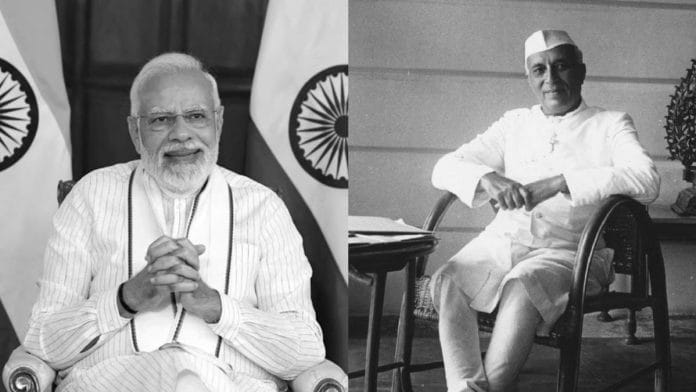


For 12 years now, Narendra Modi and the ruling BJP have run a permanent campaign against India’s first prime minister Jawaharlal Nehru. Delhi’s Nehru Memorial Museum and Library has been renamed. A 2021 poster to commemorate ‘Azadi ka Amrit Mahotsav’ omitted Nehru from the line-up of independent India’s founders. The party’s IT cell is unleashed on cue every time Nehru’s name comes up. The Modi-led BJP’s fixation on Nehru is so obsessive that ‘Blame It On Nehru’ has become an internet meme.
But instead of always attacking Nehru, Modi should in fact learn from our first and greatest prime minister.
This year, on Independence Day, Modi delivered a rambling, unusually hesitant 75-minute speech. In it, he designated a new national enemy for India: the ‘dimagi Naxal,’ or those who believe in leftist protest. Who are these ‘dimagi Naxals?’ Modi did not specify beyond blustering that they are preventing the emergence of Viksit Bharat. The ‘dimagi Naxal’ is the latest ‘enemy’ in the list of ‘enemies’ Modi has marked out through a sustained campaign of public name-calling to delegitimise all dissent. Modi has hurled abuses such as ‘andolanjeevis,’ ‘Khan Market Gang,’ ‘urban Naxals’ and now ‘dimagi Naxals’. Instead of building bridges between people, he chooses to build walls instead. This time, he has targeted those who think a certain way, a direct assault on the Constitution, which guarantees, in the Preamble itself, liberty of thought.
There was another more telling omission in Modi’s speech. He did not once mention what is arguably the proudest achievement of Indian independence: a functioning Parliament.
Not once did Modi speak of parliamentary democracy, the institution that is the beating heart of the republic.
It was not a surprising evasion. Modi was absent from Parliament throughout the 2026 Monsoon Session. He and Union Home Minister Amit Shah did not set foot in Parliament except at the ceremonial edges — the national anthem at the start and the national song at the end.
Modi now holds a dubious record — he becomes the only prime minister in India’s history who skipped an entire session of Parliament. For 20 days, the Opposition demanded that he and Shah come to the House. We shouted in vain. Both remained missing.
A mention Modi couldn’t afford
No wonder Parliament went unmentioned in Modi’s speech. Had Modi actually engaged with the subject of parliamentary democracy, he would have been forced to give credit to Nehru, the prime minister who built and nurtured India’s Parliament through its most fragile years.
Nehru came to Parliament every day without fail at 11 am. He allowed the Opposition to speak. He allowed a young Atal Bihari Vajpayee, an opposition MP and the leading speaker of the Bharatiya Jana Sangh, the platform to grow into the towering leader he eventually became. It was Nehruvian parliamentary democracy that made Vajpayee’s emergence possible. Vajpayee built his own profile and his party because Parliament gave him the space to do so.
Nehru is famously said to have predicted that Vajpayee would one day become prime minister—an ideological rival was given the oxygen to rise.
Nehru listened to parliamentary proceedings through a loudspeaker wired to his office desk. Socialists, communists, Nehru’s fiercest ideological rivals—Ram Manohar Lohia, Hiren Mukherjee, men who attacked Nehru with venom—were all heard, engaged, and occasionally conceded to.
The question can be asked: are Opposition leaders today being given that kind of space by the Modi government? Are they being given a platform, dignity and respect? No, they are being hounded, raided, suspended, muzzled and silenced. The lion’s share of Zero Hour mentions go to the BJP. Most Starred Questions (or questions where ministers answer orally on the floor of the House) are all given to the BJP.
Maybe before the Winter Session, Modi should read the parliamentary proceedings of the 1950s and ’60s—Vajpayee’s speeches, Hiren Mukherjee’s speeches, the cut and thrust of a Parliament that argued hard, argued honestly, and still respected itself and its opponents.
Nehru’s own cabinet contained Syama Prasad Mookerji, founder of the Jana Sangh and a committed Nehru detractor and critic. When Nehru died in 1964, it was Vajpayee—his ideological opponent for two decades—who rose in the House to describe him as Bharat Mata’s “rajkumar.” In my biography of Vajpayee, I have quoted these words he wrote about Nehru: “He (Nehru) considered Parliament a sacred temple…his very presence charged the atmosphere in the House lending it greater prestige, greater seriousness.”
Modi, by contrast, has never, not once in 12 years, taken a question in Question Hour, which exists precisely so that the executive can be held to direct account by elected representatives. Question Hour is the most democratic mechanism built into the parliamentary system, the moment when a minister cannot hide behind a scripted speech and must answer on the House floor. Twelve years, and the prime minister of the world’s largest democracy has never once submitted himself to it.
Hollowing-out parliamentary democracy
Besides barely coming to Parliament, Modi does not listen to Opposition speakers either. When Modi speaks in Parliament, his campaign-style speeches are pitched over the heads of the House to television cameras and social media clips. He does not attend all-party meetings, the customary forum where the government and Opposition thrash out how a session will run. And yet, ahead of every single session, Modi enacts the ritual appeal for “cooperation”—as if Parliament, having been held in open disdain for a decade, might suddenly start co-operating like a switch being flipped on.
On taking power in 2014, Modi famously prostrated himself at the steps of Parliament, touching his forehead to the stone, in a moment that was replayed endlessly on television as a symbol of humility before the temple of democracy. It was nothing but hollow optics.
After 2014, what has followed has been not humility but a hollowing-out. The Gujarat model—minimal space for the Opposition, budgets rammed through without discussion, and Opposition members suspended en masse for protesting too loudly—was brought to Delhi and scaled up to the national stage.
In December 2023, the Bharatiya Nyaya Sanhita laws were passed while 146 Opposition MPs remained suspended. In this Monsoon Session, bills have been rammed through with lightning speed: in 17 days, the Modi government passed 10 bills, allowing an average of four minutes per bill. The Opposition was given no meaningful chance to scrutinise what was actually being voted on. Twenty years ago, six out of ten bills went through committee scrutiny. Today, it’s fewer than two out of ten.
In parliamentary democracy, political opponents are not enemies. Disagreement and fierce ideological disagreement are part of the furniture of democracy. But for Modi, the Opposition is the enemy—personal enemies and enemies of the state. All Opposition members are “anti-national” or various other pejoratives like ‘dimagi Naxal.
Central Hall, once a warm, welcoming place where parties across the aisle met with conviviality, where a Congress MP and a BJP MP once shared a cup of tea and a joke between sessions, has been shut down.
Media access to Parliament has been squeezed to a fraction of what it once was. The legislative agenda now moves by stealth—will the FCRA be introduced? Will delimitation be brought in? There are whispers and hints, no open transparent declaration of the government’s intent.
Parliament is treated not as an institution to be respected and worked through, but a forum for intense political machinations and dark debilitating intrigue.
Modi-Shah responsible for trust deficit
Modi and Shah came roaring into this Monsoon Session having just presided over the engineered breaking of the Trinamool Congress, Aam Aadmi Party and Shiv Sena—parties were split, defections managed, factions rewarded. It is ironic that having come into the session, boasting that parties have been broken, Modi and Shah have been forced on the back foot and gone out with a whimper.
If breaking Opposition parties is the norm, how exactly is the Opposition supposed to trust a government? When the Home Minister is himself busy splitting rival parties, how can cooperation be demanded during Parliament? How does parliamentary cooperation survive when Opposition parties are being broken outside Parliament? How does political trust survive when defectors can smoothly cross over towards the treasury benches while disqualification proceedings are pending?
You cannot demand bipartisan goodwill inside Parliament while practising political warfare outside it. Trust is not a press release issued before the beginning of a session. Trust has to be earned.
It is shocking, deeply absurd, and constitutionally unacceptable that a breakaway faction of the TMC can be embraced and legitimised by the treasury benches while the Speaker sits — indefinitely and conveniently — on disqualification petitions against this faction. Those whose parliamentary identity has not been established were gushingly welcomed by Modi into the ruling NDA. This is not an oversight. This is the method.
In this Monsoon Session, Shah—who, like Modi, did not set foot in Parliament for 18 days—did not come even when bills were moved under his name. Imagine this: a minister responsible for a Bill is missing from the House when that Bill is moved.
Health Minister JP Nadda and Parliamentary Affairs Minister Kiren Rijiju are repeatedly sent to tackle the House, but it is all too obvious that Modi and Shah are exercising backroom control.
The message is clear: the Modi government will not tolerate any questions, remains unwilling to be interrogated, and the Home Minister will continue to be allergic to questions. Throughout this session, Shah refused to answer how the pellet gun—normally used in terror-affected areas—was used on unarmed student protesters in Delhi during the 20 July protests. On the second last day, Shah condescendingly offered to make a statement, but by then all trust had broken down.
The trust deficit between this government and the Opposition isn’t a mystery, and it isn’t the Opposition’s fault, however much the government would like to frame it that way. The trust deficit has been created, deliberately and systematically, by a leadership that has never once genuinely tried to evolve a consensus. Modi and Shah have not reached out once to the Opposition, they are far too imperious to talk to “smaller” rivals. Modi-Shah didn’t inherit a broken Parliament — they have destroyed parliamentary functioning, session by session.
Modi makes Nehru shine
Yet Parliament is the lifeblood of democracy. It is a mechanism by which a government is made accountable to the people who did not vote for it, not only to those who did. A prime minister who treats Question Hour as beneath him, who treats the Opposition as an illegitimate obstacle rather than a legitimate part of the republic, is cunningly and systematically destroying the institution that exists to check the prime minister’s power and be the voice of the people. Parliament is not a notice board for the government. Parliament is the home of the Opposition, where every government must come to answer questions.
So here’s a suggestion 12 years late: instead of constantly dissing Jawaharlal Nehru, Modi should try learning from him. Come to the House. Answer a question. Let an opponent grow instead of trying to annihilate them. Nehru built parliamentary democracy; Modi has spent a decade dismantling it. Modi can scrub Nehru’s name off posters and rename libraries, but Nehru’s legacy of Parliament and commitment to Parliament cannot be washed away. By attacking and disrespecting Parliament, Modi is only making sure that Nehru shines more gloriously than ever. Every time Modi avoids Parliament, Nehru walks in a little taller. Every empty front bench writes Nehru’s name in bigger letters.
Sagarika Ghose is a Rajya Sabha MP, All India Trinamool Congress. She tweets @sagarikaghose. Views are personal.
(Edited by Prashant Dixit)
To be historically accurate, the process of dismantlement of parliamentary democracy, the weakening of institutions, was started by none other than the great man’s daughter. Whether the sledgehammer of the Emergency or a more insidious attack on the judiciary. 2. The judiciary recovered its poise, created the Collegium. The civil service, including the police, fell in line. More in the states than at the Centre. Each CM, of whichever party, runs the state like a fiefdom. Subject only to the high command. 3. Unfortunately this concentration of power is not leading to China like economic growth. Or even high quality governance ( women’s safety, education, healthcare ).
Nehru encouraged intra party democracy.
I can’t see it in your party.
Nehru encouraged introspection – publicly.
I can’t see it in your party.
Nehru systematically weakened Indian democracy by turning India into a socialist state. Capitalist voices were buried six feet under. His socialist policies kept India poor and backward. Fellow socialist Modi is following in his guru Nehru’s footsteps.