


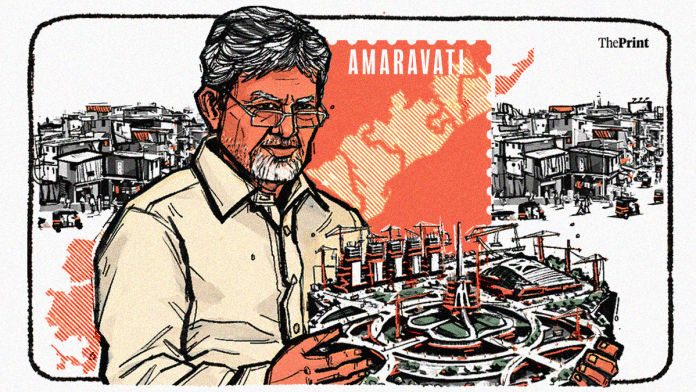
This week’s National Interest is datelined Amaravati, the new capital Chandrababu Naidu is building for Andhra Pradesh, just across the river Krishna from Vijayawada. It isn’t exactly about Amaravati, though. Our central theme is the idea.
It’s a novelty in Indian politics, audacious in an era when no politician wants to embark on something they can’t complete within one term; or four years, with the fifth reserved for electioneering.
Building a new capital takes much longer. One term may not be enough to flaunt it to voters as a success. And what happens if you lose power, as Naidu did in 2019, just after barely collecting his first ‘pool’ of land?
His successor, Y.S. Jagan Mohan Reddy, and his YSRCP (Yuvajana Sramika Rythu Congress Party) called the project a sham, intended to benefit one caste, Naidu’s own, since most farmers pooling land for the project were fellow Kamma.
Jagan scrapped the project, stopped annuity payments to farmers who had contributed their land, and declared that Andhra Pradesh would have three capitals instead. Vizag as the executive capital, Amaravati the legislative capital and Kurnool the judicial capital.
Decentralisation might be an interesting idea, but not like this. Andhra Pradesh is a large state, and the distance between Vizag and Kurnool is about 700 km, with Amaravati (Vijayawada) exactly in the middle.
This deserved to be called Tughlaq-like, which I did. And while Jagan and his party leaders remained polite, Sakshi, the newspaper owned by his family, which had Telugu rights to publish National Interest, dropped it. That, however, is a mere sidelight in a serious discourse.
Naidu’s commitment is underlined by the fact that he never abandoned the idea. He promised to revive it and is now building it at warp speed. So fast, indeed, that even if there’s a change of government in the future, there will be little left to reverse. The new capital is becoming a reality faster than electoral fortunes turn. That persistence with such an ambitious, expansive and expensive idea is what makes this project remarkable.
The idea of building a new living, political, commercial, hi-tech, cultural and educational city with a soul is unfamiliar to us. We have built sarkari enclaves out of necessity: Gandhinagar, Naya Raipur, even Bhubaneswar. But these are merely seats of government. The only new city independent India has built is Chandigarh, designed for half a million people. It now has perhaps 1.4 million. That’s no city, even if it’s my hometown for all practical purposes.
According to a report submitted by the Indian Institute of Human Settlements (IIHS) to the 15th Finance Commission, all new cities built since Independence house no more than, hold your breath, 1.3 crore people. These are mostly glorified colonies for ministers, legislators, officials, employees, their families and domestic workers. There’s no commerce, entrepreneurship or culture. For all that, you go to an old city nearby.
Also Read: India needs more Jamnagars. Anti-business, knee-jerk anti-Americanism hurt national interest
Building a new city, or even significantly upgrading an existing one, is an idea India has been fundamentally averse to. Why invest resources in cities when, as Gandhi told us, India lives in its villages? Those villages are so rotten in terms of quality of life, so short of opportunity and so socially unequal that millions have been leaving them for cities.
Yet planned spending on cities, whether the hundreds we inherited, some dating back millennia, or those that grew chaotically into urban sprawls, was seen as a waste and a political liability.
That’s why even existing cities, without exception, have decayed over time. Meanwhile, India urbanised as crores left their villages for these same cities, mostly settling in slums that the mafia gradually came to control.
What’s called a slum in Mumbai goes by the name of ‘unauthorised colonies’ in Delhi, which every political party promises to legalise. Residents are condemned to live in the same muck, with open drains. Overhanging wires and cables across the streets make them resemble a rainforest, though one made of plastic.
Mumbai has been avidly cannibalising its decrepit old mills and slums. The good thing is that it’s finally building a subcity, Navi Mumbai, with the Trans-Harbour Link connecting the island city to the mainland. It’s a work in progress.
Delhi employed the lazier ploy of letting large suburbs come up in Gurugram and Noida, creating a commuting and traffic nightmare as vehicles travel long distances between the three.
A large majority of Delhi’s population, however, continues to live in subhuman conditions in its unauthorised colonies. Sanjay Gandhi gave these settlements a ‘cute’ name: JJ colonies, or jhuggi-jhopdi (slum and hutment). Many have been partly gentrified over time, with minimal, if any, municipal facilities. Satya Niketan, where a building collapse in September killed seven students, is one such.
Bengaluru has expanded haphazardly, with the world’s worst connectivity between its city centre and economic engines. It gets flooded up to the second floor in some of its richest colonies and thirsts for water the rest of the year. The tanker mafia rules India’s Silicon Valley. And what do we say about Kolkata? Barring some new developments on the outskirts, it’s difficult to describe anything there as a slum. Most of its population still lives in some such quality of life.
Just one major Indian city bucked this trend, and it wasn’t yet a metro. Hyderabad woke up to add the muscle of tech entrepreneurship to its soul and historic spirit. It was Naidu who started this during his first of four chief ministerships, beginning in 1995. He founded Cyberabad to compete with Bengaluru. His successor, Y.S. Rajasekhara Reddy of the Congress, carried that Telugu entrepreneurship forward, and built on it. The city didn’t just survive political change, it thrived.
Naidu was told by many, including much of our ‘old school’ socialist commentariat, that he had erred by focusing on the city, playing CEO of the state and ignoring the poor in the process. His persistence with Amaravati, despite the 2019 electoral setback, is now seen as evidence that he’s incorrigible. And it’s a good thing.
Also Read: Three destroyers of Brand India. It’s all in our cities
I had told you earlier that this column isn’t about Amaravati. That deserves a full episode of WritingsOnTheWall sometime later. But a few points, especially its innovations in urbanisation, deserve mention.
The biggest challenge to infrastructure-building in our country is land acquisition. How come there were minimal protests in Amaravati?
Naidu’s first innovation was his land-pooling scheme. Farmers were invited to pool their land instead of selling it. For every acre, he committed to returning a share in developed residential and commercial plots.
And what would farmers do until the capital was built and the land monetised? Naidu promised an annuity, starting at Rs 50,000 per acre annually, with a five percent increase every year. Today it is Rs 95,000, far more than what any farmer earns from an acre. About 33,000 acres were pooled this way. The government added another 20,000 acres of its own around the planned city, taking its total area to about 53,000 acres or 217.23 sq km.
It’s a planned city, with grids neatly dividing it into one-sq-km blocks. Best of all, the entire government—offices, ministers, legislators, High Court, Vidhan Sabha and Legislative Council, and employees of all classes—will be housed along a seven-km-long central median, occupying just seven sq km. The rest will be developed privately, with universities, tech hubs and an IBM Quantum Hub (120-qubit to begin with), scheduled for inauguration next February.
This is important because governments usually consume every vacant piece of land available. Here, the government owns no more than these seven sq km. This is the second innovation.
The third is a kind of political insurance. What if someone invests on the strength of your promised incentives and you lose power? Naidu passed a law this week to protect investments and ensure that a share of the taxes received from these entrepreneurs goes into escrow accounts, with mandatory payouts on committed dates.
It’s around these political and administrative innovations that he is building this trillion-rupee city. It’s a good example for other chief ministers. Take some risks and, as he says, create wealth so the government can earn more and distribute it.
Also Read: Coaching centres are a sign of broken-window economics. See how China crushed it all overnight