


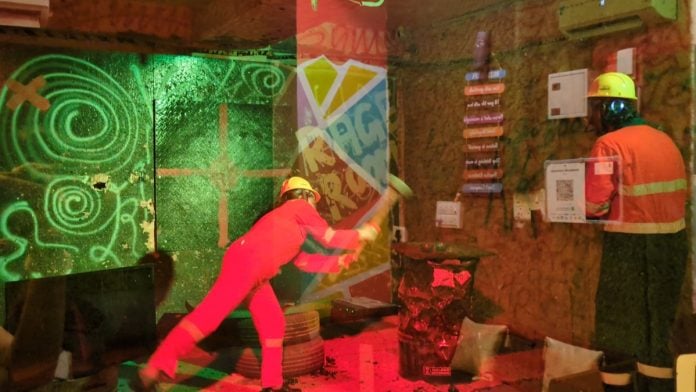
New Delhi: Nimisha Sharma had a terrible day. A rejection from her dream university, a bad mock interview, and pent-up anger over a recent breakup. So she headed straight to a rage room in Bengaluru’s Indiranagar. Smashing a bottle that had her ex-boyfriend’s photo taped to it was just the catharsis she needed.
“Those 15 minutes, they were so intense,” the 27-year-old said, recalling her visit. “It was almost like meditation at a very deep level. Nobody is around you. You’re just breaking things, tapping into your emotions, channeling that energy into destruction.”
The rage room that Sharma paid for is a simple concept: a closed room, protective gear, a shelf of glass, a hammer, and the freedom to turn anger into wreckage however you like. And the places offering it are multiplying — from multi-city market leader Rage Room to Rage Cage, Cafe Bhadaas and Anger Banger.
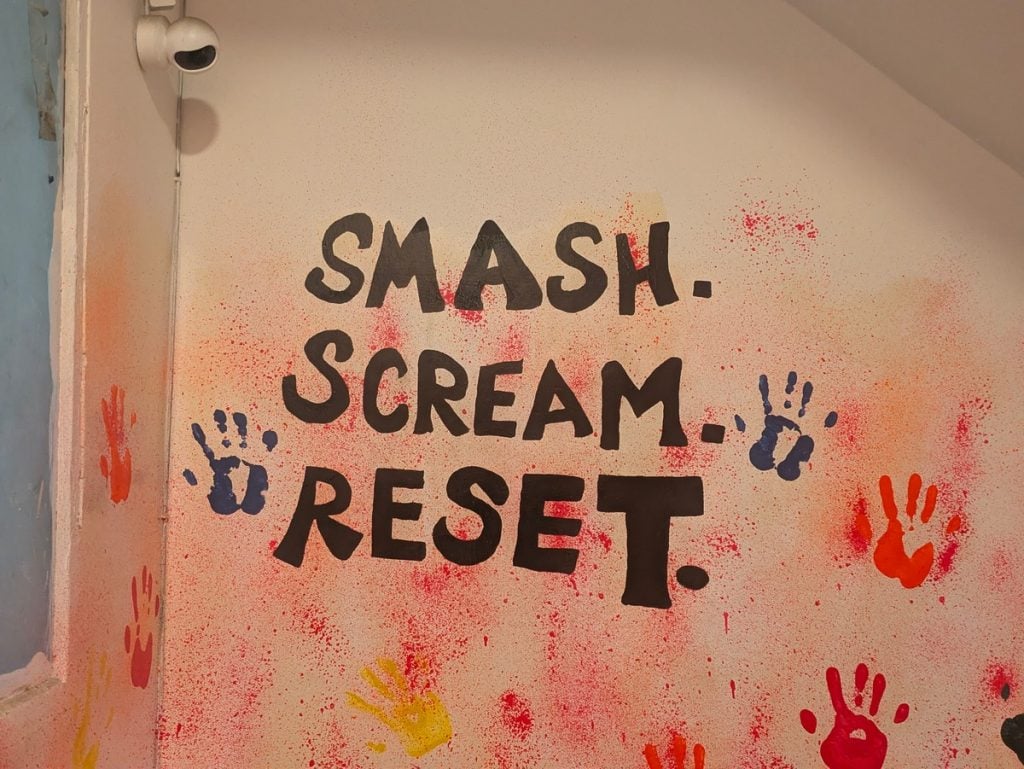
It is a new trend in Indian cities among young people to deal with urban loneliness, anxieties, anger, stress and break-ups. It’s a break from talk therapy and offers the visceral physicality of release instead. More than 97,000 people have visited Rage Room centres in Hyderabad, Bengaluru, Mumbai, Delhi and other cities since 2022, according to founder Ananya Shetty.
It is more socially acceptable for a man to express anger in public, but women keep holding it within themselves for too long and it keeps building up. Here, women get a safe and free space to vent their anger without judgment
– Ananya Shetty, founder of Rage Room
And more women than men are paying to pulverise everything from glassware to TVs, depending on their budget. Shetty said about 70 per cent of Rage Room’s customers are women, most between 18 and 35 years old—a trend seen in countries such as the UK as well.
“It is more socially acceptable for a man to express anger in public, but women keep holding it within themselves for too long and it keeps building up,” Shetty said. “Here, women get a safe and free space to vent their anger without judgment.”
While the concept has been around in Japan and the West since the late 2000s—with an estimated 360 rage rooms in the US alone—it is only in the last couple of years that the business of aggression as a ticketed activity has truly taken off in India.
“Roughly 60 per cent of customers come for emotional release and around 40 per cent for an activity, though the split is blurrier than it looks,” Shetty said.
Also Read: A Bengaluru startup has launched a dating app that is a therapist cum Seema Aunty
‘Breaking emotions’
Now studying for an MBA, Sharma has seen a professional counsellor twice, once for career anxieties and once for her personal life. But writing her ex’s name on bottles and going at them with a sledgehammer was a different kind of therapy.
“It’s like comparing apples to oranges,” she said. “The counsellor can teach you how to think about your anger, and work around it, but I can’t take the anger inside me out on her. I can do that here.”
She compares the experience to Geet’s from the film Jab We Met.
“It felt like I was letting off the emotions by breaking them,” she said. “It was strangely very relaxing.”
For some, a rage room is a place to vent anger they’ve been turning on themselves. Indu, a growth marketing associate in e-commerce, has visited the Bengaluru Rage Room thrice. The first time, she couldn’t decide whether to switch jobs or pursue an MBA.
“It was a conflicting period of my life,” she said, referring to it as the cause of her anger. “I was a little scared about a lot of things, and life not turning out how I dreamt of it.”
Did it help her decide? “No.” Did it make her feel better? “Yes.”
“I had good sleep for that day, for the next few days,” she said. “These are big confusions in life. You just have to figure your own way out through them. But this was a good experience. Just letting it all out was good.”
A little over a year later, she went back with friends just for fun.
A birthday bash
Apurva Singh received a rather unusual gift from her husband Prakhar for her 30th birthday—a session at the Delhi Rage Room. She says she has a bit of a temper over small things such as traffic and bad service, which made it the perfect birthday activity.
“She keeps breaking things anyway (accidentally),” Prakhar Singh joked. “I thought she should do it properly here.”
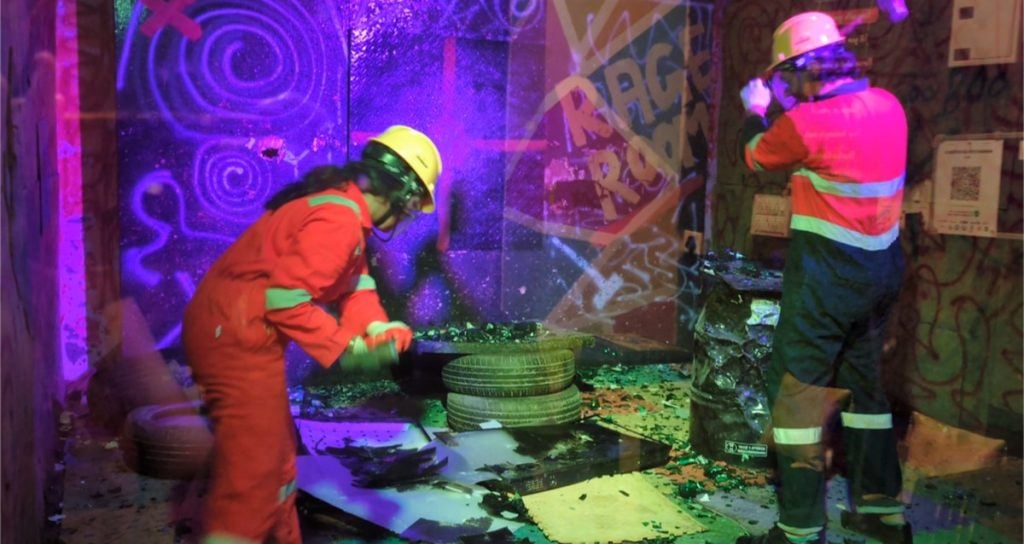
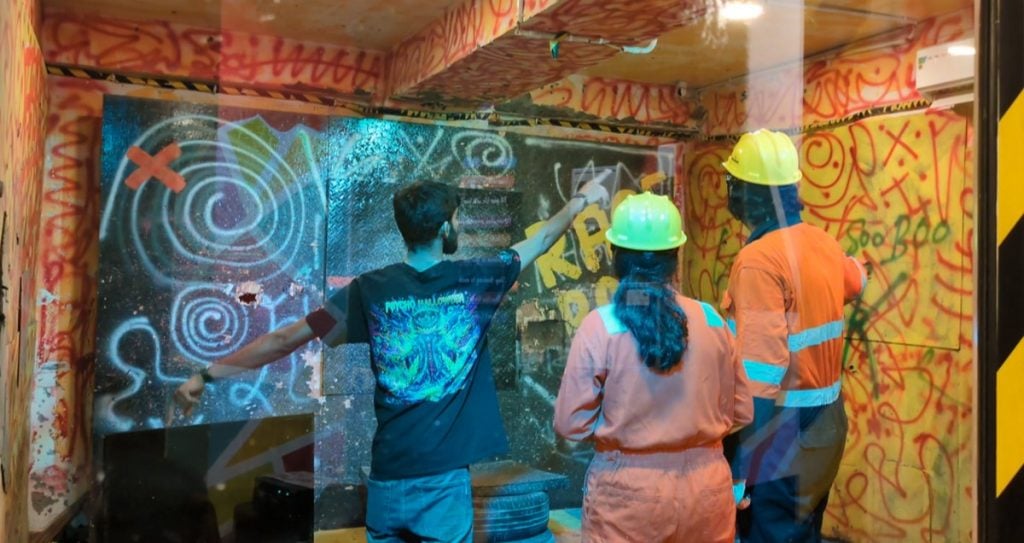
The rooms are made to look like rage. In Delhi, the yellow walls are scrawled with careless red and black graffiti. One wall is painted black and is the target; staff direct customers to aim only at it. A shelf holds the breakables. Old tyres sit on the floor, some with a board laid across them to prop up a bottle or cup. A canister in the room is badly dented by the many people who have attacked it. The floor carries the mess from every session before, and it is cleaned only once a day, at the end.
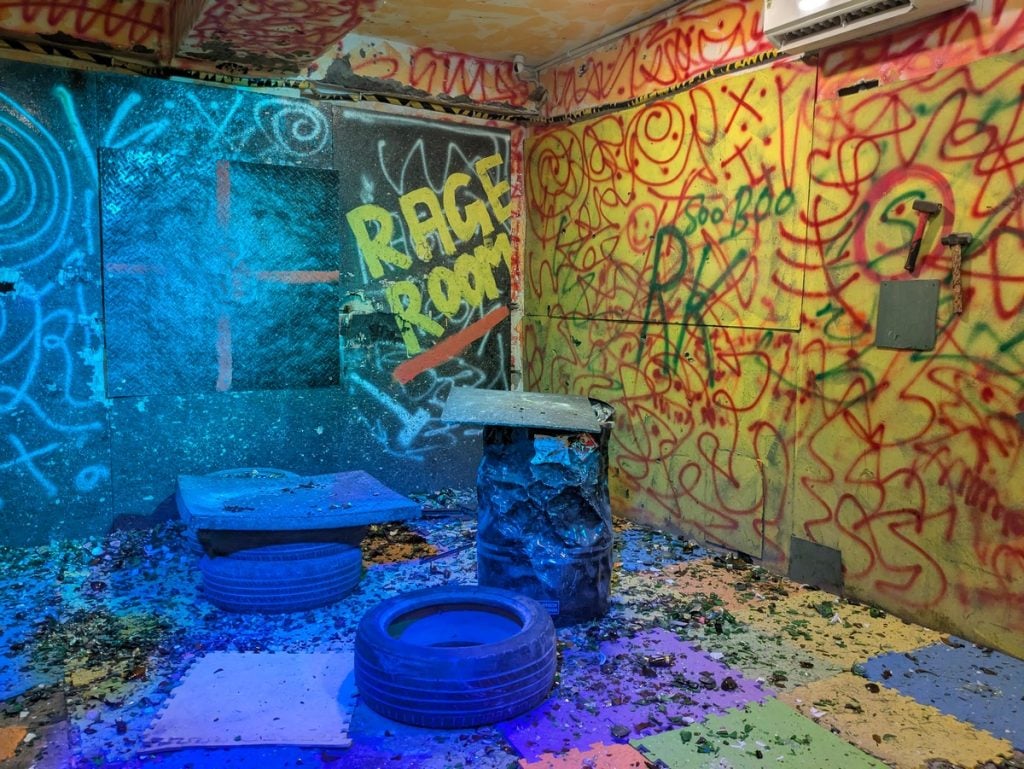
People invent their own methods of breaking things. Apurva and Prakhar tossed items into the air and swung a hammer at them. They also threw two bottles in quick succession so they collided and shattered mid-air. Others smash things against the wall, hurl them at the canister, or hit them on the tyres with the hammer.
A TV was part of the package that day. Apurva kept going at it long after it was destroyed.
“After a point it was just adrenaline,” she said. She went back for the panel and the screen, then took a smaller hammer to the leftover debris.

Apurva had hoped to work through some family tension at the rage room, but a sense of guilt got in the way.
“I tried to think about people who make me angry. I was trying to channel that anger here, but it didn’t happen that way. If I thought of them while I was breaking things, was I sort of harming them? So I stopped thinking, as it was taking the fun out of it,” she said.
For Prakhar, who described himself as a calm person, the rage room was mostly a place to let loose.
“These days, it’s hard to make yourself heard,” he said. “It’s very difficult to even talk to your parents. Sometimes you don’t feel like talking to your friends. So it seems like a place where you can just be yourself.”
Drawing or writing a poem takes skill, he added. “This has no barrier to entry.”
‘Breakup Buster’ to beast mode
The Delhi Rage Room in Lajpat Nagar sells anger the way a multiplex sells popcorn—in sizes and with upgrades. There are beer bottles and cups and glasses and bowls to break. Hammers and rods come with the session.
The more you smash, the cheaper each smash gets. Chill Mode starts at Rs 500 for eight breakables. Rampage costs Rs 1,200 for 30. The couple’s Emotional Detox costs Rs 4,900 for 120. The Rs 2,500 Breakup Buster throws in a printout of the person you are angry with.
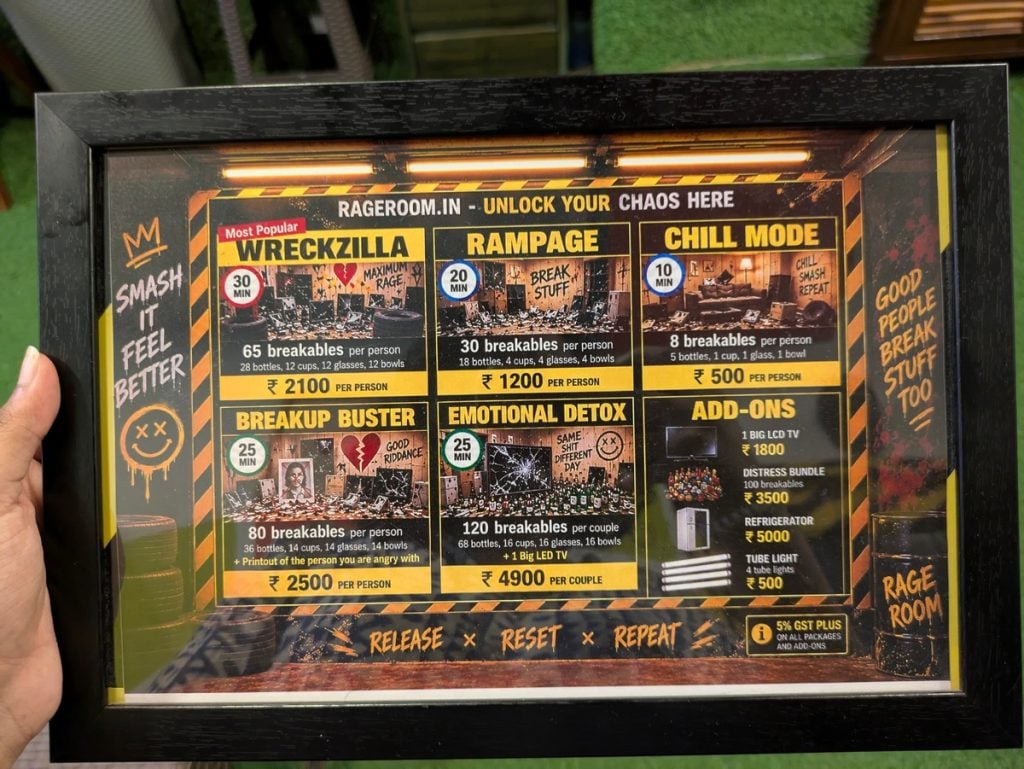
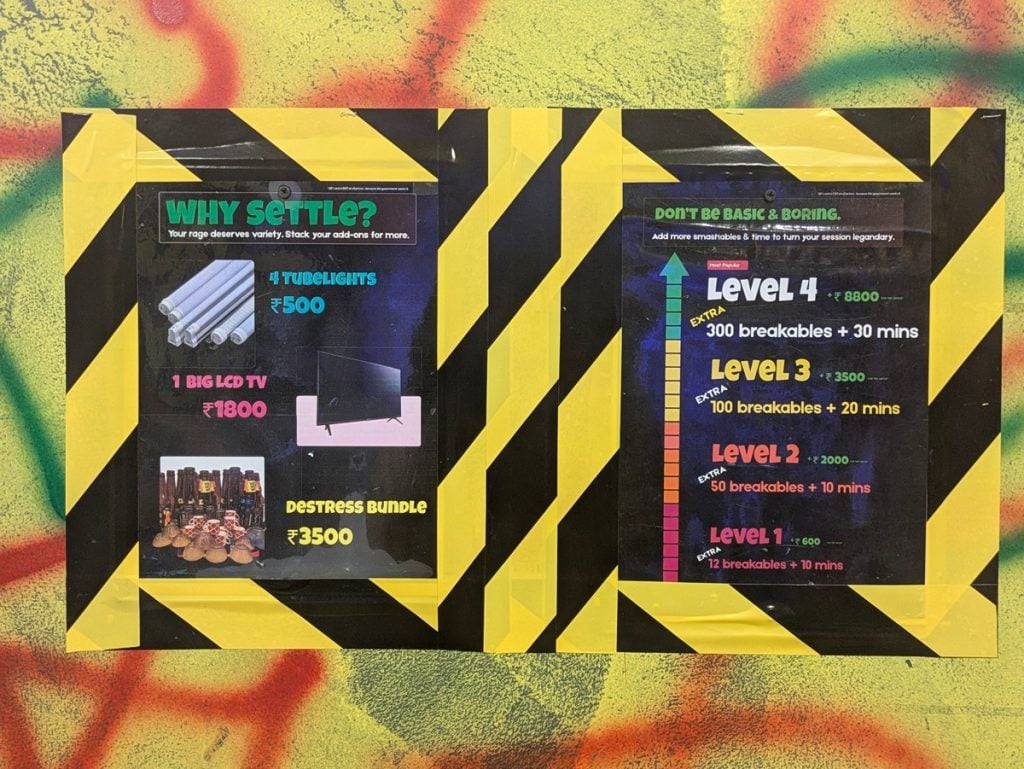
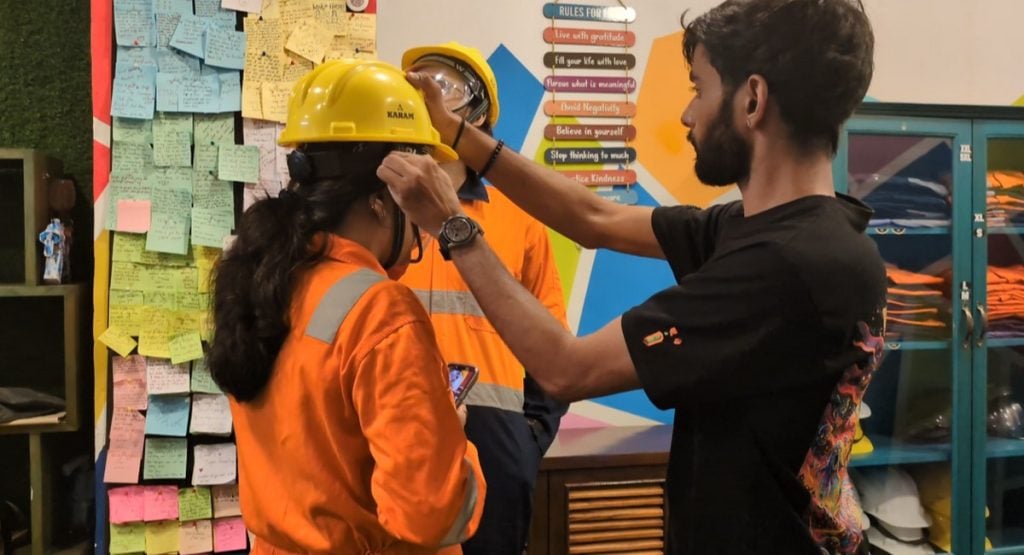
If that’s too lightweight for their level of fury, customers can add a television to any package for Rs 1,800 or four tubelights for Rs 500. The centre also sells bigger, costlier “beast” items such as a fridge for Rs 5,000. Every session starts with a briefing and a waiver. Customers get a cap and visor as well as a protective suit and shoes and gloves. The company’s website states that its injury rate is 0.05 per cent.
Behind the counter on a Saturday evening was Hemant Singh Rajput, the centre’s manager. He was juggling bookings and a crowd of influencers, as well as a blind-date event lined up for the next day.
Rajput says the centre usually gets two or three bookings a day on weekdays and four or five on weekends. It’s open from 11 am to 9 pm, though sessions have occasionally run past closing time.
When a friend took Rajput to a rage room, he didn’t quite get it. But a few months into the job, the concept makes more sense. He says people walk out calmer.
“A lot of people come here to deal with the heavy feelings they cannot talk about,” he said. “There’s a lot of pressure from society against expressing feelings. Here, you can just go berserk.”
Customers sometimes talk about why they’re there too, he added—family troubles, work stress, breakups, fights and, sometimes, political anger. One father brought his son more than once because the boy had been struggling. When he came in, the boy seemed troubled, but was more relaxed by the time he left.
Rajput laughed as he recalled a man who booked a session for a friend going through a breakup.
“He told me they plan to get drunk after the rage room because it is better that he breaks things here before getting intoxicated than after,” he said.
The counsellor can teach you how to think about your anger, and work around it, but I can’t take the anger inside me out on her. I can do that here
– Nimisha Sharma, MBA student and Rage Room customer
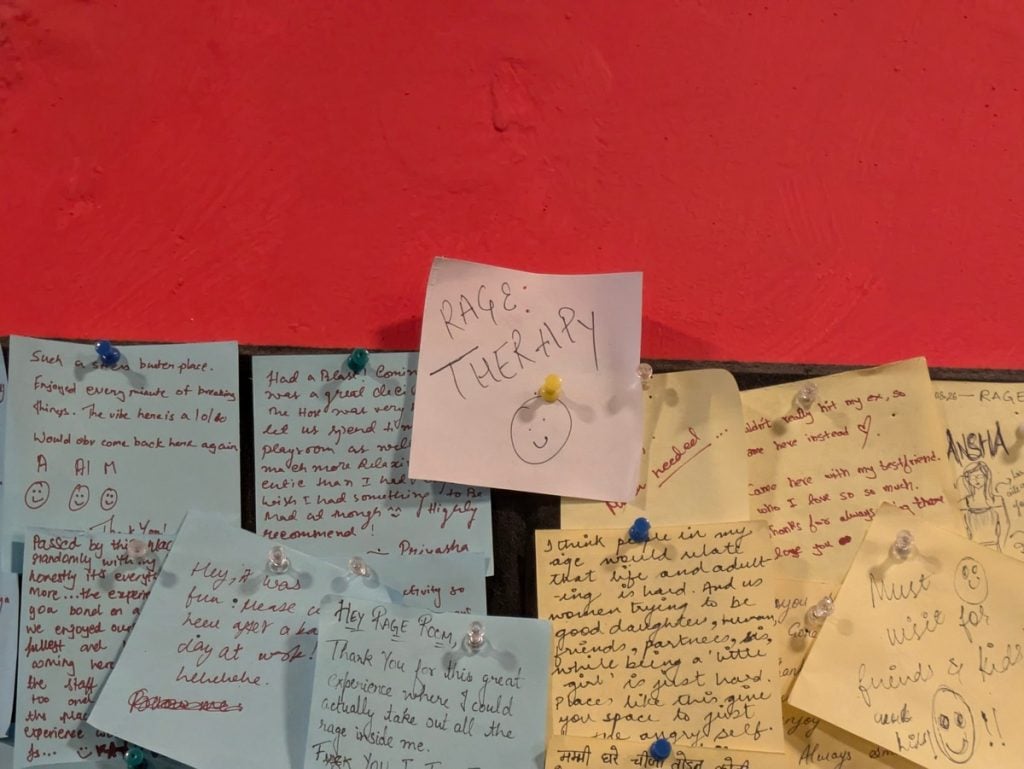
On the walls, many customers have left short testimonials on Post-it notes.
“There would be less crime if there were more rage rooms,” said one. A woman wrote of releasing the “angry self”: “Us women trying to be good daughters, humans, friends, partners, sis, while being a ‘little girl’ is just hard.”
Others are a tad darker. Someone else put up a printout of a man’s photo and invited others to have a go at it. One more note included a phone number: “We came here because of issues in my sister’s marriage. We hate the guy. If you feel like it, you can take your rage out at him.”
The big break
When Shetty was going through a rough patch around 2022, she joked with friends that she needed somewhere to break things. She looked for a rage room in Bengaluru but found nothing. She soon realised she wasn’t the only one searching.
“On Twitter, on Reddit, everyone asked for it. That is how I decided perhaps I should bring the concept here,” said Shetty, who was in her early 20s when she started the business.
Not far away in Hyderabad, Suraj Pusarla had been having similar conversations with his friends. As children, they’d been able to break things when upset. Why shouldn’t grown-ups be able to do it? Pusarla filled two rooms with cast-offs from scrap dealers and opened the first Rage Room in October 2022.

Shetty joined him as a business partner and opened the second Rage Room in Bengaluru’s Jayanagar in February 2023. She then quit her marketing job to run the business full time. The chain expanded to Mumbai, Surat and Delhi and opened a larger room in Bengaluru’s Indiranagar. Pusarla pitched the business on Shark Tank India in 2024 and sold his stake later that year. Around this time, Rage Room also made it onto Netflix’s Fabulous Lives vs Bollywood Wives, where the glamorous protagonists donned yellow helmets and let off steam.
The business, which started without outside funding, has since brought in investors and is profitable, according to Shetty. She says her bachelor’s degree in psychology helps her run the rooms and that she is “a very calm person” overall. But she had occasion to use the room herself after a breakup.
“It was a one-sided breakup, and I was holding a lot of anger and pain and grief in my system,” she said. “Most breakups end with people saying really bad things to each other. But because I had vented my anger, I was able to navigate my emotional space much better and focus on rebuilding my life.”
Also Read: Everyone’s a therapist in India—influencers, dentists, homeopaths. It’s the new epidemic
Is it really therapeutic?
Where there are rage rooms, pop psychology terms such as healing, catharsis, and recovery are never far behind.
Rage Room offers a “transformation therapy” package that pairs an online session with a therapist with an in-person room “release”. Café Bhadaas—an early mover in Indore started by PR consultant Atul Malikram in 2017—calls itself “India’s first anger management cafe” and says it is based on “destruction therapy.” Meanwhile, Delhi’s Rage Cage invites customers to “choose your therapy,” with package names such as Boss Anger, Breakup Rage and Brutal Rush.
But mental health experts remain unconvinced that smashing things solves anything on its own. Neelam Mishra, a psychologist and founder of the Mind Healing Clinic, says a rage room works as a stopgap, not a cure.
“It eases you temporarily, but it does not heal you completely,” she said. “Taking your anger out destructively gives positive reinforcement to aggression. That is unhealthy in the long run.”
She makes a distinction between anger as an emotion and anger as behaviour. When someone is repeatedly angry in daily life, she says, the first step is to understand why and, if need be, to start therapy.
“It’s a form of expression,” she said of rage rooms. “Just the form, not the solution.”
The core premise of rage rooms is that venting anger drains it, but there’s little research to back this. In a 2002 experiment, psychologist Brad Bushman found that angry participants who hit a punching bag were actually more aggressive afterward than those who did nothing. Bushman noted that venting to reduce anger is like “using gasoline to put out a fire.” A 2024 review by Bushman and Sophie Kjærvik, which pooled more than 150 studies, found little evidence that venting helps. Activities that lower arousal, such as deep breathing, meditation and yoga, worked better—and the good feeling venting produces can reinforce aggression.
Nevertheless, rage rooms—also called smash rooms and anger rooms—are a growing niche. Market research firm Research and Markets estimated the global industry at about $211 million in 2024, and expects it to reach $315 million by 2030.
The trend reportedly dates back to 2008, when stressed office workers in Tokyo frequented a venue called The Venting Place during the global financial crisis. That same year in Dallas, Donna Alexander began picking up discarded junk off the curb and charging friends $5 to smash it in her garage. By 2011, she’d moved into a warehouse and opened the Anger Room, one of the earliest rage rooms in the US.
“There’s a lot of people who are stressed out when the economy’s good; but when it’s bad, there’s an increased frustration out there,” Alexander said in a 2012 interview.
For Shetty, rage rooms are not an anger management solution, but they can start a process of self-awareness.
“When you have some intense emotions held within your body that your brain simply refuses to process, then you cannot do anything until you release the energy out of the system, until you become aware that, ‘Oh, I’m really that angry,’” she said. “For that, destruction is a very great tool. One may resort to it to gain clarity on what you’re really feeling and then take steps to ask the question ‘what’s next’ and focus on healing.”
(Edited by Asavari Singh)