


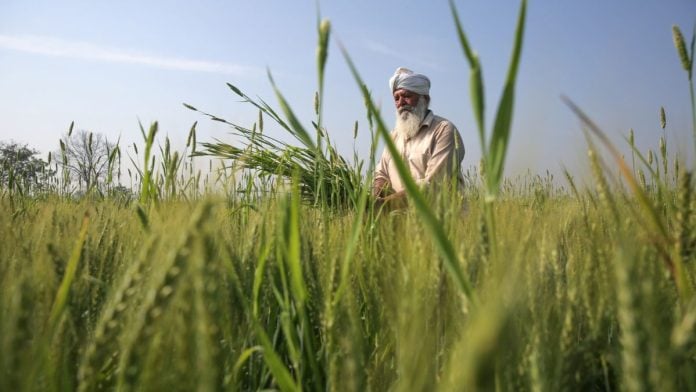
New Delhi: While farmers across Punjab are complaining of difficulty in procuring diammonium phosphate (DAP) fertiliser for the ongoing wheat sowing season, the state Agriculture Department has said that there is no shortage, claiming that available stocks and fresh supplies in transit are sufficient to meet current demand.
The complaints have been coming in during the crucial 15-day period in Punjab’s dominant farming cycle, with farmers preparing their fields to sow wheat following the paddy harvest.
Farmers have alleged that they are either being forced to buy other items along with DAP, or to pay more than the government-fixed price by the fertiliser distributors. The fertiliser is supplied to farmers at a subsidised price of Rs 1,350 for a 50-kg bag, with the subsidy being borne by the Centre.
Farmer protests have been reported in parts of the state, including Ferozepur, Fazilka and Mansa, over concerns that delays in DAP procurement could impact the timely sowing of wheat—Punjab’s principal rabi crop.
“DAP, as well as NPK (Nitrogen, Phosphorus, Potassium), are being sold at higher rates than what the government has fixed. Farmers are being told by private sellers that there is a shortage. As a result, farmers are paying the black market rate. At other places, sellers are forcing farmers to buy other items, before they give them DAP. These unwanted items include some experimental fertilisers of the nano variety,” Jagmohan Singh, chief of Bhartiya Kisan Union-Dakaunda, told ThePrint.
“We have also organised protests across the state, but the situation has changed only marginally,” he added.
On the other hand, according to the Agriculture Department, the state currently has around four lakh metric tonnes of DAP available against an estimated demand of 4.5 lakh metric tonnes for the ongoing season. Another 76,000 metric tonnes is in transit and is expected to reach the state shortly. The department maintains that the available quantity, along with the incoming supplies, is adequate to meet the requirement.
“The state’s annual DAP requirement and stocking arrangements have been worked out keeping in view the area under wheat cultivation, which is approximately 35 lakh hectares. At the recommended consumption of around one 50-kg bag per acre, the requirement works out to approximately 4.3 lakh metric tonnes,” Joint Director Gurjeet Brar, who heads the fertiliser wing at Punjab’s Agriculture Department, told ThePrint.
According to Brar’s estimate, the state has a total provision of around five lakh metric tonnes for the season. He said there are nearly 10,000 fertiliser outlets across Punjab—including private dealers—where DAP is being sold at government-fixed price. There is no reason for farmers to face a shortage, he asserted.
DAP is among the most important fertilisers used during the sowing of wheat. It is a phosphatic fertiliser, containing nitrogen and phosphorus—two essential nutrients for crop development. Applied largely at the time of sowing, it helps support early root development and establishment of the crop. Its timely availability and use is, therefore, particularly important during the short window, when farmers are preparing their fields to sow wheat.
Last month, when Union Minister for Agriculture and Farmers’ Welfare and Rural Development, Shivraj Singh Chouhan launched the nationwide Khet Bachao Abhiyan at Karnal in Haryana, he cautioned farmers against indiscriminate use of fertilisers, while taking credit for making the fertiliser available at the same rate to the farmer, despite price hikes in international markets.
“The government is bearing a substantial fertiliser subsidy of more than Rs 1.5 lakh crore to ensure that farmers could continue to obtain a bag of urea for just Rs 266, and a bag of DAP for Rs 1,350. Getting fertilisers at affordable prices certainly does not mean that we should keep applying four bags of urea to our fields,” he had said.
Also Read: There’s more to Punjab power crisis than a coal shortage. It’s a result of public-private failure
The cooperative credit factor
While denying any shortage in overall availability of DAP, the Punjab Agriculture Department acknowledged that farmers initially encountered difficulties in procuring the fertiliser through the cooperative network. The problem, officials said, was not necessarily about the availability of the fertiliser, but the inability of some farmers to access cooperative credit to make the purchase.
The matter has also been highlighted by Ajayveer Jakhar, former chairman of Punjab State Farmers Commission, and current chairman of Bharat Krishak Samaj (Farmers’ Forum India), a non-political farmers’ association. In a post on X, he alleged that Punjab stocks of lakhs of bags of unsold DAP, and farmers were being forced to buy in the black market.
“Punjab co-op societies cannot sell the fertiliser as farmers are having difficulty in meeting new conditions imposed by the Punjab Cooperative department. This creates a closed loop problem—the central government cannot allocate more fertilisers as Punjab sits on lakhs of bags of unsold stocks. When Punjab Co-op department does not listen to the Punjab Agriculture department,” he wrote.
How fertilizer shortages has been created in Punjab is an example of having a government run by morons. Today Punjab has stocks of over 2 lakh of bags of unsold DAP & farmers are forced to buy in the black market.
Punjab co-op societies cannot sell the fertilizer as farmers are…
— Ajay Vir Jakhar (@Ajayvirjakhar) November 7, 2026
The cooperative department, when contacted, told ThePrint that the initial disruption was linked to implementation of a revised Kisan Credit card policy.
“The new policy introduced certain conditions and norms governing the release of crop loans through cooperative institutions, which had to be implemented in accordance with the applicable guidelines laid down by NABARD and the Reserve Bank of India,” said Amarjit Singh, Additional Registrar of Cooperative Societies (Credit) in Punjab. “This led to queries and confusion at the field level, delaying the release of credit to some farmers.”
Since a large section of farmers depends on cooperative credit to purchase sowing inputs, including fertilisers, the delay affected their ability to procure DAP from cooperative societies.
The state government maintains that these issues have since been resolved and the process of releasing credit has resumed. “Farmers can now access the cooperative credit facility and purchase fertilisers through the societies,” claimed Amarjit Singh.
Farmer organisations, however, continue to express concerns over the additional financial conditions being imposed on agricultural borrowers of loans from cooperative banks.
“Initially under the new kisan credit card policy, farmers wanting to take loans were being asked to mortgage their lands. However, following widespread protests, this condition was withdrawn, which gave some relief to the farmers. But other conditions continue to be imposed. These include an increase in the share capital, and a hike in rate of interest being charged from farmers, especially for bigger loans, and even on smaller loans in default cases,” said Jagmohan Singh of Bhartiya Kisan Union-Dakaunda.
Supply concerns
But the availability of DAP has been a matter of concern for the state government even before the commencement of the wheat sowing season.
On 29 September, Punjab Agriculture and Farmers Welfare Minister Gurmeet Singh Khudian had urged the Union government to ensure timely and uninterrupted supply of 5.5 lakh MT of DAP and 15 lakh MT of Urea for Rabi season of 2026-27.
Addressing the National Conference on Agriculture for Rabi Season 2026, held by the Union Ministry of Agriculture at National Agricultural Science Complex in New Delhi, Khudian had said that in previous years, delays in supply of DAP and urea by the Centre during Rabi season had caused significant difficulties for farmers.
A substantial proportion of India’s DAP requirement is met through imports, making its availability vulnerable to international supply disruptions, geopolitical tensions and fluctuations in global fertiliser markets, explained Agriculture Department’s Brar.
He added that international developments, including tensions around Strait of Hormuz and the wider conflict involving the United States and Iran, had initially raised concerns about availability and movement of fertiliser supplies.
“However, deficient monsoon in parts of southern India has affected agricultural activity and consequently reduced the demand for DAP in those regions. This has helped improve the availability of the fertiliser for states in the northern agricultural belt,” Brar said.
‘Mann govt failed to distribute on time’
Meanwhile, the Punjab BJP has been taking credit for ensuring adequate supply of DAP.
Sunil Jakhar, former president of the party in the state, Thursday thanked Prime Minister Narendra Modi for his “commitment to farmers”.
“Under PM Modi ji’s leadership, Union Agriculture Minister Shri Shivraj Singh Chouhan and Union Fertilisers Minister Shri J.P. Nadda ji, the Government of India has ensured that farmers can continue to get a bag of DAP fertiliser for Rs 1,350 despite the crisis in West Asia. The Modi government is buying DAP at Rs 100 per kg, and making it available to farmers at Rs 27 per kg,” he said.
“To make this possible, the government has increased the subsidy by 64 percent compared with last year. During the Rabi season, it is providing Rs 62,370 crore in subsidies for phosphatic and potassic fertilisers alone. The subsidy for urea is separate.”
He criticised the AAP government in the state for delaying the distribution of fertilisers. “Fertiliser stocks arrived in Punjab in October itself, but the Bhagwant Mann government failed to distribute them to farmers on time. As a result, farmers were exploited,” he said in a statement to the press.
(Edited by Mannat Chugh)
Also Read: Lotus Pocus: Why BJP is emerging as preferred destination for turncoats before Punjab polls