




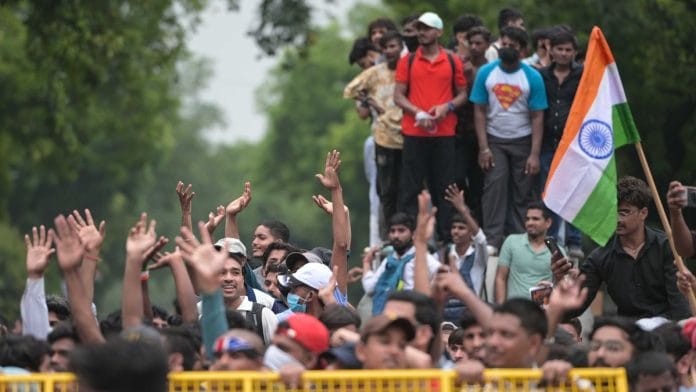

The hard-fought victory of India’s student uprising appears to be on the verge of collapse. Hailed by many as a historic youth movement, it now risks being reduced to the familiar and reductionist caste-merit dichotomy.
If that happens, it will not just be an ordinary setback, but a descent into the same old chaos. The conversation is already drifting away from the movement’s central demands and back toward the familiar, toxic online shouting match over the myths of merit, caste, and reservation.
On 25 July, the country’s youth and their organic mobilisation forced a political shake–up. The mobilisation, initiated and spearheaded by the Cockroach Janta Party (CJP), a satirical platform, later turned into a decentralised, powerful youth movement. Building on this momentum, the meta-youth movement evolved into a rare cross-identity alliance, bringing together tens of thousands of young Indians who endured more than a month-long standoff at Jantar Mantar.
These youth demanded good governance, state accountability, responsiveness, and responsibility. While this moment had not yet ebbed, within seventy-two hours of this rare collective unity, this grand architecture of student solidarity is facing a crisis and raising questions about its episodic nature. A hyper-visible counter-wave is now viral across digital spaces under the nomenclature of the “Reservation Hatao Andolan” (RHA).
This digital campaign amassed more than 5.8 million Instagram followers in just a few days. The national conversation that talked of a collective and universal ethos has been hijacked. It has shifted from the movement’s universal demands for clean examinations to a bitter, zero-sum binary war.
Thus, it has skirted the gains of the movement launched to identify and address the massive systemic crisis. It risks being reduced to a simplistic battle over caste quotas and the usual theatrics of merit that is the omnipresent “banality of evil,” plaguing Indian society, which BR Ambedkar had rightly pointed out.
Negative solidarity
The rapid decay of this youth coalition follows a predictable timeline, and as usual, it hides institutional collapse. It begins with a common enemy, as students unite across social boundaries to fight structural corruption and paper leaks. Once the immediate target of the protest recedes—marked by the tokenism of the minister’s exit—a sudden victory void is created.
This triggers an intense scramble for resources among the participants. The public focus has now shifted from systemic exam reform back to a terrifying reality of job scarcity. At this point, the movement risks falling into an identity trap, with systemic caste inequalities giving way to competing, adversarial caste identities.
By reframing this collapse of testing infrastructure as a reductionist battle over who deserves a seat. The movement is seen as actively tilting toward and buying into the hegemonic myth of “pure merit” while defaulting to historical social divisions. One must understand the machinations by which a fight for administrative clean-up so quickly turns into a polarising caste war.
The concept of merit, an innovative tactic of hegemonic patriarchy, is deployed and weaponised to protect a broken system. The RHA campaign thrives on what can be termed “negative solidarity.” We term “negative solidarity” a temporary alliance formed strictly “against” a shared adversary rather than “for” a structural blueprint.
When exam leaks were revealed, it was found that the infrastructure had been compromised and bugged. It exposed an administration failure that affected every student, regardless of their background or identity. Yet, the counter-wave is now successfully shifting the blame away from the state and onto the very concept of affirmative action. By invoking the myth of merit, a “casteised instrument,” this campaign implies that the testing system is inherently fair and the only obstacle to a student’s success is the caste quotas.
These narratives are completely ignorant of the ground realities. They don’t understand that no amount of individual merit can protect an aspirant from a corrupted, leaked, and compromised examination system.
Also read: Casteism didn’t disappear in Indian cities. It just learned English
The algorithmic trap
The RHA campaign has masterfully exploited the neo-liberal economic panic to slice the student collectives or fraternal community into highly competitive, distinct, and warring caste blocs. This fragmentation is being supercharged by the digital media ecosystem and its algorithms, which actively atomise public discourse into isolated grievances.
On the physical ground during the protests, diverse groups are forced to adopt the democratic ethos of deliberation, argument, and face-to-face debate over their internal contradictions. Digital platforms, by contrast, are mathematically and deliberately engineered to reward division. The political economy of big-data networks operates through a systematic slicing of the political process. It is a mechanism that actively punishes nuance and context.
Algorithms perform a tactical division by channelising the outrage against caste quotas, driving immediate, lucrative engagement. It thus effectively replaces a shared collective demand for institutional transparency with warfare between marginalised groups in the horizontal sphere.
An online mobilisation dedicated strictly to an anti-reservation narrative avoids any real critique of the state and its administration. It completely ignores the more important structural economic failure. Let’s face the facts: The urban graduate unemployment rate is scraping 40 per cent, and the absolute administrative rot that causes paper leaks in the first place. But the RHA or anti-reservation campaigns hyper-focus on a singular, emotional grievance. It frames another marginalised community as a permanent, existential adversary.
By assuming that chronic youth unemployment and institutional failure constitute a caste conflict rather than a governance failure, this campaign is doing a disservice to the recent youth mobilisation and sacrificing its hard-earned gains. It lets the administration completely off the hook. What is in favour of reactionary tactics like RHA is reactive, surface-level online outrage.
Also read: Why SC stand on Scheduled Caste conversion signals a structural reset in India
From protest to politics
On one side, the CJP and the fraternal youth collectives are threatening to restart protests over midnight crackdowns and ongoing student detentions across states. On the other hand, their moral leverage is being actively dissolved by algorithmic polarisation.
Without a continuous, principled, dedicated, organised commitment to a broad constitutional idea of justice, inclusivity naturally decays into caste-based silos. History has shown that youth movements often fail to transition from a negative alliance against a single politician to a positive community built on shared constitutional principles. The result is that they default to their oldest, most reliable social divisions.
India is not an exception to this case. Take the examples of the JP Movement or the Anna Andolan. There are many. We are facing a threat. If our public sphere remains trapped in the uncivility of caste and endless shouting matches over the myth of merit, India is at grave risk.
The country risks entering a state of permanent social gridlock. To build a true holistic democracy on the Indian ethos envisaged by the makers of modern India, that honours the Constitution’s social contract, the youth must look beyond the calculated outrage on their timelines. They must step away from the screens and rediscover the difficult, messy, face-to-face art of sewing a broad-based fraternity.
Nikhil Sanjay-Rekha Adsule is a lawyer, an alumnus of TISS, Creighton Peden Scholar, USA, and a Senior Scholar at IIT-Delhi. He tweets @Surajya_Raje_. Views are personal.
(Edited by Saptak Datta)
Let’s cut through the noise and call this coverage out for what it actually is: lazy, cheap caste-porn designed to generate clicks while protecting institutional failure.
Look at how these bloggers write about the *Reservation Hatao Andolan* (RHA) or try to conflate it with the Cockroach Janta Party (CJP) exam protests. Notice what they instantly do: they ignore every single administrative, structural, and legal argument, and reduce the entire issue to a crude, sensationalized “caste war.” It is a deliberate strategy to dilute real student outrage.
Why doesn’t a single one of these commentators touch the actual policy mechanisms? Because engaging with data requires work, while selling outrage pays their bills.
The reality they conveniently dodge is clear. Their ecosystem rarely engages with affirmative action as a dynamic administrative policy that needs auditing.
They refuse to ask the baseline questions that any sane policy requires:
— Where are the 10-year socio-economic audits to check who has actually benefited?
–Where is the data tracking which specific sub-castes have escaped poverty and which ones remain neglected?
–Why is there no “creamy layer” exit filter applied across ALL categories so that affluent, multi-generational families stop capturing benefits meant for the truly impoverished?
— Why do they pretend that basic literacy and education were non-existent in pre-colonial India when primary surveys like Thomas Munro’s 1822 Madras Presidency records prove that Shudras and lower castes made up huge portions of indigenous schools before the British ruined it?
Instead of treating reservation as a temporary, targeted capability-building tool with clear metrics and exit criteria, these commentators and political opportunists need it to remain an infinite, emotional battleground. If you audit the system, you fix it. If you fix it, politicians lose their permanent vote-bank levers, and these media outlets lose their sensational headlines.
So they trivialize the RHA as an “algorithm hijack,” mock unreserved students facing impossible mark disparities as “casteist,” and act as if demanding transparent, data-driven reforms is a crime. They don’t care about social justice, and they certainly don’t care about the impoverished families at the bottom who never see the benefits of these quotas anyway. They profit off keeping us divided, clinging to an unaudited, infinite system that creates resentment instead of progress.
If an administrative policy cannot survive a basic data audit after eight decades, it isn’t social justice—it’s institutionalized extortion. Affirmative action was built to be a bridge, not a permanent fortress for a privileged few. Audit it, clean it up, or admit you’d rather profit off the divide than fix the country
If ‘merit’ is indeed an innovative tactic of patriarchal hegemony, then on what basis did Ms. Narayani land her cushy job a the Dr. Ambedkar International Centre?
And on what basis did Mr. Adsule study at TISS and IIT Delhi?
But I have to admit that it’s a joy watching such Left-liberal-woke activists, masquerading as academics, wallow in the depths of despair.
Good. Leftists are burning.
Not a single student was speaking at the CJP protests. Instead, platform was given to people protesting against Article 370, and filthy cuss words on Modi and Meloni.
They didn’t care too hoots about reform. Most of them didn’t even full form of NEET.
General category students sufferred the most in paper leaks. Most if the suicides were from General Category, whereas protrsts were done by Jai Bhim types. Paper leak is done by rich, but low-scoring students. For the affected GC students, missing out due to paper leak, is same as missing out due to paper leaks.
And now, you are trying to gaslight us?
The CJP protests were the real embodiment of toxicity. Not the anti-reservation protests.
Stop fooling us, and gaslighting us.