





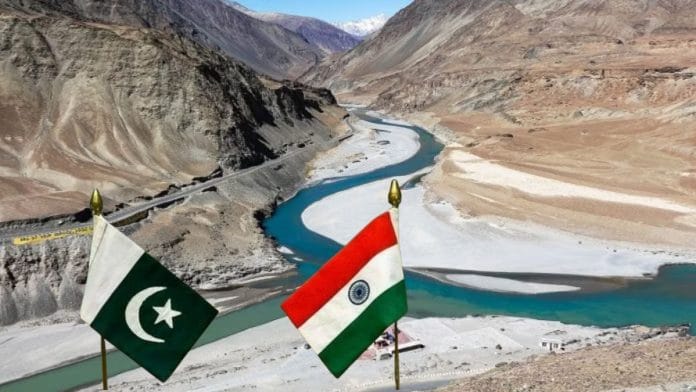

The proposed 8.7 kilometres Chenab-Beas Tunnel Link Project, traversing the towering and treacherous Himalayan terrain, intends to divert surplus water from the Chenab River straight into the Beas basin located in Himachal Pradesh.
The Project, no doubt an engineering marvel, has raised alarms on the other side of India’s border, sparking concerns that it undermines the historic Indus Waters Treaty 1960 (IWT).
Pakistan responded quickly, albeit with a degree of diplomatic caution.
Calling it a grave violation of not just IWT but also the Vienna Convention on the Law of Treaties and broader frameworks of international water law, Pakistan Foreign Office Spokesperson Tahir Andrabi said, “India has neither officially communicated nor shared any notice of these projects nor has it sought consultations in this regard.”
This massive inter-basin water transfer comes in the backdrop of India’s historic move that put the IWT in abeyance in 2025, following the tragic Pahalgam terror attacks in April 2025.
Surviving several full-scale wars, relentless border skirmishes and repeated diplomatic hiatus, the Treaty up until now, delicately managed to divorce the issue of water-sharing from the larger bilateral scuffles between the two countries.
However, New Delhi’s current geopolitical positioning, especially with the proposed Chenab Beas Link Tunnel Project, pushes the subcontinent’s water diplomacy into an unfamiliar domain. It signals a definitive shift from India’s earlier posture of strategic restraint.
The IWT divided the basin in two parts: The three western rivers (Jhelum, Chenab and Indus) were assigned to Pakistan, and the three eastern rivers (Ravi, Beas and Sutlej) went to India.
The common perception that India surrendered the western rivers tells only half the tale. India’s rights on the western rivers—including non-consumptive use, run-of-the-river hydropower, limited irrigation and even storage within limits—remain underutilised to this day.
“There was nothing technically wrong in the Treaty. For decades, India adopted a relatively restrained interpretation of its rights under the Treaty, which means that there were lots of provisions given to India on the western Rivers,” said Uttam Kumar Sinha, Senior Fellow at the Manohar Parrikar Institute for Defence Studies and Analyses.
This is precisely what India intends to rectify with the proposed Chenab-Beas Link Project. To maximise the permissible rights under the Treaty by transferring a portion of the water available from the Chenab system toward the Beas basin for storage, hydropower generation and better utilisation of water within India.
But Sinha pointed out that one of the restrictions placed on India regarding the western rivers was no inter-basin transfer of water. The Chenab Beas Link Project does exactly that.
“It is indeed an inter-basin transfer of water. But remember, we are in a different time now, we are doing this when the Treaty is in abeyance, right?” said Sinha.
The message could not be clearer—any further engagement on water-sharing cannot function in a vacuum, divorced from larger questions of national security and sovereignty.
This represents an era of absolute zero-tolerance for India—that any kind of state harbouring of terrorism will face severe and tangible consequences.
With that, the ball is surely in Pakistan’s court.
Uncharted terrain
The fractures in IWT surfaced well before it was actually put in abeyance.
It is not the first time that the idea of suspension of IWT has been entertained in Indian policy circles. With every act of terrorism or significant escalations, the debate found its way back to the forefront.
In the aftermath of the 2016 Uri attacks, Prime Minister Narendra Modi made India’s intentions loud and clear.
“Water and blood cannot flow together,” he said. And yet the two continue to define the relations between the two countries.
Ajay Bisaria, Former High Commissioner of India to Pakistan, said that in the last decade the calls for suspension have certainly amplified.
“Following the 2016 Uri attacks, the policy posture became ‘No talks with terror.’ An additional layer was added post-2019 Pulwama attack: ‘No trade with terror.’ And finally, in 2025, when all other policy instruments seemed to be exhausted, the policy posture shifted to ‘No water for terror’,” said Bisaria.
From the Indian standpoint, Pakistan has only itself to blame. With India running out of other policy levers, the decision to put IWT in abeyance is a deterrence measure—a means to escape the cost of terrorism. India is showing Pakistan that responses like Operation Sindoor aren’t the only risk, it could end up irreversibly losing the IWT.
“If terrorism stops, the Treaty could be resumed; that is the political message here,” said Bisaria.
Beyond the Indian borders, concerns and threats have been conveyed without any sugarcoating.
“The Indus River is not the Indians’ family property, and we do not have any shortages of missiles,” said Field Marshal Asim Munir, Pakistan Army Chief, while addressing Pakistani diaspora in the United States in August 2025.
Tensions and uncertainty linger over both sides of the Indus.
The IWT has clearly entered uncharted terrain. With clouds of doubts looming over its future, it only takes us back to the context in which the Treaty came into existence.
Also read: This is why Nehru-Liaquat Pact failed. Its ghost haunted Indian politics for decades
The tip of the iceberg
Just a year after Independence, India and Pakistan were already entangled in a new conflict—something more fundamental than lost territories.
It was about water.
Following the British departure from their prized colony, the division of the Indus river system was just as haphazard as the abrupt Radcliffe Line, disregarding both common sense and geography.
While most canals went to Pakistan, the headworks of two major canals, Upper Bari Doab Canal (U.B.D.C.) and the Dipalpur canal, were left behind in India.
The simmering tensions came ashore in April 1948, when the East Punjab Government temporarily suspended water supplies to the two canals flowing into West Punjab. Though the supplies were restored shortly after several rounds of negotiations, the damage was done.
The episode left deep uneasiness in Islamabad, reinforcing its anxieties and vulnerabilities as a lower riparian state.
For Pakistan, the signal was clear—the Indus basin could no longer be taken for granted. Fears of weaponisation of water had sent chills down Islamabad’s spine.
With that, cries of “Pakistan might return to being a desert” reverberated across the country.
It was a perfect diplomatic jackpot for Pakistan—they were garnering global sympathy and internationalising its issues with India, while exacerbating the episode far beyond its real scope and effect.
Mumtaz Daultana, Chief Minister of Punjab, in 1953, called the canal dispute a “first class international crisis” and that it was “a life-and-death question for the Punjab.”
“Canal waters and Kashmir are the two prongs of India’s grip on us,” declared Pakistani Prime Minister HS Suhrawardy in June 1957.
Tensions soared and threats became bolder.
“…..if the people of the Punjab were confronted with a situation of death by starvation, or by fighting, they would obviously, as brave and self-respecting people, prefer the latter course of action,” warned Daultana.
Jawaharlal Nehru, Prime Minister of India, assured that he would not “build the property of India on the misery of Pakistan cultivators.” However, no words of assurance made any impression on Pakistan.
Thus, the episode of 1948 marked the formal beginning of what eventually culminated into one of the most enduring disputes between India and Pakistan.
Etched in stone
The subcontinent’s rivers formidably defied the limits of man-made borders for thirteen years after Partition. Then came another partition.
On the shores of Karachi, on 19 September 1960, Prime Minister Nehru and Field Marshal Mohammad Ayub Khan in the presence of co-signatory William Illif, Vice-President of World Bank, signed the Indus Waters Treaty—one of the most awaited and consequential water-sharing treaties in history.
In a broadcast to his nation on 4 September 1960, Khan said, “The solution that we have now got is not the ideal one. So, whereas there is no cause for rejoicing at this juncture, there is certainly a cause for satisfaction and thanksgiving, that a very ugly situation which might have arisen in the absence of such an agreement has been averted and that we have been able to get the best that was possible.”
Khan’s counterpart, Nehru, on the other hand, while responding to the questions raised in Lok Sabha on 30 November 1960 said “…it is a good treaty for India and I have no doubt about it in my mind.”
With that, the Indus river system stood partitioned.
But the peace that Nehru expected the Treaty would assure came at a price—a mounting sum of £62 million, which India was liable to pay Pakistan to finance replacement canals from the western rivers.
The world watched with bated breath, wondering if this historic Treaty could remain insulated from the turbulent scaffolding of the bilateral ties between the two nations.
The apprehensions weren’t misplaced. On both sides of the Indus basin, deep reservations and feelings of betrayal echoed across the halls of Parliament and the streets.
Also read: Pondage, power and Pakistan—India versus ‘Indus’ court at The Hague
Did India compromise too much?
The Treaty, hailed as a hallmark of cooperation internationally, left a bitter aftertaste on both sides of the border.
A wave of clamour arose in the Parliament about what was perceived as India’s one-sided generosity. They were unanimous that as an upper riparian state—India had given away too much.
The 80-20 narrative—that India received 20 per cent of the Indus basin water while Pakistan received 80 per cent—accusations of excessive Indian generosity, and the belief that Pakistan had masterfully played the victim card soon became ingrained in Indian discourse. Such questions are raised even today.
Parliamentarians were quick to take up the matter.
“It is a kind of second partition which we are experiencing… this is being done again with the signature of our honourable prime minister,” said Ashok Mehta, Praja Socialist Party.
The uproar was not merely about the contents of the treaty itself, but about the manner in which it was concluded.
Leading the charge were Mehta and Thakur Das Bhargava, of Indian National Congress. They questioned how a treaty with such broad ramifications was signed without even a whisper to the Parliament. Recurring fault lines in Indian federalism of central overreach was also raised unequivocally.
“The Central Government had no right to enter into a treaty of this kind without consulting the states…water belongs to the states. It is a state subject; it is not a Central subject at all,” said Bhargava.
Responding to the criticism of bypassing legislative oversight, Nehru responded, “Are we to come at every step and ask Parliament?”
Saying that the government has to rely on its own judgement, Nehru said, “There is no other way. One takes a risk; maybe that Government may go wrong. But there is no other way to deal with it.”
More chaos erupted.
Discrediting the treaty as a “document of surrender,” Parliament spoke with remarkable unanimity against India’s reasoning to forgo almost 80 per cent of the Indus basin’s waters despite its strategic upper-riparian edge.
“This is a strange division. India, with a much larger population and with vast areas of arid and desert land in Rajasthan and Punjab crying for water, has been given a microscopic share,” argued Mehta.
Legislators struggled to make sense of why Indian needs were sidelined to appease Pakistan and the international community.
“It is not that our over-generousness should be at the cost of our own people and at the cost of the development of this country,” said Harish Mathur (INC) of Rajasthan.
The question was straightforward—why in addition to forgoing the lion’s share of water, are we paying for replacement works in Pakistan?
Braj Raj Singh, from the Socialist Party, called it a “unique treaty,” where the aggrieved party that has lost its waters, “is also asked to pay the costs of the other party.”
However, for Nehru, the wisdom behind the treaty was clear. Defending it forcefully, Nehru urged the parliamentarians not to evaluate it through a blurred prism of numbers, “it is the context that we have to consider.”
Convincing the house that years of negotiation, technical oversight and closest attention to details was given, Nehru argued, “the mere fact that this has taken twelve years would at least convince the House that nothing, not a comma, not a full stop has been accepted without the longest argument…”
Nehruvian idealism took centre stage. Faced with charges of a “second partition,” Nehru seemingly weary, asked, “Partition of what? Of an inch of territory? Partition of a pailful of water?….Is that the way to approach an international question?….Members have been saying…we should not give them anything. If we follow that approach it would mean turning a great part of West Punjab into almost a wilderness.”
Also read: Ending Indus treaty may hurt Pakistan’s poor, but it’ll also unite it with anti-India hatred
A relic of its time
Was the treaty a pragmatic trade-off or did India end up compromising its position?
India was a young nation. With scars of colonial rule still fresh, financially strained and struggling to pull millions out of poverty, the options seemed limited.
“The immediate developmental value of securing uncontested control over the eastern rivers, which could support irrigation expansion in northern India appeared more tangible,” said Sinha.
There were practical reasons for it. Not only were the eastern rivers critically important for India, they meander through the plains which are relatively easier to harness.
The treaty underwent years of negotiations, technical scrutiny and mediation by the World Bank. It wasn’t some hasty decision, taken in isolation.
But the treaty was designed for the hydrological and geopolitical environment of the 1960s. Its continued relevance, however, hinges on its ability to remain dynamic and to adapt to changing needs and evolving geopolitical realities.
Stalling projects
Over sixty years later, one side of the Indian camp continues to question the extraordinary generosity that still strangles the country’s needs.
They argue that the treaty controls India’s use of these waters, while imposing no parallel restrictions on Pakistan.
“India’s usage and development is highly handicapped when it comes to the western rivers,” said Pradeep Kumar Saxena, Former Indian Commissioner for Indus Waters, in his paper, The Indus Water Treaty: Asymmetric Obligations, Unequal Concessions and Pakistan’s Weaponisation.
Pakistan, on the other hand, is footloose and fancy-free. It was not subjected to the same kind of storage or operational constraints that were imposed on India on the western Rivers.
The irony is hard to miss. A treaty forged in the spirit of friendship and goodwill, argues Saxena, has been turned against India, manipulated to tarnish India’s image internationally through the rhetoric of ‘water war’ while at home hindering the development of large tracts of Indian territory.
The Indian side has also repeatedly raised issues about Pakistan’s exploitation of the treaty’s dispute resolution mechanism—it uses the provision as a strategic tool to keep Indian projects in a perpetual limbo and stalling them in a web of objections, reviews and arbitration.
Projects such as Baglihar Dam, Kishanganga, Pakal Dul and Tulbul have all borne the brunt of prolonged disputes, with cost escalations and delays extending sometimes into decades.
Objections are often raised over a few metres of height as in the case of Salal Hydroelectric Project on the Chenab.
Pakistan argued that the extra height would cause flooding. India had to concede and shave off a few feet on the proposed storage facility. The compromise, no doubt, helped clinch the deal, but it burdened the dam with severe siltation problems.
“Without exhausting commissioner-level dialogues, Pakistan has made a habit of simultaneously taking every dispute to a Neutral Expert or the Court of Arbitration, thinking that it could expand to other areas, for instance the Kashmir issue,” said Bisaria.
The problem does not end there.
“Water is quite an emotive political issue in Pakistan,” said Bisaria.
Sindh sees the Indus River, locally known as Darya-i-Sindh, as an essential part of Sindhi identity, said Fatima Malik, Assistant Professor Beaconhouse National University (BNU) Lahore, Pakistan. This emotional and cultural connection to the river strengthens opposition to projects that alter its flow. That can be seen even now.
Highlighting Pakistan’s typical anxieties of a lower riparian state, Raghavan says that it is because it’s predominantly an agricultural country. “Anything to do with the western rivers evokes a kind of Pavlovian response in Pakistan.”
Water is, therefore, more than just a resource. It is highly politicised and often used to mobilise anti-India rhetoric in Pakistan, reinforcing the strategic narratives of political-military establishment in Islamabad.
“IWT in Pakistan is seen as a national security apparatus, since the Indus River flows through Kashmir. And India, as the upper riparian, theoretically can control water flows, so any Indian project is seen as a potential threat to Pakistan’s water security,” said Malik.
Sinha said that by portraying India as the culprit of Pakistan’s water woes, the establishment tactically deflects attention from its own poor mismanagement of water resources, while perpetuating an eternal hostility with India.
All this accentuates a critical strategic reality—the inseparability of water security and the Kashmir issue.
Geographical constraints
There is also a camp that acknowledges the rationale behind the compromise. But there is a growing consensus among them that a renegotiation can no longer be kept off the table.
“No treaty is without flaws. Its success hinges less on the content and more on the willingness of the parties to make it work,” said Amit Ranjan, Research Fellow at Institute of South Asian Studies (ISAS), National University of Singapore.
Questions of compromise depend on who is telling the story, he added. And more importantly, the underlying relations between the countries.
“Shared rivers necessitate shared rules. The treaty attempted exactly that—to manage a shared resource based on cooperation rather than conflict,” said Ranjan.
The treaty guarantees India rights on the western rivers, including non-consumptive use, run-of-the-river hydropower, limited irrigation, and even storage within limits.
Ranjan added the question is not only what India gave away, but what it could have utilised realistically.
The Indus river system is huge and managing that would have entailed an enormous infrastructure build-up.
Bisaria said that the 80-20 argument is not a valid one because the Indus basin is mostly in Pakistan.
“We must understand one thing, the Treaty does not give water to Pakistan, geography does. Water flows to Pakistan because of geographical factors,” said TCA Raghavan, Former High Commissioner of India to Pakistan.
“At its core, the treaty itself was an act of upper riparian generosity and there was a sense even when it was signed in the 1960s that this generosity will help bring peace with a difficult neighbour,” said Bisaria.
The “80-20” narrative stems from simple arithmetic. The Eastern rivers allocated to India carry approximately 33 million acre-feet (MAF) annual flow in contrast to Pakistan getting a whopping 135 MAF that the western rivers carry.
In retrospect, said Bisaria, there has been some degree of negligence by India. It has not made full use of what the treaty permitted in the usage of both western and eastern rivers.
However, with the treaty in abeyance, “India is making up for it,” said Bisaria.
Also read: IWT suspension is lawful and morally right. India isn’t weaponising water, but ending charity
Building infrastructure
The argument boils down to one central fact—India lacks the infrastructure needed to utilise even the water promised under the treaty.
3.6 MAF of water is legally India’s share of the western rivers. The majority of which just flows down unused.
India has not sufficiently invested in storage, diversion and irrigation infrastructure required to fully harness those entitlements, though it is now being addressed to some extent by the NDA government.
“First, the Indus barely flows through Indian territory before entering Pakistan. Second, you would require massive infrastructure to just hold or divert that water. So, arguments about numbers and percentages are futile. Focus should rather be on the management of water resources,” said Ranjan.
Storage capacity within the bounds of the treaty remain underdeveloped, inter-state coordination weak, environmental and administrative bottlenecks continue to retard implementation.
Political discourse often conceals governance failures behind rhetoric of historic blunders.
One thing is clear, that the strategic logic of 1960s that defined the IWT no longer holds true. An Indus Waters Treaty 2.0 is definitely in sight.
Even myriad factors point in that direction. Climate change, for one, has made an update necessary. It has induced unprecedented variability in rainfall patterns, glacial melts and thereby in the flow of rivers.
Any Indian demands of renegotiation, however, should be mindful of its dual identity as both an upper and lower riparian state. Asserting unhindered autonomy could jeopardise its lower riparian status vis-à-vis China.
It will serve India well to vouch for a defined, predictable and rules-based governance structure.
The problem does not begin or end with the Treaty.
“River water issues are inherently problematic in case of transboundary-rivers. What is often missed is that the real source of friction lies not in the treaty itself, but begins with the deep downturn in India-Pakistan relations,” said Raghavan.
(Edited by Theres Sudeep)
Apart from sort of unfair IWT.
Various arbitrations has been biased against India and their judgments were devoid of technical and engineering merits.
Majority of likely hydro projects have already identified as long ago as 1947.
Further, various people at the helms of affairs did not had foresight understand the tactical and strategic importance of constructing those hydro project.
At present despite all the propoganda by Pakistan all the projects are within the parameters of IWT.
Water & power from the projects on Indus basin will change the economy of India as far away as MP & Gujarat.
I don’t see any congressi take responsibility of the all these bad decisions that every Indian need to pay on daily basis directly or Indirectly.
Thanks for a balanced piece.
Could Mr Gupta write one on the river systems in POK too? There is too much of useless rhetoric in mainstream media. An informative piece like this would help those of us who are keen to know the facts.