




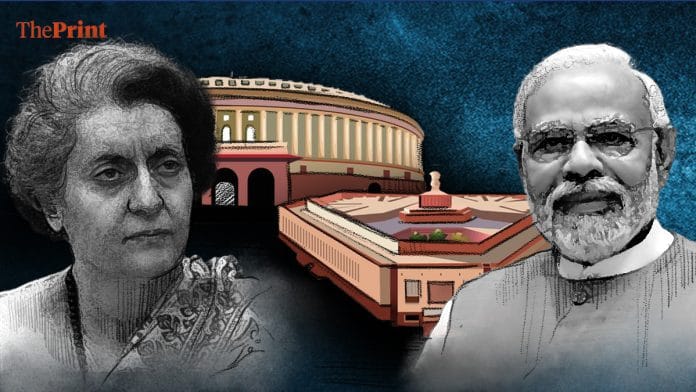

Sometimes your biggest advantage can also be your biggest disadvantage. Something like that is happening to this government.
Prime Minister Narendra Modi is the reason the government exists. Poll after poll has told us that Modi is more popular than the government he heads. The BJP has won three general elections in a row because of his charisma. The cabinet rules in his name: you could sack every single minister tomorrow and replace them with new ones and nobody (except for the sacked ministers, perhaps) would care.
And the Prime Minister’s rhetoric reflects the personalised nature of his leadership. Like many strongmen, he often refers to himself in the third person. And his terminology acknowledges his position as the Supreme Leader: it’s always ‘Modi Ki Guarantee’ rather than an assurance given by the government as a whole.
The rhetoric of his colleagues takes the same line. No speech or announcement is complete without ritual genuflection to him. Everything always happens under ‘the leadership of our beloved Prime Minister.’ Even on the rare occasions when ministers deserve credit or congratulations, they always refuse to accept them, attributing all achievements to the Prime Minister’s leadership and vision.
Modi’s critics laugh at all this adulation and worship, but what they cannot deny is that his popularity wins votes. In the general elections where Narendra Modi has led the BJP, the party’s vote share has ranged (broadly) from 31 per cent to 36 per cent. At 36 per cent (at the last general election), the BJP under Modi is a full ten percentage points ahead of where it was in 2004, the last election in which Atal Bihari Vajpayee led the party.
Opponents of the BJP like to draw parallels with Kim Il Sung and North Korea. But there are enough contemporary comparisons to be found. Even today, with everything going wrong in America, The Economist’s tracker shows that 36 per cent of US voters approve of Donald Trump. President Trump, like PM Modi, has a hard core of supporters who stick by him through thick and thin. In our parliamentary system, 36 per cent is often enough to form a government, though not necessarily enough to win a majority, as Modi discovered at the last election.
The 36 per cent core vote is the Prime Minister’s gift to the BJP, which would never have got here without him: Modi knows this. He has joked about how, in his early days in politics, the BJP would celebrate if a candidate did not lose his deposit in an election.
But there is one parallel from much closer home than America and North Korea, and not enough people are talking about it.
Indira Gandhi.
Also read: Why Modi blinked first in the student protest
The popularity and protest parallel
For all his popularity, Modi has never been in the same league as Gandhi. In 1971, after she had been expelled from the Congress and was left without an organisation, Gandhi’s newly created Congress faction won 43 per cent of the vote. In 1980, when Gandhi came back after having been written off, she won 43 per cent again. And at the 1984 election that followed her assassination, the Congress won 48 per cent.
That’s the sort of popularity that puts the BJP’s 36 per cent in perspective.
But, for all these triumphs, there was a period when Indira Gandhi was so unpopular that she became a liability for the very Congress that she had created. In 1974, popular movements against her rule reached such heights that her name became synonymous with a discredited and corrupt way of doing things. By 1975, she was so much on the defensive that her very survival seemed to be in doubt. If she had not declared the Emergency and postponed the election due in 1976, she would probably have been defeated. As it turned out, the postponement did not improve her prospects. She not only lost the next election in 1977, but she also lost her own seat.
That may be the parallel that Modi should heed.
People have drawn comparisons between the recent Jantar Mantar protests and events in Nepal and Sri Lanka. These comparisons don’t really work: the Jantar Mantar protesters were non-violent and did not want to change the entire system. The Indian student protests of 1974-75 make for a better parallel.
Much of what angered the student protesters in the Seventies was not entirely Indira Gandhi’s fault. The global economy had been devastated by the massive oil price hike of 1973, and unprecedented inflation had rocked the whole world.
But because Gandhi had run the country as though she was the Supreme Leader, she became the primary target of the protesters. The general tone of the protests was: you want the credit for everything that has gone right. Now take the blame for everything that is going wrong.
Once you become the Supreme Leader, you also become the Supreme Target.
I don’t want to belabour the point because, so far at least, Modi has not faced the kind of unpopularity that Indira Gandhi did in the mid-Seventies. But the parallels are all there. The air of invincibility he had successfully cultivated has been damaged by the fearlessness of the protesters and by the way in which they treated him as a figure of fun. We should not make too much of the BJP’s recent defeats at two by-elections but, in Bihar at least, the defeat was as unexpected as it was unprecedented. The BJP is supposed to be all-powerful in the Hindi belt. And yet it lost one of the safest seats in Bihar to a man who said his intention was to teach a lesson to the BJP.
Also read: How student protesters rewrote the language of political dissent—with humour
Tough times ahead, but don’t underestimate
In most circumstances, Modi has always known how to bounce back. But over the last week, he has seemed strangely uncomfortable. I doubt if he enjoyed having to finally sack a minister because of student protests. And his attempts to reach out to a new generation have been unusually awkward. The selfie video was poorly received, as was his grandiloquent declaration that he would forgive the students for insulting him. And the BJP’s strategy of hounding young people and children into posting video apologies for insulting the great leader has reinforced the caricature of the emperor who treats damage to his own ego as more important than the students’ grievances.
The Prime Minister is India’s shrewdest politician, so no doubt he will find a more effective strategy in the months ahead. But one solution may be to keep a lower profile and to avoid setting himself up as such a visible target for a generation whose idiom he is not comfortable with.
I don’t know how much trouble he is in electorally, but experience suggests that while the BJP is vulnerable at by-elections, it does much better when entire legislatures go to the polls. Cynics will say that this is because of a house-trained Election Commission. But it could simply be that larger elections are fought on different issues.
Either way, the events of the last week may foreshadow troubling times in the months ahead. The ethanol issue could well take off, and while I doubt that Modi will shed any tears about sacrificing Nitin Gadkari, he probably recognises that the protesters will not spare him.
Then there is a reshuffle to come, which will give him an opportunity to overhaul his Cabinet but which will also lead to dissatisfaction within the party, as most reshuffles do. Those who are dropped usually turn into dissidents, and those who don’t get the posts they expected always seethe.
I imagine that the Prime Minister’s strategy is to wait for next year’s Assembly election in Uttar Pradesh, which the BJP expects to win for the usual reasons, and to hope that this triumph will silence his critics. It could work, but he will also have to satisfy the angry young people all over India who cannot find jobs. That number will grow as AI is more widely adopted. But there is no reason to believe that this government knows how to handle the economy, let alone create employment.
It could be that the good times are ending. But it’s always a mistake to underestimate Narendra Modi. He could well play to his strengths and avoid sliding into the Indira Gandhi syndrome.
Vir Sanghvi is a print and television journalist and talk show host. He tweets @virsanghvi. Views are personal.
(Edited by Prashant Dixit)
People genuflect to Modi because he has an aura that is difficult to pierce. What Sanghvi forgets is that the Congress tried that with Rahul Gandhi till it became a laughing stock.
The aspect which Vir and other critics don’t ‘get’ is that Modi is still connected to the ground far better than any national level politician. In various WhatsApp groups, the common refrain across them is – ‘Modi has given us development. Can you imagine anyone else in the current opposition doing that?’
Now – THAT – is a question which Vir and Modi’s critics could do well to answer.
The question is not whether Modi is Indira Gandhi or not. The question is who is JP? JP was connected to the heart of India while protesting against the emergency. Neither Kejriwal, nor Rahul Gandhi nor CJP meet that.
One contradiction in the column is noteworthy. If the entire Cabinet could be replaced overnight – which is exactly what was done to the late CM Vijay Rupani and his team – what is the significance of a Cabinet reshuffle. It does seem a waste of so much potential talent and governance bandwidth. Validated by the concluding observation that the governments does not know how to manage the economy or create employment. Surely, in a developing country, that should outrank all else.
One big difference between the two leaders is the economy, its potential and possibilities. So much larger now. May the PM’s legacy stand out for the contribution made to a much more vibrant economy, its fruits more equitably shared.
Vir Sanghvi’s good times are perhaps starting. Feel so happy for him.
His strength is killing Muslims in large numbers – whenever he fears a loss, he turns to killing Muslims. however, the greatest damage that no one else in the whole world could have done to the sangh parivar was, in fact a self-inflicted one – the Ram Mandir Offerings Theft – the chanda / chadawa chor sramp that the parivar now carries will stay with them forever – this is the great opening that the the Opposition ought to exploit in future elections.