




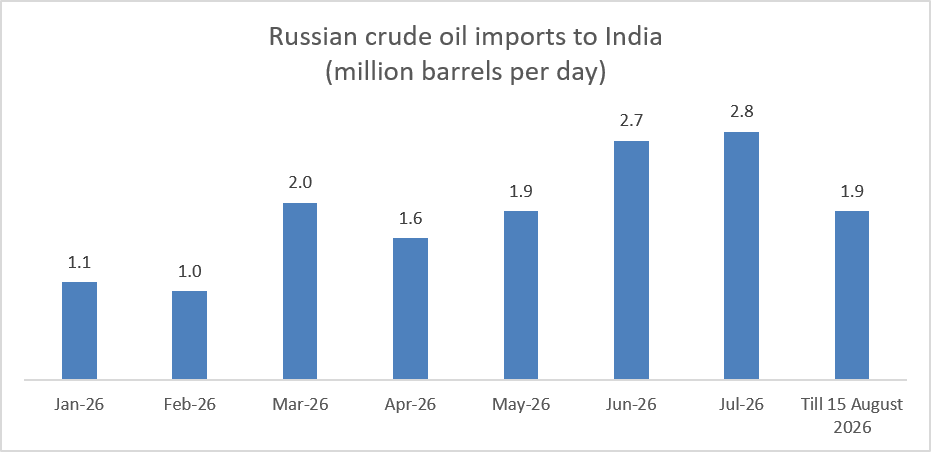
New Delhi: India’s imports of Russian crude are expected to decline in August following Ukrainian drone attacks on Russian oil terminals and planned maintenance at some Indian refineries. Russian crude supplies to India are expected to average around 1.8-2.0 million barrels per day (mbpd) this month, down from about 2.7 mbpd in both June and July, according to initial estimates for August from Kpler, a global trade intelligence firm.
“Russian barrels are set to decline in August from the peak seen in June-July, driven by turnarounds at MRPL (Mangalore Refinery and Petrochemicals Limited) and Panipat refineries, along with disruptions from drone attacks on Russian oil terminals,” Nikhil Dubey, lead analyst for oil markets at Kpler told,ThePrint.
The decline comes after Ukrainian drone attacks disrupted Russian oil infrastructure and exports last month. However, analysts say Russian oil will remain the largest source of India’s crude imports despite the decline in August.
“Russian supplies have proven to be reliable and consistent at a time when other regional barrels – on which India previously depended – have become scarce,” Dubey said.
The latest disruption came Friday, when crude oil exports from Russia’s Sheskharis terminal at the Black Sea port of Novorossiysk were suspended following a drone attack, according to Reuters. The terminal handles around 7,00,000 bpd of crude and is Russia’s main oil export facility on the Black Sea. Its shutdown adds to pressure on Russian energy infrastructure, which has faced repeated Ukrainian attacks in recent months.
The continued purchases of Russian barrels come despite pressure from Washington on India to reduce its dependence on Russian oil. The key factor supporting Russian supplies is the price advantage of its crude over Middle Eastern grades.
According to Naveen Das, senior analyst at Kpler based in London, Russian Urals continues to trade at discounts that more than compensate for the additional freight cost of bringing the barrels to India.
“The purchases keep flowing because the Urals discount to Middle Eastern grades still more than covers the extra freight,” Das said, adding that ongoing disruptions around Hormuz and the Bab el-Mandeb make Russian crude relatively more secure on a delivered basis.
Houthi attacks in the Red Sea have generally not targeted Russian oil shipments, allowing Russian barrels to pass through the route without the same level of threat faced by some other supplies.
This has given Russian crude an advantage as other suppliers face higher shipping and insurance risks because of disruptions around the two chokepoints.
Russia’s share of India’s crude imports has risen sharply this year, from around 23 percent in January to more than 50 percent in both June and July.
Gulf suppliers increasingly bypass Hormuz
India continues to receive large volumes of crude from the Middle East, but Gulf producers are increasingly using alternative routes to avoid the Strait of Hormuz.
Kpler data shows UAE crude deliveries to India stood at around 7,00,000 bpd in the first half of August, while Saudi Arabia supplied about 4,80,000 bpd. However, the volumes are expected to average lower over the full month, Dubey said.
Around 60 percent of UAE and Saudi volumes are being loaded from Fujairah in the UAE and Yanbu in Saudi Arabia. Fujairah receives crude through the Abu Dhabi Crude Oil Pipeline (ADCOP), while Yanbu is supplied through Saudi Arabia’s Petroline pipeline. Both routes bypass Hormuz.
The remaining 40 percent is loaded from terminals inside the Gulf, including Ras Tanura, Das Island and Al Basrah, and must still pass through the strait.
“About 60 percent of this UAE/Saudi volume is loading from Fujairah and Yanbu — both of which bypass the Strait of Hormuz entirely,” Das said.
Dubey said Saudi barrels have faced greater difficulty crossing the Bab el-Mandeb following the Houthi embargo. However, UAE supplies have remained strong as the country uses pipelines and ship-to-ship transfers to move crude oil.
Venezuelan supplies rise, US crude falls
India is also importing more Venezuelan crude, with supplies reaching around 4,00,000 bpd in the first half of August, up from about 2,18,000 bpd in July. However, Dubey expects Venezuelan supplies to average around 2,00,000-3,00,000 bpd for the full month as shipments normalise in the remaining days.
US crude supplies, meanwhile, have fallen to around 1,02,000 bpd in the first half of August, continuing a sharp decline from a peak of around 5,65,000 bpd in October 2025.
Das said the decline is being driven primarily by economics rather than policy. Indian refineries are largely configured to process medium and heavy sour crude, making US light sweet grades less suitable. The roughly 40-day voyage from the US also raises the landed cost.
“US light sweet grades don’t suit Indian refiners’ medium/heavy sour-optimized configurations, and once the roughly 40-day freight from the US is factored in, US barrels simply can’t compete with the Russia and Venezuela discounts on a landed-cost basis,” Das said.