





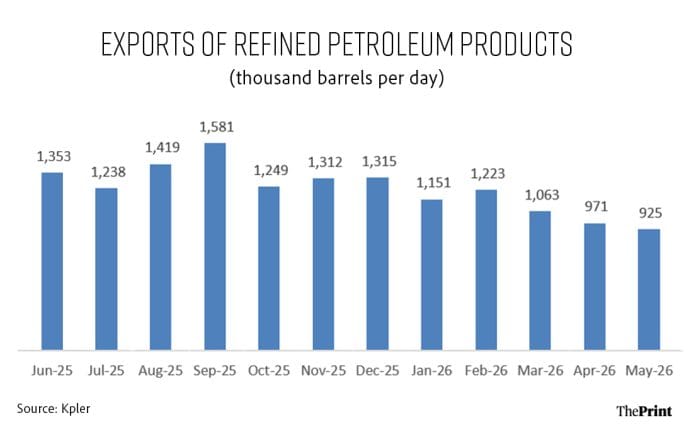


New Delhi: India’s exports of refined petroleum products fell to their lowest level in more than three years in May. The decline was caused by refinery shutdowns, a government-imposed export duty, and a growing focus on domestic fuel supplies.
Refined product exports fell to around 9,25,000 barrels per day (bpd) in May, the lowest level since October 2022 (9,26,000 bpd), according to Kpler, a global trade data intelligence firm.
The sharp decline was driven partly by maintenance-related disruptions at India’s largest refineries.
Reliance Industries’ Jamnagar refinery complex, with a capacity of processing around 6,60,000 barrels per day, was shut during the second half of May for planned maintenance. The shutdown came after Nayara Energy’s 4,00,000 bpd Vadinar refinery, which had been closed since early April, resumed operations.
As the Jamnagar refinery is India’s biggest refining and export hub, even temporary reductions in throughput have a significant impact on national export volumes.
“Planned maintenance at Reliance Industries’ Jamnagar complex significantly reduced export availability during May,” Sumit Ritolia, manager for oil markets and refineries at Kpler, told ThePrint. “The maintenance turnaround lowered crude intake and refinery throughput.”
However, refinery outages were only part of the story. According to Kpler, refiners also adjusted product yields to prioritise domestic requirements, particularly for liquefied petroleum gas (LPG). This shift reduced gasoline (petrol) and gasoil production by around 80,000 barrels per day, limiting the volumes available for export.
“Shifting refinery configurations to maximise local LPG output directly reduced the availability of export barrels, with gasoline and gasoil exports bearing the largest impact,” Ritolia said.
The fall in exports also coincides with the government tax policy that has made overseas sales less lucrative.
In March, the government imposed a special additional excise duty (SAED) on select petroleum exports, including diesel and aviation turbine fuel (ATF), amid concerns over domestic fuel availability following the West Asia conflict.
At its peak in April, the export duty stood at Rs 55 per litre on diesel and Rs 42 per litre on ATF. Although the government gradually reduced the levy from late April onwards, exporters continue to face duties of Rs 13.5 per litre on diesel and Rs 9.5 per litre on ATF as of June 2026.
According to Ritolia, these taxes have weakened export economics and reduced the attractiveness of overseas sales compared with supplying the domestic market.
State-run refineries have also increasingly prioritised local demand amid continued uncertainty in global energy markets.
“PSU refiners have increasingly prioritised domestic market requirements amid continued uncertainty in global energy markets,” Ritolia said. “Concerns around supply security and the mandate to maintain adequate local availability encouraged PSU refiners to direct a larger share of production toward the domestic grid rather than international export channels.”
While the sharp decline marks India’s lowest refined product export level in over three years, economists do not expect a significant macroeconomic impact.
Arya Roy Bardhan, Junior Fellow at Observer Research Foundation (ORF), said the fall in exports largely reflects a deliberate policy and industry response to geopolitical uncertainty rather than a structural weakness in India’s refining sector.
“The fall in refined product exports is unlikely to have a substantial impact on India’s current account. It only reflects a deliberate prioritisation of domestic fuel availability amid heightened geopolitical uncertainty,” Bardhan told ThePrint.
He added that the refinery maintenance cycle is temporary and is, therefore, unlikely to materially affect India’s current account deficit. Despite being one of the world’s larger exporters of refined petroleum products, India is also unlikely to influence global fuel prices through the reduction in shipments, he said.
However, Bardhan cautioned that lower exports could weigh on earnings from overseas sales. “On the other hand, this risks lower export earnings, which should be a concern if reserves are headed towards depletion.”
(Edited by Nida Fatima Siddiqui)
Also Read: US emerges as India’s largest source of LPG amid Gulf disruption, Russia remains top crude supplier