



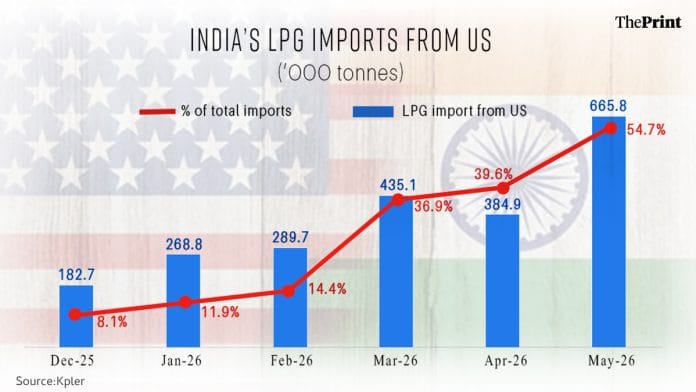
New Delhi: The US has emerged as India’s largest supplier of liquefied petroleum gas (LPG), accounting for 55 percent of the country’s imports in May 2026, compared to 14 percent in February. This underscores a major shift in energy sourcing since disruptions in Gulf supplies triggered by the West Asia conflict and the Strait of Hormuz blockade.
Gulf suppliers—UAE, Saudi Arabia, Kuwait and Qatar—together accounted for 81 percent of India’s LPG imports in February 2026, before the initial strikes by US and Israel inside Iran. Since then, lower availability of cargoes from the region has steadily increased India’s reliance on US supplies.
Gulf suppliers’ share in India’s LPG imports stood at 16 percent in May.
Data from global trade intelligence firm Kpler, accessed by ThePrint, shows the US exported around 6,66,000 metric tonnes of LPG to India in May, with shipments rising 73 percent from the previous month.
The shift highlights how India has increasingly turned to alternative suppliers to manage disruptions in one of its most critical energy import corridors.
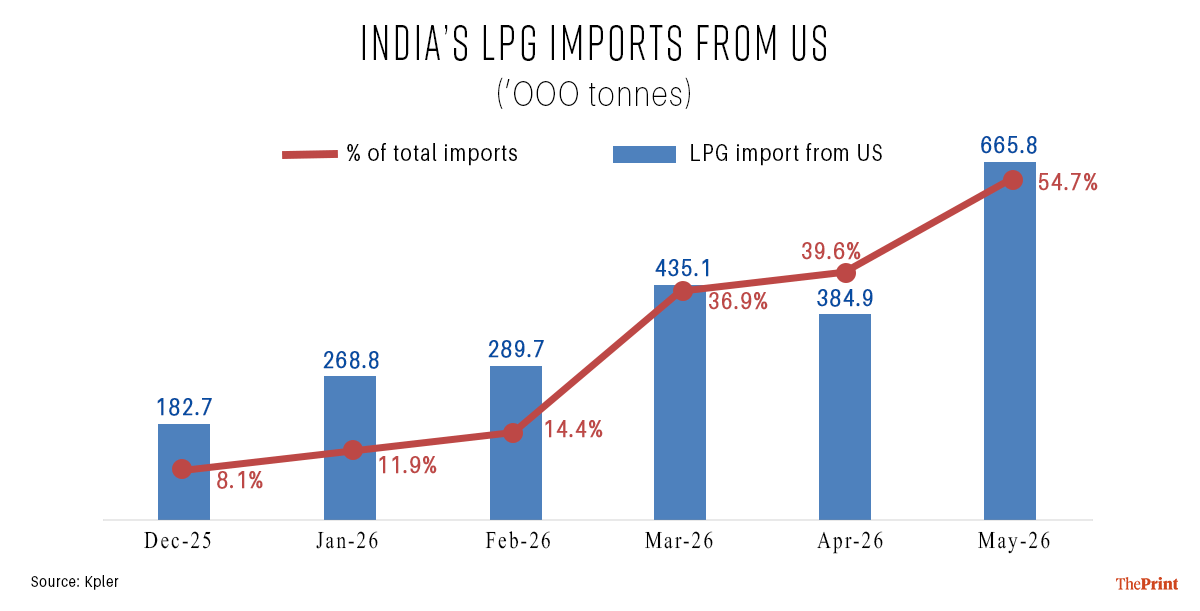
Kpler data also shows that overall LPG imports have declined sharply from pre-conflict levels of 2 million tonnes per month in February 2026 to 1.2 million tonnes in May, reflecting both supply disruptions and a rise in domestic production.
“LPG was more visibly disrupted. Imports fell sharply from above 2.0 million tonnes/month in Jan-Feb to around 1.0-1.2 million tonnes/month in March-May, with lower Middle Eastern availability partly offset by higher US inflows,” Sumit Ritolia, manager for oil markets and refineries at Kpler, told ThePrint.
The decline in imports has been partly cushioned by a sharp increase in domestic output. Before the conflict, India was producing around 35,000 metric tonnes of LPG per day. According to the latest numbers shared by Sujata Sharma, Joint Secretary in the Ministry of Petroleum and Natural Gas, domestic LPG production has now risen to around 50,000-52,000 metric tonnes per day, against a total demand of around 72,000 metric tonnes per day.
Russian, Venezuelan crude cushion
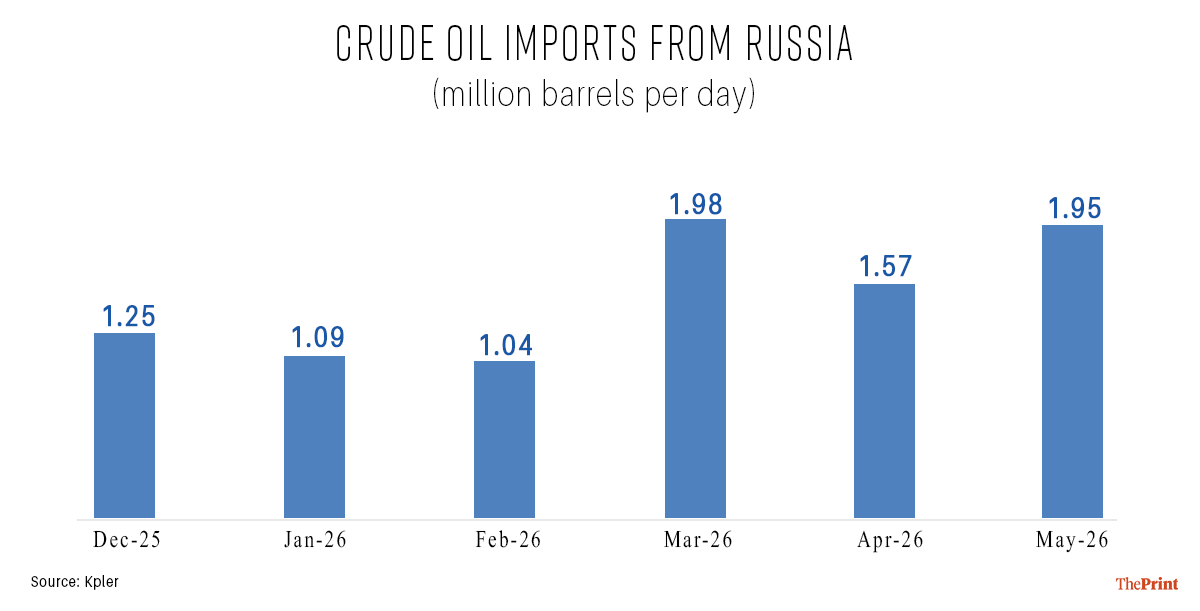
Kpler data shows India imported around 1.95 million barrels per day (mbpd) of Russian crude in May 2026, up 24 percent from 1.57 mbpd in April. The volume was the second highest in the last 11 months and only marginally below the 1.97 mbpd imported in March.
Overall, India’s crude imports recovered to around 4.9 mbpd in May after falling to nearly 4.5 mbpd during March and April. The increase in Russian crude purchases came even as uncertainty around US sanctions continued.
On 18 May, the US issued a third 30-day waiver allowing ‘most vulnerable nations’ to continue purchasing Russian crude transported by sea. The waiver remains valid until 17 June. On the other hand, the Indian government has repeatedly maintained that it will continue purchasing Russian crude irrespective of the US waiver.
Russian barrels continue to offer Indian refiners stable supplies and logistical flexibility at a time when many traditional suppliers have faced export constraints. Thus, Russia has maintained its position as India’s largest crude supplier during a period of heightened market uncertainty.
“One of the most notable developments over the past three months has been the resilience of Russian crude flows to India. Despite significant disruptions to Middle Eastern supply chains, Russian exports to India have remained strong, helping offset part of the decline in Gulf availability,” Ritolia said.
Kpler data suggests that India is also steadily increasing purchases of Venezuelan crude as refiners seek to diversify sourcing.
In May, India imported nearly 266 thousand barrels per day (kbpd) of Venezuelan crude. After a gap of nearly one year, India resumed Venezuelan crude purchases in April with around 283 kbpd.
“Indian refiners have historically shown interest in Venezuelan crude whenever sanctions have been eased, given its compatibility with India’s complex refining system and attractive economics. We expect Venezuelan crude imports into India to remain strong going forward,” Nikhil Dubey, lead analyst for oil markets at Kpler, told ThePrint.
The crude flows from Russia and Venezuela have helped India offset part of the decline in crude supplies from the Gulf and reduce its exposure to disruptions in the Hormuz.
Oman may emerge as alternative
Despite the Hormuz blockade, a significant volume of crude from the UAE and Saudi Arabia continues to reach Indian refineries via the pipeline network in those countries that bypass Hormuz. In May, India imported 497 kbpd from the UAE and around 350 kbpd from Saudi Arabia, 48 percent lower from April levels.
However, Kpler data suggests that the disruption has been far more pronounced for other Gulf producers.
India did not import any crude oil from Kuwait and Qatar during April and May. Imports from Iraq recovered marginally to 97 kbpd in May after falling to zero in April, but remained far below the nearly 1 mbpd imported from the country in January this year.
“Middle Eastern flows became more uneven, particularly from Iraq and Kuwait,” Ritolia said.
One notable exception has been Oman. India imported nearly 250 kbpd of Omani crude in May, a 179 percent increase from the previous month. Historically, India’s crude purchases from Oman have remained below 100 kbpd a month.
The rise in volume is significant because much of Oman’s coastline lies outside the Strait of Hormuz, directly on the Arabian Sea and the Gulf of Oman, making its exports less vulnerable to disruptions in the strategic narrow waterway.
The development coincides with the India–Oman Comprehensive Economic Partnership Agreement (CEPA) that formally came into effect Monday.
Global Trade Research Initiative (GTRI), a Delhi-based think tank focused on global trade, climate change, and technology in a statement said the agreement would deepen India’s energy security by ensuring access to Omani crude oil, fertilisers, methanol and ammonia worth over $7.2 billion in imports during FY 2026.
It also noted that major Omani ports such as Salalah and Duqm can continue to serve as reliable trade and energy gateways during periods of conflict in the Gulf, when traffic through Hormuz is disrupted.
According to Ritolia, going forward, the market is likely to remain dependent on how quickly Middle Eastern flows normalise. “If the disruption persists, India may need to continue relying more heavily on Russian, US, African and Latin American barrels,” he said.
(Edited by Amrtansh Arora)
Also Read: Waiver or no waiver, Russian crude remains centrepiece of India’s oil imports strategy