








New Delhi: The US has once again eased pressure on Russian oil flows, issuing a fresh 30-day waiver for purchases of Russian crude cargoes already at sea for what it described as the world’s “most vulnerable nations” dependent on energy imports.
US Treasury Secretary Scott Bessent announced the third temporary waiver late on Monday, extending the relief until 17 June after the previous exemption expired on 16 May. In a post on social media platform X, Bessent said, “This extension will provide additional flexibility, and we will work with these nations to provide specific licenses as needed. This general license will help stabilize the physical crude market and ensure oil reaches the most energy-vulnerable countries.”
Even before Washington renewed the waiver, India had signalled continuity in its Russian oil strategy. Petroleum Ministry Joint Secretary Sujata Sharma told reporters on Monday that India was purchasing Russian oil before the waiver, during the waiver, and would continue to do so.
“Regarding American waiver on Russia, I would like to emphasise that we have been purchasing from Russia before waiver also, during waiver, and now also,” Sharma said.
Data from global trade intelligence firm Kpler, accessed by ThePrint, shows India imported around 1.8 million barrels per day (mbpd) of Russian crude till 18 May 2026. The figure is higher than April’s 1.57 mbpd, though still below the March 2026 high of nearly 2 mbpd, when disruptions in West Asia pushed refiners toward discounted Russian barrels.
“Regarding Russian oil, we expect import volumes to remain robust. While they may not reach the peak levels seen in March, we anticipate they will stay healthy, especially given that the US has issued further sanction waivers,” Nikhil Dubey, Lead Analyst (Refining and Modeling) at Kpler, told ThePrint.
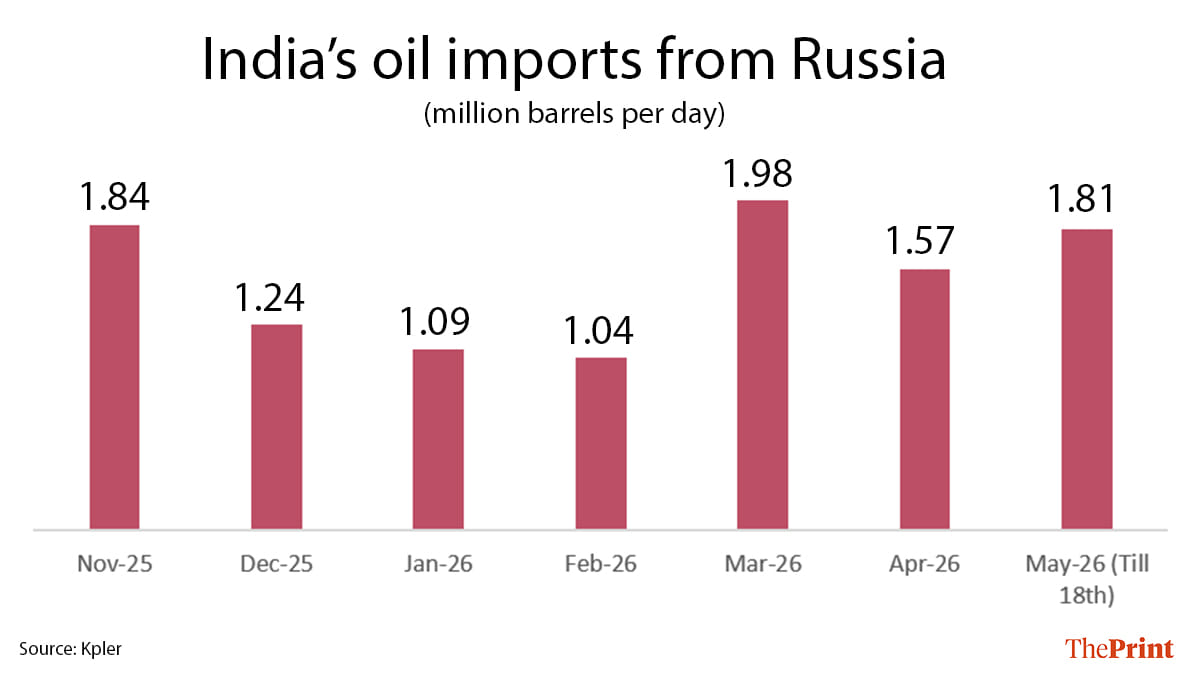
“Waiver or no waiver, Russian crude is likely to remain central to India’s import strategy for now,” said Sumit Ritolia, Manager of Modeling and Refining, at Kpler. “With continued geopolitical uncertainty and the Strait of Hormuz situation still far from normal — including restricted transits, higher freight risks, and slower flows — Middle Eastern barrels are no longer as straightforward or secure as they were previously,” he said.
“In that environment, Russian crude continues to offer a clear advantage through both pricing and relatively stable logistics via non-Strait routes,” Ritolia added.
According to Ganesh Sivamani, Associate Fellow at Centre of Social and Economic Progress (CSEP), India appears to be pursuing a multi-layered strategy combining “waiver diplomacy” with alternative crude sourcing to shield domestic industries from supply disruptions while reducing excessive dependence on any single energy corridor.
Some analysts, however, say the latest waiver also reflects mounting pressure on the US administration from rising global crude prices and tightening inventories. “US themselves were under pressure because of rising oil prices. At current rate of inventory drawdown their strategic petroleum reserve would have hit the lowest in their history in 60 days,” said Navin Thakur, Director at Drewry Maritime Research, an independent maritime consultancy firm.
According to Thakur, the decision to extend the waiver serves a dual purpose for Washington. “US is a net importer of oil. And rising prices is causing stress in their economy as well. To arrest the price rise they have allowed Russian oil,” he said.
“It does two things – gives them window to broker a peace deal with Iran which is increasingly becoming a possibility now, and ease oil prices to manage domestic prices,” Thakur added.
Venezuela crude purchases
India is also steadily widening its crude sourcing beyond Russia, with imports from Venezuela rising sharply in recent weeks to their highest levels in several years. Kpler data shows Indian refiners imported nearly 394 thousand barrels per day (kbpd) of Venezuelan crude till 18 May 2026. India had resumed purchases in April after a gap of a year, when imports stood at around 283 kbpd.
Venezuelan Merey grades—the country’s primary benchmark crude oil blend—have become particularly attractive for complex Indian refiners as they help offset the growing share of lighter crude in the import basket while supporting secondary unit utilisation and middle distillate yields.
Nayara Energy, Reliance Industries Limited (RIL), Indian Oil Corporation Limited (IOCL), and HPCL-Mittal Energy Limited (HMEL) are equipped to process heavier and sour crude grades such as Venezuela’s Merey blend.
“Venezuelan crude imports into India have risen sharply in recent months, reaching the highest levels seen in several years. The increase has been driven by the reopening of Venezuela’s oil sector, improved crude availability, favourable pricing, and refiners seeking heavier replacement barrels amid ongoing Strait of Hormuz disruptions,” Ritolia said.
(Edited by Nardeep Singh Dahiya)
Also Read: India aims to switch to ethanol amid the global oil crisis. Not all cars are ready