








It’s common knowledge now that an energy crisis in India and elsewhere was precipitated by the conflict in West Asia and the effective closure of the Strait of Hormuz. Although the Indian government kept fuel prices steady over the past few months, no doubt due to political concerns, various news reports indicated that oil marketing companies faced serious under-recoveries, to the tune of Rs 1,000-1,700 crore daily.
Thus, the Rs 3 hike in fuel prices (benchmarked to prices in Delhi) on Friday morning should not have come as a surprise to anyone. However, despite the relative stability of fuel prices in India, wholesale inflation has increased dramatically as the cost of imports, including fertiliser and food, has risen.
Even if this crisis ends soon, it has starkly highlighted the challenges India faces when it comes to energy security. Sure, the country can secure new suppliers — several tanker loads of crude oil from Venezuela are reportedly on their way to India right now, according to ship-tracking websites — but how does India overcome its crude oil addiction? And given that the transportation sector is the largest consumer of refined petroleum products, what can be done?
Well, certain things will not change. Aviation, for example, despite much talk of sustainable aviation fuel, has seen painfully slow progress globally. But personal and commercial transport are changing, and that is visible to anyone on Indian roads as more electric vehicles join the fleet.
That is not to say there are no geopolitical issues associated with shifting to electric vehicles. China controls a large portion of the supply chain and, when it restricted exports of rare earth magnets critical for electric drive motors, India was impacted. Although it must be said that progress is being made, slowly but surely, on the supply-chain front. Ola Electric has started manufacturing cells with both Li-NMC and LFP chemistries at its gigafactory in Hosur.
But with hundreds of millions of vehicles on Indian roads running on petrol or compressed natural gas (CNG), even rapid electrification, as envisaged in new state-level policies such as those in Delhi, will not curb demand anytime soon. On the CNG front, biogas will play a role, and in my column last week, I visited one such facility producing biogas from cow dung. Other feedstocks, such as municipal solid waste and agricultural waste, will also play a part.
Also read: Automotive influencer warns people against buying EVs. His grouse lies with charging ports
India’s ethanol gamble
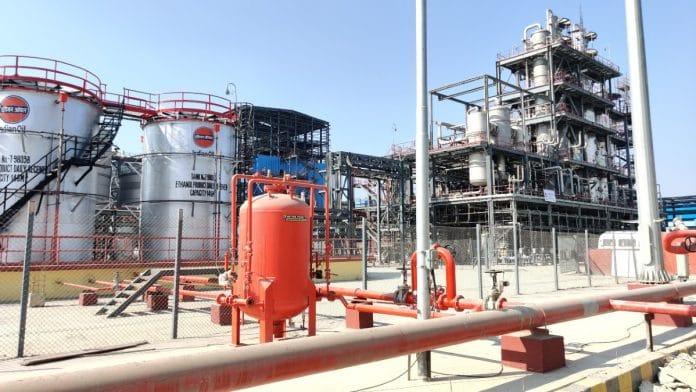
This brings me to the core issue of today’s column: ethanol. As of 1 April, all standard petrol sold in India is blended with 20 per cent ethanol. All internal-combustion vehicles sold in India since 2023 — and even earlier for some carmakers — are able to cope with this ethanol blend in petrol. Carmakers like Maruti Suzuki have also introduced kits that allow older vehicles to handle increased ethanol blending. This is because ethanol has a corrosive effect, especially on rubber fittings.
Ethanol is also less energy-dense than petrol, which has affected the fuel efficiency of older petrol vehicles, with losses in the range of 10-15 per cent. More modern petrol engines, with advanced knock sensors, ignition-advance systems, and variable valve timing, mitigate this almost entirely.
While “pure” petrol is available — the 100-octane variant — it serves a very specific use case for the most part, and the government did not hold back from increasing its price. It currently costs around Rs 160 per litre. Some claim this improves efficiency and engine health, and while that may be true to a limited extent for older vehicles, it is not worth the 60 per cent premium.
Ethanol is produced from agricultural sources, which has led to the pejorative phrase ganne ka juice. However, according to the Petroleum Ministry, 47 per cent of the ethanol blended in petrol came from maize, a far less water-intensive crop than either sugarcane or rice. This fact gained attention after a scare-mongering article claimed that each litre of ethanol consumed 10,000 litres of water.
The true figure is far lower, closer to around 1,500 litres. But it is also true that several parts of India are undergoing severe water stress, which is why work is being undertaken on “Gen 2” ethanol production from sources such as bamboo in Numaligarh, Assam, with some success.
But the fact remains that India produces ethanol domestically. The country does not have to depend on imports, and with crude oil prices shooting up, the government is tempted to consider a higher blend of ethanol in petrol.
And apparently it is doing exactly that. A blend of 22-25 per cent is reportedly on the anvil and, while the rollout may take a few years — especially considering that vehicles built before 2019 were definitely not tuned to accept ethanol blends above 10 per cent, which is itself nearly standard in many parts of the world — higher blends will almost certainly damage older vehicles unless they are retrofitted.
That said, there is also the concept of “flex fuel”, which essentially refers to vehicles that can run on up to E100 — nearly pure ethanol. In reality, E100 is actually 98 per cent ethanol, with 1.5 per cent petrol and 0.5 per cent additives. The more likely blend, however, is E85, and from what I understand, this will be sold at a 15-20 per cent discount to regular E20 petrol at the pump to compensate for the lower energy density and encourage adoption of flex-fuel vehicles.
Multiple carmakers, including Maruti Suzuki and Tata Motors, have hinted at launching such flex-fuel vehicles in the coming months because the required modifications are not particularly extensive and Brazil already has a large market for such vehicles.
But the future may actually lie in “flex-fuel hybrids” (FFHs). At the Japan Mobility Show last year, I saw a production-ready prototype of a Suzuki Fronx FFH vehicle. The ability to run on E100, or any blend for that matter, while combining it with the fuel efficiency of a hybrid is something multiple senior government officials have described as a “win-win”. When exactly that will happen remains to be seen.
Kushan Mitra is an automotive journalist based in New Delhi. He tweets @kushanmitra. Views are personal.
(Edited by Saptak Datta)