








In a recent post, Gaurav Yadav, founder of GaadiWaadi and leading automotive influencer, argued that people should not buy an EV. With over 1 million views, his reel led to considerable anger from the rather virulent community of EV enthusiasts in India.
But as he told me this past week, it isn’t because he is against electric vehicles. Far from it.
The trigger for his Reel was a note his residential society in Gurugram had sent to all residents—to remove their electric vehicle chargers. This is because the society was not able to get a ‘No-Objection Certificate’ (NOC) from the Gurugram fire department.
Yadav said that if you have access to your own charger at home, an electric vehicle makes immense sense, and I agree with him. I have a home charger, and it not only makes electric vehicles easier to test when I get them, but also allows me to keep them long-term. This is not only convenient during periods of heavy air pollution and the resultant GRAP rules in the NCR, but also in terms of cost.
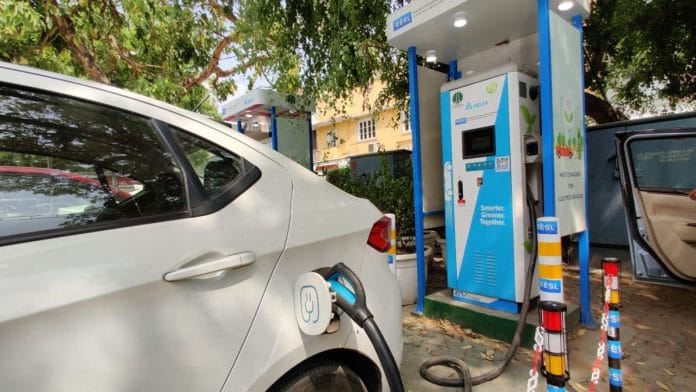
The Mahindra XEV9S gave me a power efficiency of 6.5 kilometres per unit of power. Charging it at home worked out to just Rs 1.50 a kilometre at residential power rates. But use a public charger, and the cost goes up almost three times.
Compare this to Mahindra’s own 7XO. Not only is it much cheaper than the XEV9S, but the operating costs of the diesel variant are also more or less equivalent to the XEV9S if one uses public charging.
Of course, there are other factors to consider. If you were to take an electric vehicle for a long-distance trip, you would have to use public charging. And diesel and petrol prices will inevitably rise sooner rather than later, given the current scenario.
But as Yadav said, to really take advantage of an electric vehicle, home charging is a must.
Also read: MG Cyberster, another EV in town that redefines performance. But I miss the drama of ICE
What is the solution?
That is not to say that his society’s worry about the potential dangers of charger fires is unfounded. There have been fatal EV charger fires in India. An electric vehicle, even a two-wheeler, draws a considerable load, and the wiring has to be of an approved standard.
Underground basement parking facilities might not have access to proper fire-fighting equipment, especially for high-voltage situations. These can be solved with standardised wiring and approved vendors, as well as proper fire-fighting and built-in electrical safeguards. Not an issue in most modern apartment complexes built in the past decade, but it might be a huge issue in older complexes where even the basic wiring is incapable of supporting the higher loads required for electric vehicle charging.
Are surface-level community chargers an option? Well, yes and no. “If my society has 400 households and just ten per cent of them have electric vehicles—40 EVs—and there are eight charging points, not everyone can charge when they want to. Even if the chargers are DC Fast Chargers, you’re not going to come downstairs at two in the morning to disconnect your car and let someone else charge,” Yadav remarked.
The solution of installing chargers, even slow-speed AC chargers, sounds great on paper, but impractical in real life.
And as another Gurugram society resident told me, power-cuts are still a fact of life in many societies—“Which society is going to let you charge your EV on backup power from a petrol-powered genset? Kind of defeats the purpose.”
Yadav shared with me that the issue in his society was escalated to the District Commissionerate and the Chief Minister’s Office. The Fire Department has been told not to deny NOCs until a new charger policy is formulated. New building rules are being made for residential and commercial buildings, where a certain number of chargers are being made mandatory.
However, there is no clarity on whether these new rules will apply to older buildings. And these underlying issues regarding chargers and charging installations are prevalent in all high-rise societies across India, from Worli to Indiranagar and Begumpet to Zirakpur.
The matter becomes more complex because of all the institutions involved—fire departments, municipalities, RWAs, the state government.
A friend from Mumbai mentioned that municipal and state laws around chargers and parking actually contradict each other on the issue of ownership. The Central Government should intervene and establish a model set of rules that states can base their EV charger regulations on.
Kushan Mitra is an automotive journalist based in New Delhi. He tweets @kushanmitra. Views are personal.
(Edited by Theres Sudeep)
My grouse is that EVs are costlier than ICE vehicles.