





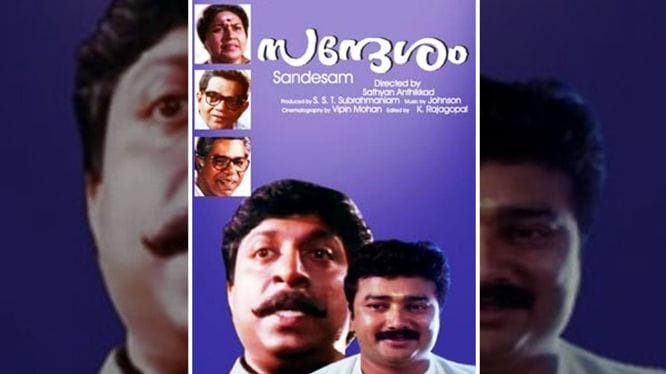


There is nothing subtle about Sandesham. The 1991 Malayalam political satire draws blood from both the Congress and the Left. It’s a ruthlessly funny and biting critique of how politics without heart destroys families and the nation.
The central conflict is between brothers Prabhakaran (Sreenivasan, who also wrote the film) and Prakashan (Jayaram). The former is a member of the Revolutionary Democratic Party, an unmistakable parody of the CPI(M), and the other belongs to the Indian National Secular Party, a Congress caricature.
It’s not just the great writing and acting that have gotten this film on the top 100 list of IMDB; the humour still sticks because Kerala’s political scenario isn’t that different 35 years later.
While the film doesn’t dismiss the importance of politics, it cautions viewers about the perils of getting into politics as a way to serve yourself.
The movie begins with Raghavan Nair (Thilakan), father of Prabhakaran and Prakashan, returning to his family in Kerala after 30 years of service as a railway station master. He’s looking forward to spending retirement with his five children and his wife, and keeping himself busy farming the plot he bought with his pension.
Even before the film picks up pace, a fleeting moment establishes Sandesham’s tone—it uses dark and dry humour to portray Kerala’s political culture, marked by corrupt police and the ruling party’s abuse of power.
Before we see the brothers, we’re introduced to the chaos they cause through Anandan, the town’s sub-inspector and their brother-in-law. The government in Kerala has just changed—from RDP to INSP—and Anandan is getting threats from INSP workers. During election time, he beat them up as Prabhakaran promised him a promotion, confident that RDP would win.
“I didn’t think the government would change,” he laments to his wife. For the rest of the film, he is given multiple transfers across Kerala as a punishment.
Power games
Sreenivasan doesn’t hold back in his writing. The film calls out RDP’s intellectualism, INSP’s corruption and the opportunism of both parties with wit and laugh-out-loud humour.
Prabhakaran is the self-appointed party buddhijeevi, who takes classes on Communist theory for fellow party workers. This posturing has an advantage, as he explains to his father. “If I’m not a buddhijeevi, I’ll have to go for protests and fights, and I’ll get hurt. Now, I just have to give orders — ‘Close down the factory, attack the police, stab and kill the capitalist’,” Prabhakaran says with utmost seriousness. He’s a non-practising LLB graduate who only got the degree to set himself apart from the ‘ordinary’ people joining politics.
Prakashan is jostling for the spotlight in a national party, cosying up to whoever he can and exaggerating his influence. He’s abbreviated his name to KRP because all the great leaders have a three-letter English name. He’s riding high on imaginary power and threatens anyone opposing him with a transfer. He even threatens to sabotage his sister’s wedding because the groom refused to give the party money.
The film also introduces a moral foil to the brothers. Udayabhanu (Siddique) is an agricultural officer who helps Raghavan turn his plot into a farm. The orphaned son of a manual labourer, his work ethic and questioning of party politics, are framed as ideals to strive for.
Raghavan is on board with his sons’ pursuits in the first half of the film. Politics, he says to his wife, is a noble pursuit.
“You don’t understand what they’re talking about. Neither do I,” he says in awe of their knowledge of the world.
This comes right after the tightly-written dining table conversation that ends with one of the most iconic dialogues in Malayalam cinema—Polandine Patti Oraksharam Mindaruth (don’t you dare say anything about Poland).
And it’s not the only one; the film is endlessly quotable. The pennukal (the traditional meeting between a prospective groom and bride) scene featuring Prabhakaran has spawned many memes. The visit of INSP senior leader, Yashwant Sahai, to the town is a masterclass in comedic writing.
Played by Innocent, the politician speaks in (a highly-Malayalam-accented) Hindi, causing confusion among the Malayali party workers who want nothing but to get in his good books. The choice of having a Malayali actor play the role adds to the absurd hilarity.
Also read: Shashi Kapoor went beyond his lover boy persona in ‘Chor Machaye Shor’. It was a hit
Politics turns dark
The film is relentless in its criticism of party politics. Every scene featuring the brothers mocks an aspect of the culture.
The viewer is left waiting for their party obsession to backfire, for them to be taught a lesson. And around the halfway mark, the movie delivers what one would expect to be the turning point—a brawl has broken out in the town centre between the parties, and a man is dead.
But Sreenivasan smartly subverts it and kicks it up a notch. The scene cuts to him talking to his fellow party members. He’s convincing them to claim the dead man as one of their members.
“He can be our martyr, who was brutally murdered by INSP. We’ll come back from our election defeat, and the public won’t spare the INSP worker,” he lays out the plan triumphantly.
Prakashan and the INSP hear of this and rush to claim the dead man as their own. The ensuing chaos is morbid, but one can’t help but laugh; it’s the genius of Sreenivasan and Anthikad at play.
The real turning point of the film comes with the arrest of Raghavan due to the confusion that follows. The view he has of his sons cracks when neither of them comes to the station to get him out.
From there, the dominoes fall. It ends with Raghavan kicking his sons out of the house, delivering the one-liner that sums up the film’s message— “First better yourself, then your family, only then should you go make your society better”.
But Sreenivasan doesn’t deprive his audience of a feel-good ending. Prabhakaran and Prakashan are welcomed back after they promise to leave party politics and mend their ways.
(Edited by Saptak Datta)