





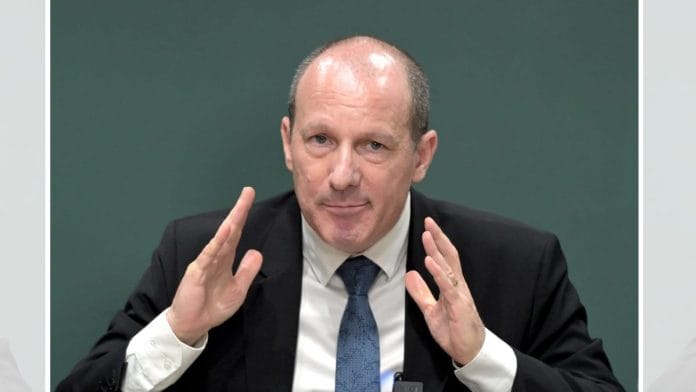


New Delhi: Israeli Ambassador to India Reuven Azar visited ThePrint newsroom for an interaction Thursday. The discussion revolved around the West Asia war and Pakistan’s role as mediator, Lebanon, Iran and Israel’s complex history, and the situation in Gaza.
The Islamic Revolutionary Guard Corps (IRGC) was calling the shots in Iran, and it was ignoring the Iranian government’s statements, Israeli Ambassador to India Reuven Azar told ThePrint Thursday. The IRGC’s conduct of the war had led to many mistakes that could boomerang on Iran, Azar also speculated.
“We feel that the IRGC is calling the shots, and they have made many mistakes. First, the IRGC targeted its neighbours in the Gulf, despite President Mohamed Pezeshkian’s statement that no neighbours would be attacked. The IRGC targeted civilian infrastructure in these countries, and that will have repercussions in the future,” Azar said, while interacting with ThePrint’s newsroom.
“The other mistake is using the Hormuz card, which not only punished their friends, like you [India], but it also boomeranged, because the Americans came in with a naval blockade,” the Israeli ambassador added.
The IRGC has been the key pillar of Iran’s defence, following the joint US-Israeli strikes on Tehran on 28 February. In its retaliation, Iran has not only struck Israel but also US installations in the Gulf Cooperation Council’s member States. The UAE has faced the brunt—with over 2,500 missiles and drones directed at it—while Bahrain, Qatar, Kuwait, Saudi Arabia and Oman were also targeted. Meanwhile, the Iranian government’s strategic move to effectively close the Strait of Hormuz impacted global energy markets, raising costs in the US, too.
About the end of the war, Reuven Azar was circumspect, saying that it was unclear whether the Iranian regime “would change their ways, or if regime change would occur”.
“We hope there will be a political outcome. Despite all the disinformation campaigns, the Americans hold quite strong leverage. They have the military capability to strike again…I hope that things can conclude diplomatically, but I am not very optimistic, given the policies of the IRGC,” he added.
The Israeli envoy also claimed that regime change in Iran was not one of Tel Aviv’s goals of the war.
“We didn’t have an objective at the start of the war of regime change. We hoped that there would be a change in regime—because of the internal actions of the people of Iran…We know that the Iranian people are slowly moving away from the regime,” Azar commented.
The Israeli ambassador pointed to demonstrations that roiled Iran at the end of 2025 and the first month of 2026. He also condemned the Iranian administration’s response, which, he claimed, left at least “30,000 people dead”.
Iran has maintained that the demonstrations were primarily funded and supported by the US and Israel, against the backdrop of President Donald J. Trump publicly stating earlier this month that the American administration sent weapons to support the protesters. It has also stood by its decision to close the Strait of Hormuz, which has sent energy prices skyrocketing worldwide. On Wednesday, US Congressperson Ro Khanna said that the increased costs for Americans due to rising gas and food prices would be equivalent to $631 billion, or $5000 per citizen.
Reuven Azar said that for Israel, the war had two clear military objectives: degrading Iran’s ballistic missile capabilities and setting back its nuclear programme by a few years.
“We were very clear we wanted to remove two existential threats, and this is what we are doing,” said the Israeli envoy, claiming that thousands of Iranian military installations had been hit. However, Azar added that some “residual capabilities” remained in Iran.
(Edited by Madhurita Goswami)
Also Read: ThePrint Off The Cuff with Abdul Majid Hakeem Ilahi, Iran Supreme Leader’s envoy to India