



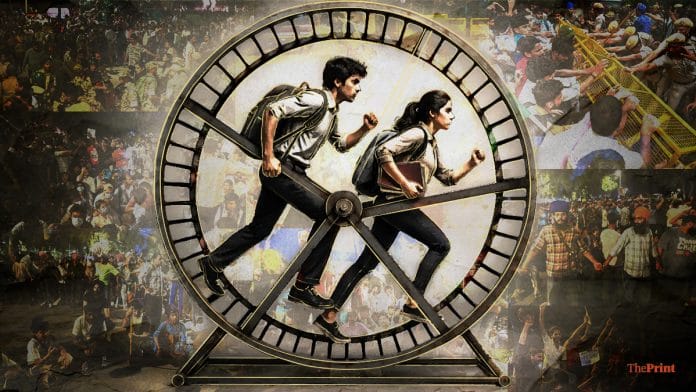
Direct negotiations between Modi government and CJP leaders have begun, Sonam Wangchuk has broken his fast, and one dramatic late-night move has also been made to impress the protesters. This was the removal, Thursday night, of the higher education secretary.
The protesters, who want the education minister’s head, were obviously not impressed. And here’s why it also reminded me of a tiny framed poster on a wall in my office, given to me by my daughter who knows I so adore the 1942 film, Casablanca. Even if you haven’t seen it, you’d be familiar with the expression it made immortal. That’s the character of Captain Louis Renault asking his cops to “round up the usual suspects” after a fatal shooting in Rick’s (bar). These secretarial movements are just that, a rounding up of the usual suspects.
In any such crisis, the civil servants become a convenient target. Even earlier, some key people in the NTA (National Testing Agency), including its director-general Subodh Kumar Singh (IAS, Chhattisgarh cadre), had been removed after the NEET leakage in 2024. Politicians think it’s convenient. Vineet Joshi, the outgoing higher education secretary, now Panchayati Raj secretary, was the first director-general of NTA. It’s a merry musical chairs of the usual suspects.
Even though Dharmendra Pradhan has resigned and protesters will now hopefully go home happy, the struggles of the Indian youth won’t end. Indian childhood has now become the most stressful, competitive and unidimensional in our history.
Take NEET. This year 22 lakh appeared for it. About five percent were selected for 1,39,489 MBBS seats. Another 25,000-35,000 will go overseas for MBBS, mostly to former Russian republics, the Philippines, even Bangladesh. Clearing NEET (being above the 50 percentile cut-off) is essential for them too if they want to return and work as doctors in India. This underlines the undersupply problem.
That leaves out more than two million. Many of them also sat for CUET (Common University Entrance Test) for all central universities and their affiliated colleges—with quite poor odds. Millions of others are already competing in JEE for engineering colleges. And even for those that climb this first ladder, competitive exams will never end. For post-graduation, PhD, teaching jobs, and so on.
Also Read: CJI, IPS, IAS & Homebound: A wake-up call 75 years in the making
From the age of 15, the life of an Indian kid from a middle-class family or below is an endless trap of coaching classes, competitions, and then paper leaks, so re-examinations. Now you know why so many children are at Jantar Mantar, many with parents. There’s no time for extra-curricular, hobbies, and for heaven’s sake, sport. Then we ask why we do so poorly in sports. Your parents will feel like killing you or themselves if you start “wasting” time on sport.
To understand how this works, check out the composition of the one sport in which we’re finding world-class talent, cricket. The current teams, across formats for India and in almost every franchise, from IPL to a dozen other local leagues, would rarely field a college graduate. This talent has been picked up by scouts at Class 10-level. Vaibhav Sooryavanshi is just an extreme example.
Our education system is a destroyer of all talent by enforcing learning by rote, and then pushing students to coaching classes to “crack” competitive exams. As a result, we’re creating a generation of nerds or the bitter majority that feels left out and hard done by. Changing any minister won’t reform this mass oppression. It needs to be uprooted entirely, but it’s unlikely simply because it doesn’t go with the philosophy of a “strong” government. Because, what’s the point of a “strong” government in New Delhi if it won’t centralise everything under it.
You might wonder how come NEET paper leakages weren’t a problem until the other day, which means the pre-Modi era. That’s because there was no NEET. The UPA had also tried centralising medical admissions, but the NEET it set up was struck down in 2013 by a three-judge Supreme Court bench, 2-1, as unconstitutional. Several states, especially in the South, saw it as the stealing of their federal rights.
The action of the infamous Medical Council of India (MCI) in setting up NEET in 2010 was intended to indirectly take over the admissions process in private medical colleges. The 2013 order was, however, challenged and struck down by a five-judge bench in 2016. Now, NEET was a judicially-mandated body.
The push for this centralisation had come from the UPA-era socialist thinking to curb high capitation fees in many private medical colleges. If they can no longer decide who to admit, how will they charge these extortionate fees? In that sense, it was part-nationalisation of medical education. And because the South and Maharashtra dominated medical education, the MCI and the central establishment tried to strangle the industry by mandating a population-based licensing for new medical colleges. So, one medical college license per 10 lakh population. The southern states and Maharashtra pushed back and it was set aside. The fact that so many of these colleges are owned by politicians, many from the ruling party and its allies, helped.
Also Read: Coaching centres are a sign of broken-window economics. See how China crushed it all overnight
Pre-NEET, the states followed their own admission tests and processes and the masses of school kids were spared this national stress-fest, as also the central government the risk of holding an examination at this scale. But this government loves to centralise. They’re now ready with a fresh law to make their control of higher education across the country even tighter. Google Viksit Bharat Shiksha Adhishthan Bill, 2025. This proposes an overarching higher education commission and three regulatory councils, subsuming UGC, AICTE and NCTE or all supervision over university, technical and teachers’ educations. Mercifully, the Standing Committee has stalled it for now.
Going back to NEET, it was to consummate this centralisation success that the Modi government set up NTA, under the Societies Registration Act. It’s supposed to conduct NEET, JEE, UGC-NET (research), and CUET for undergraduate and postgraduate central university admissions.
That’s humongous power for a mere “society” even if it’s headed by an ideological faithful in Pradeep Kumar Joshi. He’s an academic, not IAS. Check his record. Chairman of Madhya Pradesh Public Service Commission (2006-11), Chhattisgarh PSC (2011-15), UPSC (2020-22), and now NTA. This kind of power and politicisation was bound to create a mess. This is what the Modi government is now caught in.
As I finish writing this, news breaks that NTA has fired 47 officials. This is the price the Modi government is paying for centralising so much power. And every time there’s a crisis, the government gives you the lollipop of a fresh law. There’s even a standalone law against cheating in a NEET examination. As if the basic cheating law won’t apply. Or special courts that go on forever like the others. There’s a reason we once called it ‘lawlipop’ politics.
Ministers will come and go, but if you want to cut the roots of the problem, start with NEET. Decentralise all technical admissions and restore to the states their autonomy. Abolish NTA. Treat the states as adults in our federal family. Legalise educational institutions for profit and let hundreds more colleges rise. I’d go as far as to say, scrap the Emergency-era 42nd Amendment that made education a concurrent subject and thereby restore to the states their autonomy. It won’t happen, but there’s no harm in suggesting.
(The text was amended after Dharmendra Pradhan’s resignation.)
Also Read: College pedigree, daddy’s name, BBC accent no longer golden ticket. India has a growing new elite
Excellent column by Shri P B Mehta in Indian Express on the “ centralisation of education “. A conscious policy choice. Driven by ideology, has produced mediocrity.
Quite conveniently my leige has skipped in calling out reservations as another colossal road block for youth. Its ok…we need a spine for it.
Decentralisation will not help. The govt should enforce IB curriculum and Singapore maths. All state boards, NCERT, and ICSE should be shut down.
Bad idea sir! When Engineering JEE is centralized for so many years and there are no leaks, why can’t NEET be managed?
Never bring politics into education.
Biggest mistake of BJP government.
After the third victory, a sense of hubris and invincibility set in and they started to tweak the education system to appease hindutva.
Teach children how to think, not what to think.
What are shekhar Gupta’s views on private schools exorbitant arbitrary fees ?? Will free market solve this ?? Is it enough ?? If not what is ??
A grim note to start the weekend on. 2. Centralise everything if you have the bandwidth to see it through. Make a glittering success story like the towers of Shenzhen. Or let the states do things their way. That automatically puts a premium on calibre and performance. Let Uttar Pradesh and Bihar catch up with Maharashtra and Tamil Nadu, or pay the price for failing to do so. The same principle is violated in sharing the central tax pool. Bihar gets seven rupees for each rupee it contributes, Karnataka gets about fifteen paise. 3. Consider the list of education ministers over the last twelve years, starting with the first one. Education czar for a country whose demographic dividend window has begun to shut, state by state. Is there an ability to comprehend the immensity of the challenge, find solutions. And, of course, the unfortunate conviction that education should march to an ideological beat. Its effect seen now in elite institutions like IIT and IIM, where they absolutely do not belong. How many Indian higher education institutions in the list of the world’ top 500 and 100. JNU, one of our best, being subjected to the same stresses. 4. Perhaps a companion column on Employment, where Education is supposed to lead. The heart stirring promise of two crore jobs a year, obviously from manufacturing. The flop show of Make in India.
We are again running around in circles and Mr Shekhar has conveniently picked up one issue ignoring the other as if people werent fed up with high capitation fees. When one speaks of decentralisation, who benefits ? In an ideal competitive and fair system, every entrepreneur would have had a fair shot at establishing a medical college or higher education institute. Instead what actually happened with regard private medical colleges in Southern states ? Politicians inserted themselves in it and were in direct conflict of interest. This is NOT whataboutery but was a lived reality which NEET sought to address. The Mr Shekhar is ignoring this again shows that he too is unfortunately taking a myopic view of the issue in line with current “trends”. Technical education has been long decentralised. Have the private colleges come even close to challenging the supremacy and research output of IITs ? NO ! A big fat NO ! Problem is not with NEET. Problem is plain and simple – Indian youth be in GenZ or the older millenials always sought a level playing field. Nothing more. Nothing less.
Who gave CJP to speak on everyone’s behalf?
What reforms have they suggested?
They are an unelected body making political demands.
Better stand in an election with a manifesto and prove themselves.
Different people want different things from the education system. Are the CJP any experts on education? No. They are instagram rabble rousers.